




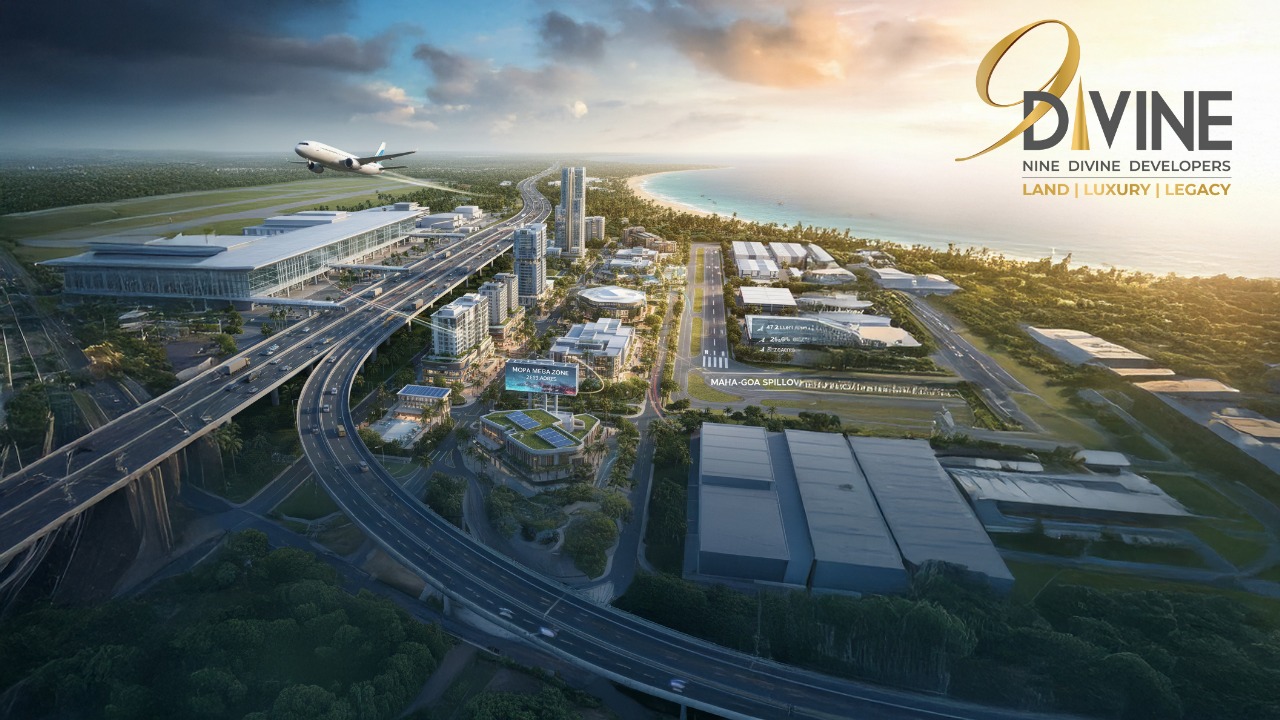
 MOPA Airport and North Goa’s smart town planning are driving unprecedented growth in mopa corridor commercial real estate.
From Airports to Smart Towns: How the MOPA Belt & North Goa’s New City Plan Are Powering Mopa Corridor Commercial Real Estate
India’s Most Strategic Airport-Led Growth Corridor Is No Longer a Future Story — It’s Unfolding in Real Time
India’s coastal economy is witnessing a historic shift, and at the center of this transformation lies mopa corridor commercial real estate. What began as the launch of a new international airport has rapidly evolved into a multi-city, cross-border economic engine, seamlessly linking North Goa with Maharashtra’s high-potential Sindhudurg belt. This corridor is no longer driven by speculation — it is being shaped by measurable passenger growth, institutional planning, and irreversible infrastructure momentum.
Table of Contents
- From Airports to Smart Towns: How the MOPA Belt & North Goa’s New City Plan Are Powering Mopa Corridor Commercial Real Estate
- India’s Most Strategic Airport-Led Growth Corridor Is No Longer a Future Story — It’s Unfolding in Real Time
- THE TECTONIC SHIFT IN INDIA’S COASTAL ECONOMY
- MOPA Airport Performance Snapshot
- MOPA — THE AIRPORT THAT KICKSTARTED A REGIONAL ECONOMIC REVOLUTION
- Passenger Migration That Redefined Commercial Demand
- THE 2,133-ACRE MOPA MEGA ZONE — BLUEPRINT OF AN AIRPORT CITY
- THE NEW CITY PLAN — GOVERNMENT POLICY AS A GROWTH MULTIPLIER
- MOPA Airport Development Authority: A City-Level Framework
- Pernem Zoning — Silent Reclassification, Massive Impact
- BILLION-DOLLAR INVESTMENTS FUELING THE MOPA CORRIDOR
- Delta Corp’s ₹3,000-Crore Integrated Resort Township
- Hospitality Boom — 1,500 New Rooms by 2030
- Cargo & Logistics — The Silent Commercial Engine
- INFRASTRUCTURE — THE REAL GROWTH ENGINE
- The 6.7-km MOPA Link Road
- NH-66 + SH-180 + Coastal Highway Integration
- THE MAHA-GOA SPILLOVER — EXPANSION BEYOND GOA
- 22% Land Appreciation in Sindhudurg
- 38% Rise in Property Inquiries
- Sawantwadi — The Maha-Goa Anchor Node
- WHY NINE DIVINE GROUP IS ALIGNED WITH THE MOPA CORRIDOR
- 2025–2030 OUTLOOK FOR MOPA CORRIDOR COMMERCIAL REAL ESTATE
- FINAL TAKEAWAY — THE WEALTH CYCLE HAS BEGUN
Unlike traditional real estate cycles that rely on organic urban sprawl, mopa corridor commercial real estate is being powered by an airport-led development model — the same model that created wealth in Delhi Aerocity, Hyderabad GMR Aerocity, and Navi Mumbai’s airport influence zone. Airports don’t just move people; they redirect capital, accelerate zoning changes, and compress decades of urban growth into a few years.
What makes this corridor uniquely powerful is the simultaneous alignment of four forces: explosive aviation growth at MOPA, government-backed smart city and zoning reforms, billion-dollar hospitality and tourism investments, and highway-led connectivity between Goa and Maharashtra. Together, these forces are transforming the MOPA–Pernem–North Goa–Sindhudurg belt into a single, integrated commercial ecosystem.
This blog, presented by Nine Divine Group, breaks down how aviation expansion, structured urban planning, infrastructure convergence, and evolving tourism economics are collectively fueling demand across hospitality, retail, offices, logistics, and mixed-use developments — positioning mopa corridor commercial real estate as one of India’s strongest and most future-secure investment themes of the decade.
THE TECTONIC SHIFT IN INDIA’S COASTAL ECONOMY
When Manohar International Airport (MOPA) became operational, the expectation across policy makers and industry analysts was limited — ease congestion at Dabolim and marginally improve tourism flow into North Goa.
What followed instead was a fundamental redistribution of economic gravity, triggering one of the fastest airport-led transformations in India’s coastal economy and laying the foundation for accelerated growth in mopa corridor commercial real estate.
MOPA Airport Performance Snapshot
📈 47.2 lakh passengers in 2024
📈 26.6% year-on-year growth — the highest in Western India
This was not just an aviation milestone.
It was a structural turning point.
Passenger growth at this scale changes how:
Hotels plan capacity
Retail brands select locations
Corporates establish regional offices
Logistics firms design distribution hubs
As tourism and business travel shifted north, infrastructure funding, private capital, and developer focus followed. The result was the birth of a new commercial geography centered around mopa corridor commercial real estate.
Tourism moved north.
Commercial planning followed.
Capital allocation followed.
And the corridor entered a new long-term growth cycle.
MOPA — THE AIRPORT THAT KICKSTARTED A REGIONAL ECONOMIC REVOLUTION
Passenger Migration That Redefined Commercial Demand
According to aviation and media reports:
MOPA gained over 8% passenger share between Apr–Sep 2025
Dabolim lost nearly 12% share in the same period
This represents the largest tourism behavior shift in Goa in over 30 years.
Passenger concentration is the first signal commercial real estate tracks. Wherever passengers land in volume, ecosystems emerge — hotels first, retail next, offices after, and finally logistics and townships.
That is exactly why mopa corridor commercial real estate demand accelerated simultaneously across:
Hospitality assets
Retail high streets
Office back-ends
Warehousing clusters
Mixed-use townships
More passengers translate into:
✔ More hotel keys
✔ More F&B outlets
✔ More service offices
✔ More logistics facilities
✔ Higher land absorption
✔ Faster commercial appreciation
THE 2,133-ACRE MOPA MEGA ZONE — BLUEPRINT OF AN AIRPORT CITY
The Government of Goa allocated 2,133 acres to GMR under a Public–Private Partnership model.
Within this master land bank:
232 acres are officially designated as “City-Side Commercial Development.”
This zoning is legally significant because it permits:
Large-format hotels & resorts
Grade-A office towers
Retail boulevards & lifestyle streets
Convention and MICE centers
Entertainment & multiplex zones
Business parks & aviation services
This is not experimental planning.
This is the same aerocity framework that created exponential wealth in:
Delhi Aerocity
Hyderabad GMR Aerocity
Dubai Airport Freezone
What gives MOPA a stronger edge is proximity to one of India’s most established tourism belts. This dramatically amplifies the upside for mopa corridor commercial real estate, allowing aviation demand and leisure demand to compound together.
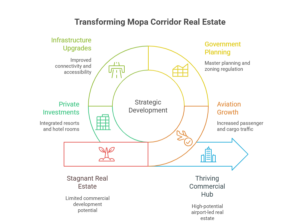
THE NEW CITY PLAN — GOVERNMENT POLICY AS A GROWTH MULTIPLIER
MOPA Airport Development Authority: A City-Level Framework
The Mopa Airport Development Authority Act established a dedicated urban body responsible for:
Integrated master planning
Land-use regulation
Commercial zoning approvals
Township and infrastructure integration
Long-term transport planning
Historically, regions governed by independent airport development authorities evolve into self-sustaining economic cities, not fragmented suburbs. This institutional backing significantly de-risks mopa corridor commercial real estate compared to purely speculative growth markets.
Pernem Zoning — Silent Reclassification, Massive Impact
Recent zoning notifications have quietly reshaped land use across North Goa:
Land-use reclassification is the single most powerful catalyst for commercial appreciation. When zoning shifts, land values often rise 40%–200% over a decade, making these changes central to the mopa corridor commercial real estate story.
BILLION-DOLLAR INVESTMENTS FUELING THE MOPA CORRIDOR
Delta Corp’s ₹3,000-Crore Integrated Resort Township
Delta Corp’s large-scale integrated resort township near Dhargal includes:
Luxury hotels
Casino & entertainment districts
Retail promenades
Convention and event infrastructure
Globally, such projects act as anchor demand generators, pulling hospitality, retail, office, and service businesses into surrounding zones. This significantly boosts absorption across the mopa corridor commercial real estate belt.
Hospitality Boom — 1,500 New Rooms by 2030
Confirmed pipelines indicate 1,500+ premium hotel rooms by 2030 across the MOPA region.
Hotels act as demand engines for:
✔ Retail outlets
✔ Office back-ends
✔ Laundry & service hubs
✔ Logistics & food supply chains
Each new hotel key indirectly supports multiple layers of mopa corridor commercial real estate demand.
Cargo & Logistics — The Silent Commercial Engine
MOPA’s projected cargo capacity:
📦 ~25,000 metric tonnes annually
Cargo hubs typically trigger development of:
Warehousing parks
Fulfilment centers
Cloud kitchens
Regional distribution hubs
With limited logistics infrastructure north of Goa, Maha-Goa locations like Sawantwadi are emerging as strategic anchors in the mopa corridor commercial real estate network.
INFRASTRUCTURE — THE REAL GROWTH ENGINE
The 6.7-km MOPA Link Road
This high-speed corridor connects:
MOPA → NH-66 → North Goa beaches → Pernem
Impact on commercial real estate:
✔ Reduced travel time
✔ Improved hotel feasibility
✔ Higher retail footfall
✔ Efficient logistics movement
Every minute of reduced travel time directly increases land value — strengthening mopa corridor commercial real estate fundamentals.
NH-66 + SH-180 + Coastal Highway Integration
The convergence of these highways creates a cross-border economic spine, integrating Goa with Sindhudurg into a single functional commercial zone.
As a result, investors now evaluate mopa corridor commercial real estate holistically instead of isolated city markets.
THE MAHA-GOA SPILLOVER — EXPANSION BEYOND GOA
22% Land Appreciation in Sindhudurg
Between 2023–2024, Sindhudurg recorded 22% land appreciation, driven by:
Proximity to MOPA
Tourism spillover
Highway upgrades
Rising NRI & HNI interest
This appreciation is a direct extension of mopa corridor commercial real estate growth dynamics.
38% Rise in Property Inquiries
After MOPA and Chipi Airport became operational, real estate inquiries rose 38% across Sindhudurg.
Investors realized:
“You don’t need to be inside Goa to benefit from Goa’s economic engine.”
Sawantwadi — The Maha-Goa Anchor Node
Sawantwadi’s position at the intersection of:
NH-66
SH-180
MOPA connectivity
makes it a natural hub for logistics, tourism services, and commercial expansion within the mopa corridor commercial real estate ecosystem.
WHY NINE DIVINE GROUP IS ALIGNED WITH THE MOPA CORRIDOR
Nine Divine Group focuses on early-stage, infrastructure-backed growth corridors that mirror global airport-city success models.
By identifying strategic nodes within mopa corridor commercial real estate, Nine Divine Group aligns development with:
Zoning readiness
Infrastructure absorption timelines
Commercial demand cycles
Long-term township planning
This is the same framework that created generational wealth in Delhi Aerocity, Hyderabad Financial District, and Navi Mumbai’s airport region.
2025–2030 OUTLOOK FOR MOPA CORRIDOR COMMERCIAL REAL ESTATE
📈 35%–55% commercial land appreciation
📈 18%–22% annual retail rental growth
📦 4–5X increase in logistics demand
🏨 65%–70% stabilized hotel occupancy
🏙️ Integrated townships outperform standalone plots
FINAL TAKEAWAY — THE WEALTH CYCLE HAS BEGUN
An airport becomes a city.
A city becomes a corridor.
A corridor becomes an ecosystem.
An ecosystem becomes a wealth cycle.
That cycle is unfolding around mopa corridor commercial real estate.
With aviation growth, zoning reforms, infrastructure convergence, and capital inflow aligning simultaneously, this corridor represents one of India’s most compelling commercial real estate opportunities of the decade.
Nine Divine Group stands positioned at the forefront of this transformation — enabling investors to enter early into a corridor that will define the future of Goa–Maharashtra real estate.
The future isn’t coming.
It’s already being built — around MOPA.









No Comments