





Why 2026 Is a Defining Year for Indian Real Estate
Indian real estate has always moved in cycles—urban expansion, infrastructure growth, migration, consolidation. However, 2026 stands apart from previous cycles. This shift is not driven by speculation or hype, but by a deeper recalibration of how investors perceive risk, resilience, and long-term value.
Table of Contents
- Why 2026 Is a Defining Year for Indian Real Estate
- The Growing Crisis With Traditional Real Estate Models
- What Sustainable Land Investment Really Means in 2026
- Why Sustainability Has Become a Financial Imperative
- Infrastructure: The Invisible Engine Behind Land Appreciation
- What Makes Land Truly Sustainable: A Practical Framework
- Understanding Returns: Patience vs Speculation
- Common Myths About Land Investment—Debunked
- Who Should Consider Sustainable Land Investment in 2026?
- FAQ
- The Bigger Picture: Why the Future of Wealth Is Grounded
- Infrastructure Is Decentralising Wealth
- The Psychology of Ownership Is Changing
For decades, residential apartments dominated investment conversations. Vertical growth symbolised progress. But today, investors are asking new questions. Will cities remain livable? Will buildings hold value in a climate-stressed future? Will regulatory complexity continue to erode returns?
Search data already reflects this shift. Queries related to safe real estate investment, eco-friendly land, future-proof assets, and long-term land appreciation have increased steadily. At the center of these searches lies one idea gaining consistent traction: sustainable land investment India 2026.
This is not about nostalgia for open land or lifestyle aspiration alone. It is about economics, environmental realism, and strategic foresight. Land—when legally secure, ecologically balanced, and infrastructure-aligned—is increasingly viewed as the most resilient real asset class for the coming decade.
According to the Reserve Bank of India, housing stress and inventory overhang continue in multiple urban markets, while construction costs and compliance timelines rise. At the same time, the Government of India is redirecting infrastructure spending toward regional corridors, coastal zones, and decentralised growth hubs.
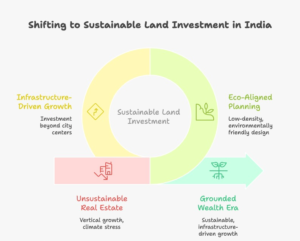
The result is a clear inflection point. Investors are moving away from congested vertical assets toward grounded, long-term, sustainable land investment in India 2026.
The Growing Crisis With Traditional Real Estate Models
To understand why sustainable land investment India 2026 is gaining momentum, it is essential to examine the structural problems within conventional real estate.
1. Project Delays and Regulatory Fatigue
Despite regulatory oversight through RERA, delays remain common. Capital gets locked, possession timelines shift, and dispute resolution takes years. According to the official RERA portal, thousands of projects remain stalled or delayed across states.
For investors, this introduces execution risk—something land ownership largely avoids when legal due diligence is done upfront.
2. Diminishing Returns in Urban Apartments
Rental yields in Tier-1 cities often hover between 2–3%, sometimes lower after taxes and maintenance. Capital appreciation has slowed as supply outpaces absorption.
Industry research consistently shows that high-density urban inventory struggles to maintain long-term value once infrastructure and livability deteriorate.
3. Climate Vulnerability of Built Assets
Flooding, heat stress, water shortages, and pollution increasingly affect urban real estate. Climate exposure directly impacts insurance costs, resale demand, and habitability.
The Intergovernmental Panel on Climate Change has clearly linked climate stress to declining asset stability in vulnerable zones.
4. Loss of Flexibility
Apartments are rigid assets. They age, depreciate, and depend on collective decision-making. Land, on the other hand, offers flexibility—use, development timing, and exit strategies remain in the owner’s control.
These combined factors explain why investors are re-evaluating traditional real estate and exploring sustainable land investment India 2026 as a smarter alternative.
What Sustainable Land Investment Really Means in 2026
The phrase sustainable land investment India 2026 is often misinterpreted as simply buying land in a green area. In reality, sustainability in land investment is multi-dimensional.
Sustainability Is Not Location Alone
True sustainable land investment integrates:
- Legal clarity and zoning compliance
- Environmental balance and resource availability
- Infrastructure alignment
- Long-term livability
- Market exit viability
According to the United Nations Sustainable Development framework, land use that balances development with ecological preservation delivers stronger long-term economic outcomes.
In India, sustainability has become a policy-driven and market-driven imperative rather than a niche preference.
Planned Land vs Speculative Land
Speculative land relies on hope—price inflation without fundamentals. Sustainable land investment relies on planning—value creation aligned with infrastructure, regulation, and environmental capacity.
This distinction is central to understanding why sustainable land investment India 2026 is outperforming traditional land speculation models.
Why Sustainability Has Become a Financial Imperative
Sustainability is no longer about ethics alone. It has become a measurable financial advantage.
Climate Risk = Asset Risk
Climate change is now a balance-sheet issue. Assets exposed to flooding, heat waves, or water scarcity face:
- Higher insurance premiums
- Reduced demand
- Regulatory restrictions
The IPCC and World Economic Forum have repeatedly highlighted climate resilience as a core determinant of asset longevity.
ESG Is Reshaping Investment Logic
Environmental, Social, and Governance (ESG) standards increasingly influence capital flows. Institutional investors are reallocating capital toward assets that demonstrate resilience and sustainability.
This shift directly supports the logic behind sustainable land investment India 2026—land that respects ecological limits and long-term planning attracts sustained interest.
Infrastructure: The Invisible Engine Behind Land Appreciation
Infrastructure remains the most powerful catalyst for land value creation.
India’s infrastructure roadmap prioritises:
- Expressways
- Regional airports
- Rail corridors
- Port connectivity
- Tourism-driven development
These initiatives are designed to decongest metros and activate regional economies.
Land located near infrastructure corridors benefits from:
- Accessibility improvements
- Economic activity spillover
- Regulatory clarity
- Demand diversification
Data from the Ministry of Road Transport and Highways shows continuous expansion of national expressway networks connecting emerging regions.
This is why sustainable land investment India 2026 must be evaluated through the lens of infrastructure alignment, not isolated geography.
What Makes Land Truly Sustainable: A Practical Framework
Not all land qualifies as sustainable investment. Investors must evaluate multiple layers.
1. Legal and Zoning Compliance
Clear title, verified land records, and correct land-use classification are foundational. India’s digitised land record systems have improved transparency significantly (https://bhulekh.gov.in).
Water access, natural drainage, soil health, and surrounding ecosystems determine long-term usability. Land that disrupts ecological balance may face future restrictions.
3. Density and Design Philosophy
- Resource sustainability
- Lifestyle quality
- Long-term desirability
Overcrowding erodes value over time.
4. Climate Resilience
Elevation, vegetation, and natural buffers matter. Climate-resilient land retains relevance even as environmental conditions evolve.
5. Exit Potential
Sustainable land is easier to sell because it appeals to future buyers seeking safety, compliance, and livability.
These principles separate sustainable land investment India 2026 from risky land speculation.
Understanding Returns: Patience vs Speculation
One of the most misunderstood aspects of land investment is returns.
Land does not offer instant gratification. It offers:
- No structural depreciation
- Lower carrying costs
- Inflation protection
- Strong long-term appreciation
Research from real estate advisory firms shows that well-planned land aligned with infrastructure growth often outperforms built assets over 10–15 year horizons .
Sustainable land investment India 2026 is therefore best suited for investors who prioritise capital preservation and long-term growth over short-term yield.
Common Myths About Land Investment—Debunked
Risk arises from poor due diligence, not land itself. Verified, compliant land significantly reduces uncertainty.
“Land Doesn’t Generate Value”
While land may not generate rental income immediately, appreciation often surpasses yield-based assets over time.
“Only Insiders Benefit”
Digital records, policy transparency, and data access have democratised land investment.
“Maintenance Is Expensive”
Land requires minimal maintenance compared to buildings, especially when sustainably planned.
Who Should Consider Sustainable Land Investment in 2026?
Sustainable land investment India 2026 aligns particularly well with:
- Long-term investors
- Portfolio diversifiers
- Second-home planners
- NRIs seeking stable assets
- ESG-aligned capital
The common denominator is future orientation.
FAQ
Q 1: What is sustainable land investment in India in 2026, and how is it different from regular land buying?
Sustainable land investment India 2026 refers to purchasing land that is legally compliant, environmentally viable, infrastructure-aligned, and resilient to long-term risks such as climate change, regulatory shifts, and urban congestion. Unlike regular land buying—which often focuses on short-term speculation—sustainable land investment prioritizes long-term value preservation and appreciation.
In 2026, sustainability is no longer optional. Factors such as water security, zoning compliance, ecological balance, and future development controls directly impact land value. According to the United Nations Sustainable Development framework, land use that balances economic growth with environmental responsibility delivers more stable long-term outcomes.
Q 2: Why is sustainable land investment in India 2026 gaining more attention than apartments or flats?
Sustainable land investment India 2026 is gaining attention because traditional real estate formats—especially apartments—are facing structural challenges. These include delayed projects, low rental yields, high maintenance costs, and increasing climate vulnerability in dense urban areas.
Land, when sustainably planned, does not depreciate like buildings. It offers flexibility of use, lower carrying costs, and stronger protection against inflation. Research from real estate advisory firms shows that land aligned with infrastructure and sustainability trends often outperforms built assets over longer holding periods.
Q 3: Is sustainable land investment in India in 2026 safe from a legal and regulatory perspective?
Yes—sustainable land investment India 2026 is considered safer when proper legal due diligence is conducted. This includes verifying clear title, zoning classification, land-use permissions, and compliance with regional development plans.
India has significantly improved transparency through digitised land records and regulatory frameworks. Investors can verify ownership and land status through official portals such as the National Land Records Modernization Programme and state land record systems. Compared to under-construction properties, legally vetted land often carries lower execution risk.
Q 4: How does climate change impact sustainable land investment in India in 2026?
Climate change is a critical factor influencing sustainable land investment India 2026. Assets located in flood-prone zones, heat islands, or water-stressed regions face higher long-term risk, including insurance challenges, habitability issues, and declining demand.
The Intergovernmental Panel on Climate Change (IPCC) has clearly stated that climate resilience is now a key determinant of asset stability. Sustainable land investment focuses on elevation, drainage, vegetation, and ecological balance—factors that help protect value in a climate-stressed future.
Q 5: What role does infrastructure play in sustainable land investment in India in 2026?
Infrastructure is one of the strongest value drivers for sustainable land investment India 2026. Expressways, rail corridors, airports, and ports enhance accessibility, stimulate economic activity, and generate demand for planned development.
India’s infrastructure expansion strategy aims to decongest metros and activate regional growth corridors. Land located near such infrastructure—when combined with sustainable planning—tends to experience consistent appreciation over time rather than volatile price spikes.
Q 6: What kind of returns can investors realistically expect from sustainable land investment in India 2026?
Returns from sustainable land investment India 2026 are typically realized over the medium to long term. Unlike apartments, land does not generate immediate rental income but benefits from capital appreciation driven by infrastructure growth, scarcity, and demand for low-density living.
Industry research indicates that strategically located land parcels can deliver higher compounded appreciation over 10–15 years compared to many built assets, especially when aligned with infrastructure and regulatory planning. Sustainable land investment rewards patience rather than speculation.
Q 7: How is sustainable land investment in India 2026 different from speculative land buying?
Speculative land buying relies on price hype and short-term market sentiment. In contrast, sustainable land investment India 2026 is based on fundamentals—legal clarity, environmental capacity, infrastructure alignment, and long-term livability.
Speculative land often lacks zoning approvals or ecological feasibility, increasing the risk of regulatory restrictions. Sustainable land investment focuses on compliance and resilience, making it easier to hold, develop, or exit in the future.
Q 8: Who should consider sustainable land investment in India in 2026?
Sustainable land investment India 2026 is suitable for:
- Long-term investors seeking capital preservation
- Individuals diversifying beyond apartments
- NRIs looking for stable, tangible assets
- Second-home planners focused on livability
- ESG-aligned investors prioritizing resilience
According to Invest India, long-term infrastructure-led growth and policy reforms are creating new opportunities beyond traditional urban markets.
Q 9: What risks should investors be aware of in sustainable land investment in India 2026?
While sustainable land investment India 2026 reduces many traditional risks, investors must still consider:
- Inadequate legal verification
- Misalignment with zoning or land-use rules
- Poor environmental assessment
- Overpaying without long-term fundamentals
Most risks can be mitigated through structured due diligence, verified documentation, and understanding regional development plans published by government authorities.
Q 10: Why is sustainable land investment in India 2026 considered future-proof compared to other assets?
Sustainable land investment India 2026 is considered future-proof because it aligns with long-term macro trends—climate resilience, decentralised growth, infrastructure expansion, and changing lifestyle preferences.
Unlike buildings, land does not physically depreciate. When chosen correctly, it adapts to future use cases while preserving value. Global institutions like the World Economic Forum emphasize that resilient, sustainable real assets are likely to outperform in an era of uncertainty.
The Bigger Picture: Why the Future of Wealth Is Grounded
Wealth creation has always followed structural shifts in society. In earlier decades, wealth flowed toward industrial hubs. Later, it concentrated in cities, financial districts, and high-rise developments. Today, however, the underlying forces shaping value are changing once again—and with them, the very definition of a “safe” and “smart” asset.
The future of wealth is no longer purely vertical. It is increasingly grounded—in land, in sustainability, and in long-term resilience.
From Density to Durability
For years, real estate growth was synonymous with density. Taller buildings, tighter cities, and faster construction were seen as progress. But density also brought unintended consequences: infrastructure strain, declining air and water quality, climate vulnerability, and reduced quality of life.
By 2026, investors are recognizing that durability matters more than density. Assets that can withstand environmental stress, regulatory evolution, and shifting lifestyle preferences are becoming the foundation of long-term portfolios. This is where sustainable land investment India 2026 fits into the broader economic narrative.
Land, unlike buildings, does not age structurally. When chosen carefully, it adapts to future needs rather than becoming obsolete. In an era defined by uncertainty, adaptability has become a core wealth attribute.
Climate Reality Is Reshaping Asset Value
Climate change is no longer a distant concern—it is a present-day economic variable. Flooding, heat stress, water scarcity, and ecosystem degradation are already influencing property insurance, infrastructure planning, and regional development policies.
Global climate assessments emphasize that assets lacking resilience will face rising costs and declining desirability over time. In contrast, land that respects natural systems—water flow, vegetation, soil health—offers a buffer against these risks.
This reality is pushing investors to look beyond short-term appreciation and toward sustainable land investment India 2026, where value is rooted in environmental compatibility rather than excessive construction.
Infrastructure Is Decentralising Wealth
Another critical force shaping the future of wealth is infrastructure-led decentralisation. Governments are actively reducing pressure on major metros by investing in expressways, logistics corridors, ports, airports, and regional connectivity.
According to national planning frameworks, infrastructure expansion is designed to unlock economic activity across wider geographies rather than concentrating growth in a few urban centers. As a result, land in well-connected but underdeveloped regions is emerging as a strategic asset.
This shift reinforces the logic behind sustainable land investment India 2026—wealth creation is no longer limited to city skylines but extends along corridors of connectivity and opportunity.
The Psychology of Ownership Is Changing
There is also a subtle but powerful psychological shift underway. Investors are increasingly seeking control, transparency, and tangibility.
High-rise real estate often comes with shared decision-making, regulatory complexity, and dependence on third parties. Land ownership, on the other hand, offers autonomy. It allows investors to decide when, how, or whether to develop—providing flexibility in an uncertain future.
This desire for control aligns closely with sustainable land investment India 2026, where ownership is not just financial, but strategic.
From Short-Term Yield to Long-Term Relevance
Traditional investment conversations have focused heavily on yield—monthly returns, rental income, short holding periods. However, long-term investors are increasingly prioritising relevance over yield.
Will this asset still be desirable in 15 or 20 years?
Will it comply with future regulations?
Will people want to live, work, or retreat there?
Land that is legally compliant, environmentally viable, and infrastructure-aligned is more likely to remain relevant as markets evolve. This is why sustainable land investment India 2026 is not positioned as a quick win, but as a foundational asset for generational wealth.
Wealth That Aligns With the Future
Globally, institutional investors, sovereign funds, and long-term capital allocators are reassessing real assets through the lens of sustainability and resilience. The World Economic Forum has repeatedly highlighted that future-ready assets must integrate environmental responsibility with economic viability.
This alignment is not ideological—it is pragmatic. Assets that work with future realities rather than against them are better positioned to preserve and grow value.
Grounded Wealth in an Uncertain World
In a world of rapid technological change, geopolitical uncertainty, and climate volatility, grounded assets offer psychological and financial stability. Land—when sustainably planned—anchors wealth to something tangible, finite, and adaptable.
This is the deeper significance of sustainable land investment India 2026. It represents a shift away from speculative growth toward intentional ownership. Away from chasing short-term gains and toward building assets that endure.
The future of wealth will not be measured solely by how high it rises—but by how well it is grounded.









No Comments