

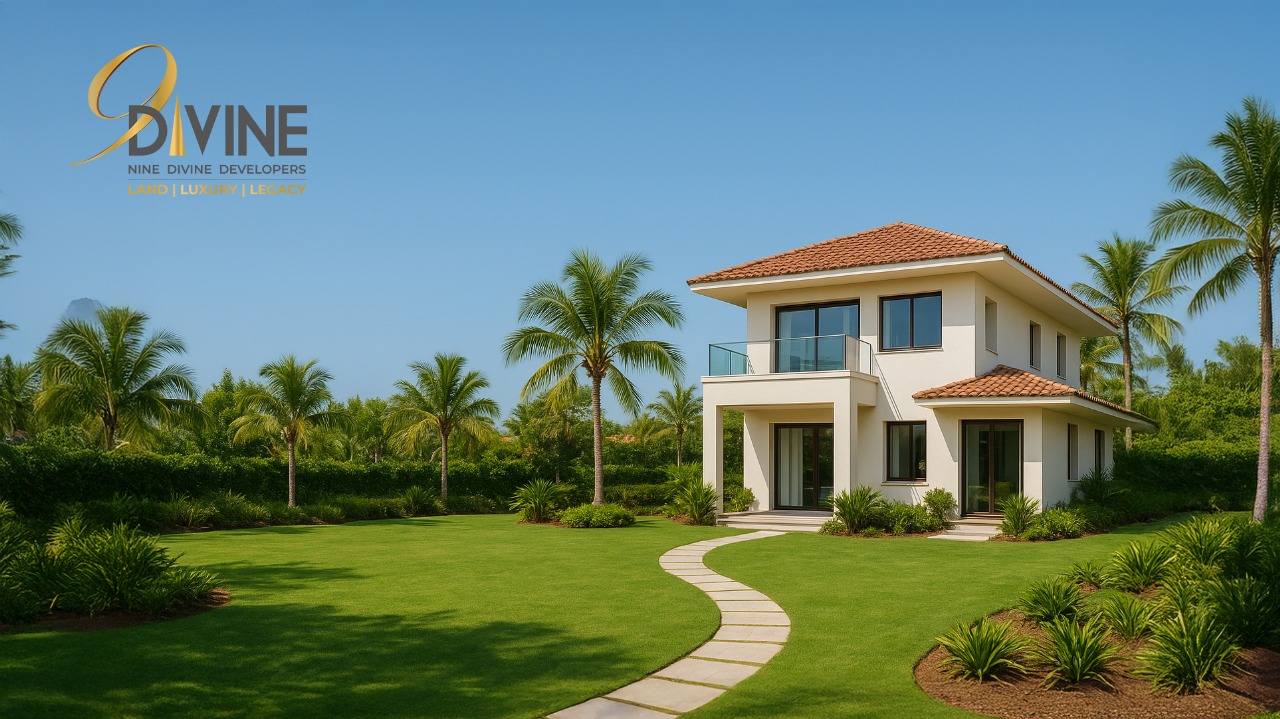


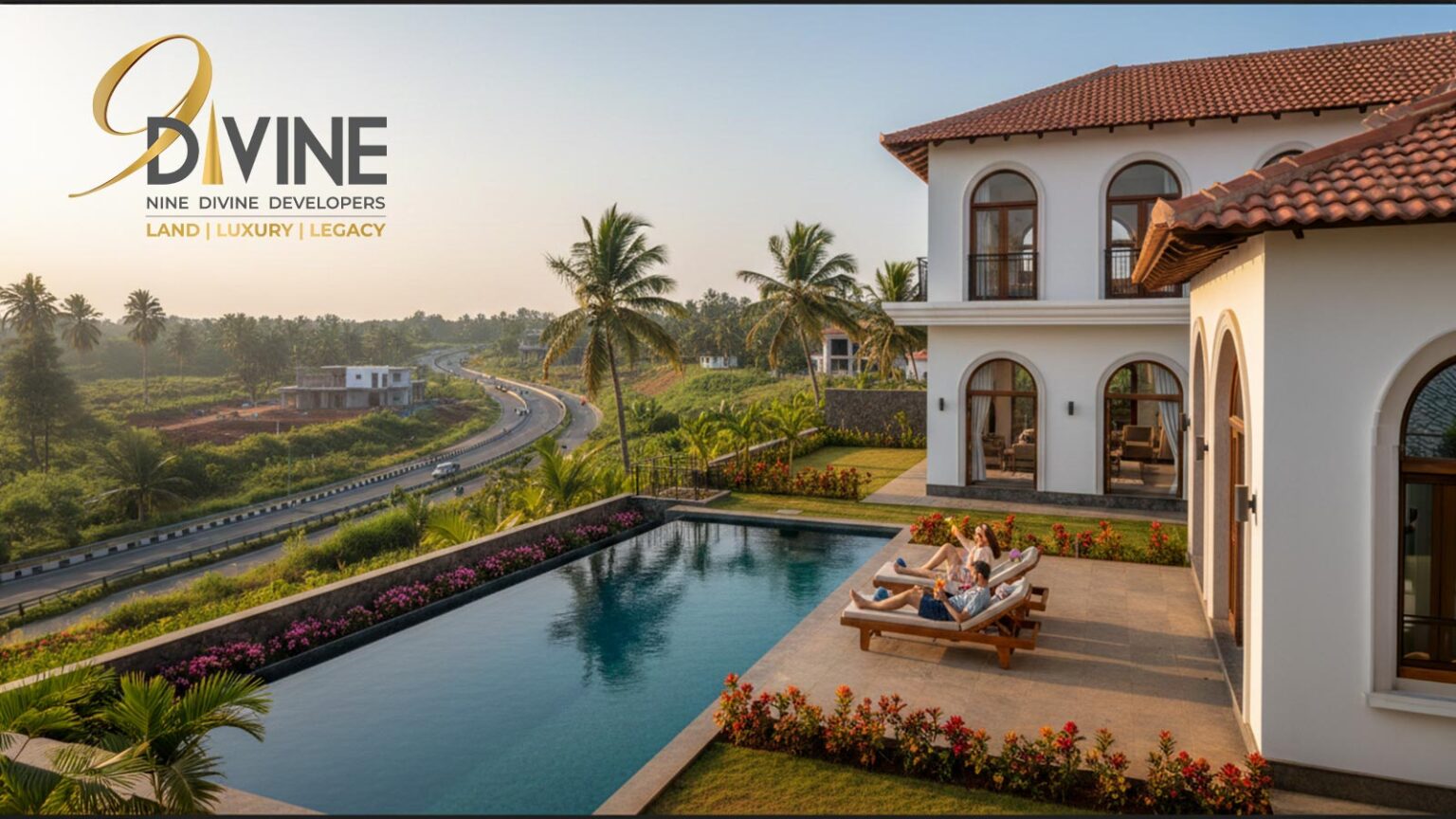
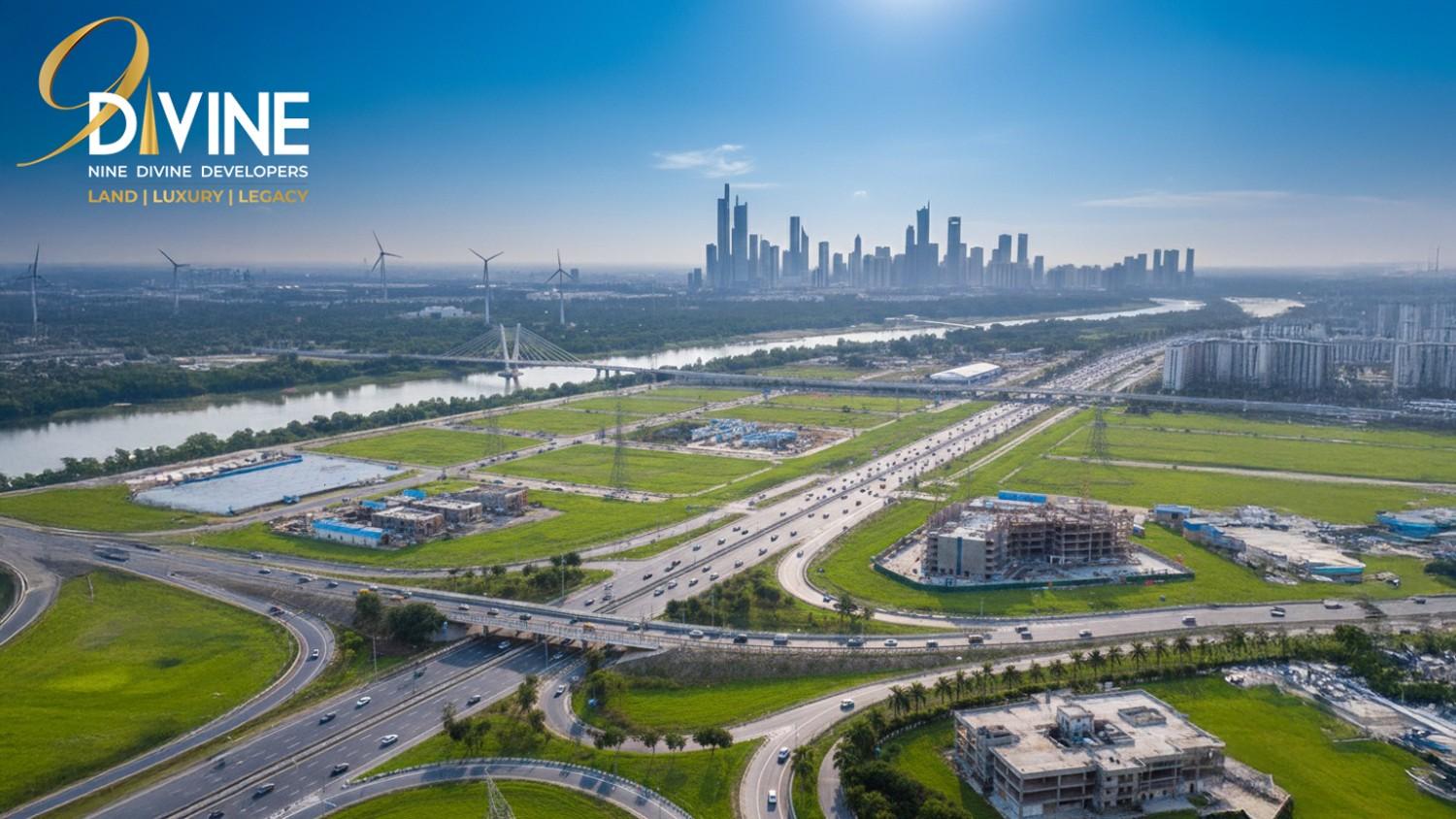
 This main banner represents Goa Airbnb investment 2026, focusing on infrastructure expansion, tourism growth exceeding 1.08 crore arrivals, Mopa airport connectivity, NH-66 corridor development, and North Goa villa rental potential for structured investors.
Goa Airbnb Investment 2026: 7 Data-Backed Reasons the Mopa–NH66 Belt Is Emerging as a Strategic Villa Corridor
For decades, Goa has been viewed through a lifestyle lens — beaches, music, cuisine, and seasonal tourism. But for experienced investors, HNIs, NRIs, and legacy-focused families, Goa today is something else: a functioning travel economy supported by infrastructure, rising domestic mobility, and structured short-term rental demand.
Table of Contents
- Goa Airbnb Investment 2026: 7 Data-Backed Reasons the Mopa–NH66 Belt Is Emerging as a Strategic Villa Corridor
- Tourism Volume: The Foundation of Goa Airbnb Investment 2026
- Mopa Airport: Access Is the First Yield Multiplier
- NH-66 Upgrades: The Silent Driver of Weekend Economics
- The Numbers: What Short-Term Rental Benchmarks Indicate
- Micro-Market Behavior: Why Not All North Goa Is Equal
- Operational Discipline: The Real Difference Maker
- Seasonality: Planning for Stability, Not Peaks
- Risk Awareness: Responsible Investment Thinking
- The Corridor Thesis: Why Mopa–NH66 Is Being Discussed
- FAQ
- A Measured Conclusion: Evaluating Goa Airbnb Investment 2026 with Discipline, Not Excitement
That is why Goa Airbnb investment 2026 deserves a calm, data-backed evaluation — not a speculative one.
This is not a promise of extraordinary returns. It is not a short-term flip narrative. And it is not a criticism of any location or product. Instead, this is a structured, fact-led analysis of why Goa Airbnb investment 2026 — particularly along the Mopa–NH66 corridor — is being discussed more seriously in wealth circles in 2026.
For mature investors between 35 and 75 years old, capital preservation and structured income matter more than trends. The right question is not “Is Goa popular?” The real question is:
Has Goa’s travel economy matured enough to support disciplined, professionally managed short-term rental assets in 2026?
Let’s examine that carefully.
Tourism Volume: The Foundation of Goa Airbnb Investment 2026
Short-term rental markets only stabilize when tourism volume crosses a certain threshold. Goa appears to have crossed that threshold.
Recent official communications from the Goa Tourism Department indicate that the state recorded approximately 1.08 crore tourist arrivals in 2025, driven primarily by domestic tourism, with foreign arrivals also contributing meaningfully.
Why does this matter for Goa Airbnb investment 2026?
Because scale reduces fragility.
When arrivals exceed one crore annually:
- Demand is no longer purely seasonal.
- Weekends begin to normalize.
- Repeat domestic travel increases.
- Corporate offsites, family celebrations, and extended stays become frequent.
For investors evaluating Goa Airbnb investment 2026, the key takeaway is this: tourism in Goa is no longer episodic. It is systemic.
Mopa Airport: Access Is the First Yield Multiplier
Connectivity determines frequency. Frequency determines occupancy.
The operational launch and scaling of Manohar International Airport (Mopa) have meaningfully altered North Goa accessibility patterns.
Recent reporting has highlighted passenger growth and increasing traffic share being handled by Mopa relative to Dabolim during specific periods.
For Goa Airbnb investment 2026, this shift is structural.
What changes when airport proximity improves?
- Time-to-villa reduces.
- Fly-in weekend travel increases.
- Corporate and NRI visits become more frequent.
- North Goa’s hospitality density strengthens.
In mature STR markets globally, properties within efficient airport corridors consistently demonstrate stronger booking velocity. The same logic now increasingly applies to Goa Airbnb investment 2026.
This does not mean “every North Goa villa will outperform.” It means mobility has improved, and mobility drives rental viability.
NH-66 Upgrades: The Silent Driver of Weekend Economics
Flights enable long weekends. Roads enable frequency.
Progress and repair updates on the Mumbai–Goa highway (NH-66) have been covered by multiple publications, indicating improved sections and smoother connectivity over time.
For Goa Airbnb investment 2026, better road comfort has three implications:
- Drive-in guests from Mumbai and Pune are increasing.
- Family road trips become less stressful.
- Repeat visitation probability improves.
Experienced investors understand this dynamic. In hospitality markets, reduced travel fatigue increases booking frequency more reliably than promotional pricing.
In practical terms, Goa Airbnb investment 2026 benefits when the weekend radius expands.
The Numbers: What Short-Term Rental Benchmarks Indicate
No serious investment discussion is complete without numbers.
Market analytics platforms tracking Goa listings have published indicative benchmarks, including:
- Approximate median occupancy around 47%
- Around 170+ booked nights annually for typical listings
- ADRs in the mid-thousands (with wide variation by product quality)
These figures are not guarantees. They are directional benchmarks.
For Goa Airbnb investment 2026, interpretation matters more than raw data.
Key observations:
- There is a wide performance spread.
- Premium villas with privacy and management outperform averages.
- Poorly managed assets underperform regardless of location.
In sophisticated markets, dispersion indicates opportunity. The wide performance range within Goa Airbnb investment 2026 suggests that operator quality determines yield far more than geography alone.
Micro-Market Behavior: Why Not All North Goa Is Equal
Investors in the 35–75 age bracket often prefer clarity over marketing narratives. So let us speak directly.
Goa Airbnb investment 2026 is a micro-market story.
Different belts serve different demand types:
- Pernem-side zones often attract quieter family demand.
- Morjim–Ashwem areas appeal to premium lifestyle travelers.
- Anjuna–Vagator supports higher activity density and event-driven stays.
- Candolim–Calangute provides volume but faces commoditization.
There is no “best location.” There is only “best fit.”
For Goa Airbnb investment 2026, the question becomes:
Does the villa align with the guest segment that naturally gravitates to that micro-market?
Alignment drives pricing power.
Operational Discipline: The Real Difference Maker
Many first-time investors assume location is the decisive factor. In reality, operations dominate.
In Goa Airbnb investment 2026, operational quality affects:
- Review ratings
- Repeat bookings
- ADR sustainability
- Damage control
- Maintenance longevity
Essential operational pillars include:
- Consistent housekeeping standards
- Reliable water supply and backup
- Power backup planning
- Preventative damp and pest management
- Transparent guest communication
In coastal climates, maintenance is not optional — it is strategic.
A villa that is architecturally superior but poorly managed will underperform a simpler but reliably operated property in Goa Airbnb investment 2026.
Seasonality: Planning for Stability, Not Peaks
Goa remains seasonal. That is not a weakness; it is a characteristic.
Peak months can create strong revenue spikes. Shoulder and monsoon months require a strategy.
For conservative underwriting of Goa Airbnb investment 2026, consider:
- Lower occupancy assumptions outside peak.
- Maintenance cycles during the off-season.
- Flexible pricing models.
- Conservative annual revenue projections.
Investors above 50 particularly appreciate structured planning. A well-managed Goa Airbnb investment 2026 accounts for variability rather than assuming uniform demand.
Risk Awareness: Responsible Investment Thinking
It is important to clarify that this analysis does not criticize any project, location, or legality. Compliance and local adherence remain essential in all real estate investments.
For Goa Airbnb investment 2026, prudent considerations include:
- Verification of local operational permissions.
- Neighborhood compatibility.
- Insurance coverage.
- Property management reliability.
- Guest policy enforcement.
Responsible capital respects structure. That principle applies equally in Goa Airbnb investment 2026.
The Corridor Thesis: Why Mopa–NH66 Is Being Discussed
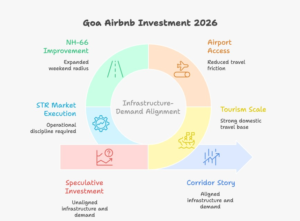
When infrastructure, tourism volume, and rental data align, investor attention follows.
The Mopa–NH66 corridor represents:
- Improved air access.
- Strengthened road connectivity.
- Concentrated North Goa lifestyle demand.
- Expanding hospitality ecosystem.
For seasoned investors evaluating Goa Airbnb investment 2026, this is not about chasing hype. It is about recognizing alignment between infrastructure and income-generating assets.
At a broader advisory level, firms like Nine Divine often evaluate such corridors not through promotional language, but through infrastructure mapping, demographic patterns, and micro-market performance metrics. That analytical lens is increasingly relevant in Goa Airbnb investment 2026 discussions.
FAQ
1. Is Goa Airbnb investment 2026 supported by real tourism demand or just post-pandemic momentum?
Yes, Goa Airbnb investment 2026 is supported by sustained tourism volume rather than a short-term rebound narrative. According to official communication from the Goa Tourism Department, the state recorded approximately 1.08 crore tourist arrivals in 2025, driven largely by domestic travel, with foreign arrivals also contributing meaningfully.
For investors evaluating Goa Airbnb investment 2026, this volume indicates depth of demand, not just seasonal spikes.
2. How does Mopa Airport influence Goa Airbnb investment 2026?
Airport proximity influences frequency of travel, particularly weekend and short-duration stays. Reporting indicates that Mopa Airport has seen increasing passenger movement and traffic share in recent periods.
For Goa Airbnb investment 2026, improved access to North Goa reduces arrival friction, which historically correlates with improved booking velocity in hospitality markets.
3. Do highway improvements genuinely impact Goa Airbnb investment 2026 performance?
Road connectivity influences repeat travel behavior. Progress updates on the Mumbai–Goa NH-66 corridor suggest smoother connectivity improvements over time.
For Goa Airbnb investment 2026, improved road comfort increases drive-in travel probability from Mumbai and Pune — strengthening weekend occupancy potential.
4. What occupancy levels should investors realistically expect in Goa Airbnb investment 2026?
Short-term rental analytics platforms tracking Goa listings indicate median occupancy figures around the mid-40% range, with annual booked nights typically above 150 in many segments.
In Goa Airbnb investment 2026, occupancy varies significantly by micro-market, villa quality, and management discipline. Conservative underwriting is recommended.
5. Is Goa Airbnb investment 2026 suitable for HNIs and NRIs seeking stable income?
For HNIs and NRIs, Goa Airbnb investment 2026 functions as a hybrid asset — part lifestyle, part hospitality real estate. Stability depends on professional management, realistic projections, and micro-market alignment rather than speculative pricing assumptions.
This broader travel data supports the continued structural demand environment surrounding Goa Airbnb investment 2026.
6. Does North Goa outperform South Goa in Goa Airbnb investment 2026?
The question is less about outperforming and more about demand concentration. North Goa benefits from airport proximity (Mopa), higher hospitality density, and established lifestyle demand pockets.
For Goa Airbnb investment 2026, micro-market alignment is more important than broad geographic labels.
7. How important are reviews and property management in Goa Airbnb investment 2026?
In mature short-term rental markets, reviews directly influence pricing power and occupancy. Data benchmarks indicate wide performance spreads in Goa listings.
In Goa Airbnb investment 2026, operational reliability often determines whether a property performs at or below market averages.
8. Is Goa Airbnb investment 2026 dependent on foreign tourism?
While foreign tourism contributes meaningfully, domestic tourism forms the larger share of arrivals.
For Goa Airbnb investment 2026, strong domestic travel demand provides resilience against international volatility.
9. Does infrastructure guarantee returns in Goa Airbnb investment 2026?
Infrastructure improves probability, not certainty. Airport expansion and highway upgrades enhance accessibility, but performance ultimately depends on property quality and management.
In Goa Airbnb investment 2026, disciplined underwriting remains essential.
10. What makes Goa Airbnb investment 2026 different from traditional long-term rental investment?
Traditional rentals offer stability but lower yield variability. Goa Airbnb investment 2026 offers higher potential income variability tied to tourism cycles, dynamic pricing, and occupancy patterns.
For experienced investors, Goa Airbnb investment 2026 represents a hospitality-aligned real estate strategy rather than a fixed-income substitute.
A Measured Conclusion: Evaluating Goa Airbnb Investment 2026 with Discipline, Not Excitement
For seasoned investors — whether HNIs, NRIs, second-generation wealth custodians, or public figures — decisions are rarely driven by excitement. They are driven by structure, probability, and downside awareness.
When viewed through that lens, Goa Airbnb investment 2026 should not be approached as a tourism trend or lifestyle indulgence. It should be evaluated as a hospitality-linked real estate strategy supported by measurable variables:
- Sustained tourism volume exceeding one crore annual visitors
- Expanding airport capacity and North Goa accessibility
- Progressive improvement in highway connectivity
- Transparent short-term rental performance benchmarks
- A maturing domestic travel culture
Each of these components individually may not guarantee performance. Together, however, they create a demand ecosystem. And demand ecosystems are what allow income-generating real estate to stabilize over time.
That said, maturity in investing requires balance.
Goa Airbnb investment 2026 is not risk-free.
It is sensitive to seasonality.
It requires operational discipline.
It demands realistic underwriting.
It rewards management quality over speculative optimism.
For investors in the 35–75 age group, particularly those focused on wealth preservation, succession planning, and structured cash flow, the key question is not “Can this generate high yield?” but rather:
Does this asset align with infrastructure growth, tourism depth, and long-term usability?
On those parameters, Goa Airbnb investment 2026 demonstrates several encouraging signals.
Unlike purely speculative land banking, this strategy integrates an operating business model. Unlike volatile market instruments, it is backed by a tangible asset. Unlike passive long-term rentals, it offers flexible usage — personal, family, diplomatic hosting, or structured leasing.
The Mopa–NH66 corridor in particular illustrates what seasoned investors typically look for: infrastructure alignment preceding full price normalization. In real estate history, infrastructure-linked corridors often move gradually rather than abruptly — and disciplined investors tend to enter during structural shifts rather than peak enthusiasm cycles.
However, caution remains essential.
The right approach to Goa Airbnb investment 2026 involves:
- Conservative occupancy assumptions
- Realistic cost modeling
- Professional property management planning
- Maintenance budgeting suited to coastal climates
- Legal and operational compliance verification
It also involves emotional discipline — resisting exaggerated projections and focusing instead on sustainable performance.
Importantly, this analysis does not criticize any location, project, product typology, or regulatory framework. Goa’s market is diverse, and each micro-market carries its own dynamics. The objective is not comparison for superiority, but evaluation for suitability.
For many mature investors, Goa Airbnb investment 2026 represents something more nuanced than yield — it represents asset diversification within India’s expanding domestic travel economy. It offers optionality: income generation today, capital preservation tomorrow, and lifestyle utility across decades.
That optionality is often underappreciated in traditional investment discussions.
And while individual diligence must always guide capital allocation, structured advisory evaluation — including the corridor-based frameworks sometimes applied by firms such as Nine Divine — increasingly centers around infrastructure-backed micro-markets rather than promotional narratives.
In that broader context, Goa Airbnb investment 2026 should be viewed neither as speculative enthusiasm nor as guaranteed income. It should be viewed as a strategic hospitality-aligned asset class emerging within a maturing tourism economy.
For disciplined capital, that distinction makes all the difference.







No Comments