



 Understanding the future of land investment in India through connectivity and transparency.
Land Investment in India (2026): Why Digitised Land Records and Infrastructure Corridors Are Creating New Micro-Markets
Over the past decade, the conversation around land investment in India has quietly evolved. Earlier, discussions about land often revolved around anecdotal advice, word-of-mouth insights, and broad assumptions about where development might happen next. Today, the environment is far more structured.
Table of Contents
- Land Investment in India (2026): Why Digitised Land Records and Infrastructure Corridors Are Creating New Micro-Markets
- Understanding the Structural Shift in Land Investment in India
- Infrastructure Corridors: The Silent Drivers of Land Demand
- Why Accessibility Changes Land Economics
- The Role of Airports and Regional Connectivity
- Digitised Land Records: A Major Confidence Booster
- Micro-Markets: The Future of Land Investment in India
- The Importance of Due Diligence
- Long-Term Wealth and Land as a Strategic Asset
- Avoiding the Hype Cycle
- The Role of Knowledge Platforms and Responsible Developers
- Why 2026 Could Mark a New Era for Land Investment in India
- FAQ
A growing network of highways, logistics corridors, airports, and digitally accessible land records is transforming how serious investors approach land investment in India. For experienced investors—whether they are high-net-worth individuals, NRIs, entrepreneurs, or long-term asset allocators—the focus is shifting from speculation toward verification, connectivity, and structural demand.
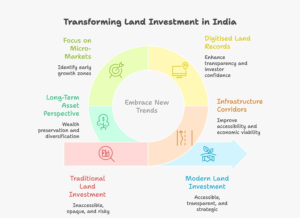
In 2026, evaluating land investment in India increasingly means examining two important pillars. The first is infrastructure connectivity, which determines how accessible a region becomes for economic activity, tourism, and residential growth. The second is transparency in land records, where digitisation initiatives are reducing uncertainty around ownership and documentation.
These two developments together are shaping what experts describe as micro-markets—specific pockets of land that gain importance due to improved access, infrastructure alignment, and rising investor confidence. Understanding how these micro-markets emerge is essential for anyone studying land investment in India from a long-term perspective.
Understanding the Structural Shift in Land Investment in India
Land has historically been one of the most respected asset classes in India. Families, institutions, and entrepreneurs have often preserved wealth through land ownership across generations. However, land investment in India has also traditionally required patience, strong due diligence, and familiarity with local systems.
What is changing today is not the fundamental value of land itself, but the ecosystem surrounding it.
Large national infrastructure programs are connecting regions that were once considered remote. At the same time, the digitisation of land records is gradually making it easier to verify documentation. Together, these developments are making land investment in India more transparent and research-driven.
The Digital India Land Records Modernization Programme (DILRMP), introduced by the Government of India, aims to modernize and digitize land records across the country to improve transparency and accessibility.
Meanwhile, infrastructure initiatives such as PM GatiShakti aim to coordinate infrastructure planning across multiple sectors—roads, railways, ports, and logistics networks—to improve connectivity and economic productivity.
Source: https://pmgatishakti.gov.in
These initiatives collectively create an environment where land investment in India can be studied with greater clarity and data.
Infrastructure Corridors: The Silent Drivers of Land Demand
One of the most important drivers of land investment in India today is the emergence of infrastructure corridors. These corridors are not simply highways; they represent integrated networks that link economic zones, cities, ports, airports, and industrial regions.
Programs such as Bharatmala Pariyojana, for example, are focused on expanding national highway infrastructure across India, improving logistics efficiency, and reducing travel time between regions.
When travel time between locations decreases, several economic changes occur:
- Tourism becomes more feasible
• weekend travel becomes practical
• businesses expand into new regions
• logistics and warehousing improve
• hospitality and residential demand follow
Each of these shifts can influence land investment in India because they expand the pool of potential buyers and users of land.
For investors evaluating land opportunities, infrastructure corridors effectively increase what analysts call the “buyer radius.” In simple terms, more people can realistically reach and use the location. As the buyer radius expands, the land market gradually becomes more liquid.
Why Accessibility Changes Land Economics
Accessibility plays a powerful role in determining the future of land investment in India. A location that was once considered distant may become far more viable once a highway upgrade, expressway, or airport connection reduces travel time significantly.
This transformation does not happen overnight. However, over time, improved access can influence several economic patterns:
- increased tourism flows
• hospitality development
• second-home demand
• small-scale commercial ecosystems
• logistics and supply chain activity
For many regions in India, these changes gradually shape new micro-markets where land investment in India becomes increasingly structured rather than speculative.
This is particularly important for experienced investors who look beyond short-term price movements. Instead, they study long-term access economics.
When evaluating land investment in India, a simple but powerful question often guides the analysis:
“How easily can people reach this place today—and how easily will they reach it five years from now?”
The Role of Airports and Regional Connectivity
In addition to highways, regional airports are also influencing the landscape of land investment in India. The government’s UDAN (Ude Desh ka Aam Nagrik) scheme was introduced to improve regional air connectivity and bring smaller cities and destinations onto the aviation map.
Improved air connectivity can dramatically change how investors perceive a location. Even limited flight frequency can support tourism, business travel, and high-value weekend mobility.
For example, when an airport connects a coastal region or tourism corridor to major cities, the entire economic profile of that region can change over time. Such developments influence hospitality investments, eco-tourism ventures, and second-home markets.
These patterns have historically shaped several successful land investment stories in India, where improved connectivity gradually increased demand for land over the years.
Digitised Land Records: A Major Confidence Booster
While connectivity expands opportunity, documentation clarity builds confidence.
For decades, one of the biggest challenges in land investment in India has been the complexity of land records. Buyers often had to rely on manual verification processes, multiple government offices, and extensive local knowledge.
Digitisation initiatives are gradually transforming this landscape.
Under the Digital India Land Records Modernization Programme, several improvements are being implemented across states, including:
- digitisation of land records
• integration of registration and mutation processes
• modernization of survey and mapping systems
• improved access to records through online platforms
Many states, including Maharashtra, have also introduced online land record portals such as Mahabhulekh, which allow users to view certain land records digitally.
For investors studying land investment in India, this progress reduces verification time and increases transparency. While due diligence remains essential, digital access to records represents an important step toward a more organized land market.
Micro-Markets: The Future of Land Investment in India
An important concept emerging in modern real estate analysis is the micro-market.
A micro-market is not defined simply by district or city boundaries. Instead, it refers to a smaller geographical pocket where economic conditions align to support sustained demand.
In the context of land investment in India, micro-markets often emerge near:
- major highway intersections
• tourism circuits
• logistics corridors
• airport catchment zones
• rapidly growing towns
These locations may initially attract attention because of connectivity improvements. Over time, if supporting infrastructure and governance systems improve, they evolve into more stable investment zones.
However, not every location becomes a micro-market. Successful micro-markets typically display a combination of factors:
- accessibility
- infrastructure alignment
- documentation clarity
- economic use cases
- long-term demand drivers
Investors who focus on these fundamentals tend to approach land investment in India with greater discipline.
The Importance of Due Diligence
Regardless of how promising a location appears, responsible land investment in India always begins with thorough due diligence.
Investors should examine several aspects carefully:
- land ownership records
• mutation history
• zoning and land use classification
• survey numbers and boundaries
• road access and easements
• encumbrance status
• local infrastructure development
Digitised systems can assist in verifying certain records, but they do not replace professional diligence or on-ground verification.
Experienced investors typically combine document research, legal consultation, and site visits before finalizing any decision involving land investment in India.
Long-Term Wealth and Land as a Strategic Asset
One reason land investment in India continues to attract interest from experienced investors is its ability to function as a strategic long-term asset.
Unlike many financial instruments, land is finite. It does not depreciate in the same way as buildings or machinery might. Instead, its value is influenced by the surrounding environment—connectivity, economic activity, and governance.
For families and investors who think in generational terms, land investment in India often represents more than a financial asset. It can be a store of wealth, a strategic reserve for future development, or a foundation for long-term diversification.
This perspective is particularly common among:
- legacy family businesses
• agricultural investors
• NRIs seeking diversification
• entrepreneurs with long investment horizons
In many cases, the goal is not quick resale but patient asset accumulation in emerging corridors.
Avoiding the Hype Cycle
As interest in land investment in India grows, it is also important for investors to remain cautious of hype cycles.
Social media trends, promotional claims, or speculative rumors can sometimes exaggerate the short-term prospects of certain locations. A disciplined approach involves focusing on verifiable facts rather than speculation.
Key indicators worth studying include:
- government infrastructure announcements and execution status
• transportation accessibility
• economic growth patterns in nearby towns
• population and tourism trends
• administrative transparency and governance
When these indicators align, land investment in India becomes a research-driven decision rather than a sentiment-driven one.
The Role of Knowledge Platforms and Responsible Developers
In recent years, some organizations in the real estate sector have begun focusing on educational approaches to land ownership—sharing insights about documentation, connectivity trends, and responsible investment practices.
Among the platforms working in this direction is Nine Divine, which emphasizes research-backed information around emerging land corridors and structured land ownership. By highlighting the importance of due diligence, connectivity analysis, and documentation transparency, such initiatives aim to support informed discussions around land investment in India.
Educational engagement of this kind reflects a broader shift within the real estate ecosystem toward responsible land awareness rather than aggressive sales narratives.
Why 2026 Could Mark a New Era for Land Investment in India
Looking ahead, several structural trends suggest that land investment in India will continue to evolve over the coming decade.
First, infrastructure expansion is likely to continue across highways, logistics corridors, and regional connectivity networks.
Second, digital governance initiatives are improving access to information and reducing documentation friction.
Third, demographic and economic growth in India will continue to create demand for tourism, housing, logistics, and industrial development.
Together, these factors may gradually transform several regions into organized micro-markets where land investment in India becomes easier to evaluate through measurable indicators.
FAQ
1. Why is land investment in India gaining attention again in 2026?
Interest in land investment in India is increasing because several structural changes are taking place simultaneously. Large infrastructure programs such as Bharatmala, PM GatiShakti, and expanding regional airports are improving connectivity between cities, tourism corridors, and economic zones. Improved accessibility often increases the number of people who can realistically reach and use a location.
At the same time, government initiatives like the Digital India Land Records Modernization Programme (DILRMP) are working to digitize land records and simplify verification processes. This makes it easier for investors to check land ownership records and reduces reliance on manual paperwork.
When connectivity improvements combine with better documentation transparency, many regions begin to evolve into emerging micro-markets, which explains the growing interest in land investment in India.
2. How do infrastructure corridors influence land investment in India?
Infrastructure corridors play a major role in shaping land investment in India because they reduce travel time and improve logistics connectivity. When highways, expressways, or multimodal transport networks connect regions more efficiently, they expand the potential buyer and user base for land in those areas.
For example, programs like Bharatmala Pariyojana aim to strengthen national highway connectivity and improve freight movement across India. Reduced travel time encourages tourism, residential development, hospitality projects, and logistics hubs—all of which influence land demand.
However, experienced investors usually analyze not only announcements but also the actual execution stage of infrastructure projects before considering land investment in India decisions.
3. What is the Digital India Land Records Modernization Programme (DILRMP)?
The Digital India Land Records Modernization Programme (DILRMP) is a central government initiative designed to modernize land record management systems across India. The program focuses on digitizing land ownership records, integrating registration systems, and improving transparency in land administration.
For investors studying land investment in India, DILRMP is significant because it helps reduce ambiguity around land documentation. Digitized records allow individuals to access and verify certain land ownership details online, depending on state-level systems.
While digitization does not eliminate the need for due diligence, it represents an important step toward improving transparency in land investment in India.
4. How can investors verify land records online in India?
Many states now offer online portals where certain land records can be viewed digitally. For example, in Maharashtra, the Mahabhulekh portal allows users to access land records such as the 7/12 extract, which provides information about ownership, cultivation, and land details.
These portals are part of the broader effort to improve accessibility and transparency in land investment in India. However, investors should understand that online records are only one part of the verification process.
Professional due diligence, legal verification, and physical site inspection remain essential steps before making any land investment in India.
5. What are “micro-markets” in the context of land investment in India?
A micro-market refers to a specific geographic pocket where economic conditions align to support sustainable demand for land. Micro-markets are usually influenced by factors such as transportation connectivity, tourism potential, economic activity, and infrastructure development.
In the context of land investment in India, micro-markets often emerge near:
- highway junctions
• airport catchment zones
• tourism circuits
• logistics hubs
• rapidly developing towns
Investors typically analyze these areas carefully because they often represent early stages of structured growth within broader regional economies.
6. Why is connectivity considered one of the most important factors in land investment in India?
Connectivity directly affects the economic viability of land. When highways, railways, or airports reduce travel time between locations, they expand the number of people who can realistically access and use that land.
For example, a region connected to a major city by a faster highway may suddenly become attractive for tourism projects, second homes, logistics facilities, or hospitality ventures.
For this reason, investors evaluating land investment in India often study transportation networks and infrastructure plans before making decisions.
7. Is land investment in India suitable for long-term wealth preservation?
Historically, land investment in India has been considered a long-term asset class that can support wealth preservation across generations. Land is a finite resource, and its value often grows alongside infrastructure development, population expansion, and economic activity.
However, long-term success in land investment in India usually depends on disciplined decision-making, proper documentation verification, and careful evaluation of connectivity and development trends.
Experienced investors typically approach land with a long-term perspective rather than expecting immediate returns.
8. What risks should investors consider before making land investment in India?
While land investment in India can offer strong long-term potential, investors should also be aware of possible risks.
Common considerations include:
- unclear land titles or documentation
• zoning and land use restrictions
• access road disputes
• delays in infrastructure development
• limited liquidity in remote areas
These risks highlight the importance of thorough research, legal consultation, and professional due diligence before making any land investment in India.
9. How are government infrastructure programs shaping land investment in India?
Government infrastructure initiatives play a major role in shaping the future of land investment in India. Programs such as PM GatiShakti aim to integrate infrastructure planning across roads, railways, ports, and logistics networks.
This coordinated approach is designed to improve connectivity and reduce transportation bottlenecks. Over time, such improvements can create new economic clusters and emerging investment zones.
As a result, many investors now study infrastructure corridors carefully when evaluating opportunities in land investment in India.
10. How can investors approach land investment in India responsibly?
Responsible land investment in India begins with education and research. Investors should focus on understanding documentation, connectivity patterns, and economic fundamentals rather than relying solely on speculative trends.
Important steps include:
- verifying land ownership records
• consulting legal professionals
• understanding local land-use regulations
• studying infrastructure development plans
• conducting on-ground inspections
Platforms that promote research-based awareness—such as initiatives by organizations like Nine Divine—often encourage investors to approach land investment in India with patience, knowledge, and long-term thinking.
In many ways, the conversation around land investment in India is entering a more mature phase. For decades, land has been valued not only as a financial asset but also as a symbol of long-term security, legacy, and generational wealth. Families, entrepreneurs, and investors across India and the global Indian diaspora have traditionally viewed land ownership as a foundation of stability. What is changing today is not the importance of land itself, but the ecosystem that surrounds land ownership and investment decisions.
The combination of expanding infrastructure networks and improving land record transparency is gradually reshaping how people evaluate land investment in India. Initiatives aimed at strengthening highways, logistics corridors, and regional connectivity are making more locations accessible than ever before. At the same time, digitisation of land records and administrative modernization are helping investors access clearer information about land ownership and documentation.
For experienced investors—especially HNIs, NRIs, policymakers, and long-term asset allocators—these developments create a more research-driven environment. Instead of relying solely on speculation or local narratives, investors can now evaluate land investment in India through measurable indicators such as connectivity, infrastructure alignment, economic activity, and documentation transparency.
However, even in this evolving landscape, some principles remain timeless. Responsible land investment in India still requires patience, careful due diligence, and a clear understanding of local regulations and documentation. Infrastructure announcements alone do not determine land value; what ultimately matters is sustained economic activity, accessibility, and governance that supports long-term growth.
Investors who approach land with a disciplined perspective—studying connectivity trends, verifying land records, and focusing on long-term potential—often find that land can serve as a strategic asset within a diversified portfolio. For many families, land investment in India is not merely about financial returns but about building assets that can endure across generations.
Within this evolving ecosystem, organizations and knowledge platforms are also contributing by encouraging a more informed conversation about land ownership. Nine Divine, for example, has focused on promoting awareness around emerging land corridors, documentation clarity, and responsible land ownership practices. The emphasis in such initiatives is not on aggressive promotion but on helping investors understand the broader dynamics shaping land investment in India.
As India continues to develop new infrastructure corridors, tourism circuits, logistics hubs, and regional connectivity networks, the landscape of land opportunities will inevitably evolve. The regions that benefit the most will likely be those where accessibility improves, governance systems support transparency, and economic activity gradually builds around new infrastructure.
For thoughtful investors, the key takeaway is simple: land investment in India rewards patience, research, and long-term thinking. By focusing on verified information, infrastructure alignment, and responsible due diligence, investors can navigate this evolving landscape with greater confidence and clarity—ensuring that their decisions reflect both financial prudence and a deeper understanding of the country’s growth trajectory.










No Comments