




 Land investment in india 2026 is defined by structure, discipline, and long-term policy alignment.
Land Investment in India 2026: 7 Government & Tax Advantages That Are Quietly Reshaping Long-Term Wealth Strategy
For decades, land in India has represented permanence. It has outlived currencies, governments, and market cycles. Yet it has also been misunderstood—sometimes romanticised, sometimes feared.
Table of Contents
- Land Investment in India 2026: 7 Government & Tax Advantages That Are Quietly Reshaping Long-Term Wealth Strategy
- Why Policy Matters More to Land Than Any Other Asset Class
- The 7 Structural Advantages Supporting Land Investment in India 2026
- 1. Capital Gains Clarity: The Shift Toward a More Predictable LTCG Framework
- 2. Indexation Adjustments: Exit Strategy Now Requires Greater Precision
- 3. Section 54EC Bonds: Policy Continues to Encourage Reinvestment
- 4. PM GatiShakti: Integrated Infrastructure Planning Changes Land Utility
- 5. Dedicated Freight Corridors (DFC): Logistics Efficiency as a Wealth Catalyst
- 6. Land Records Digitisation (DILRMP): Transparency Reduces Structural Risk
- 7. ULPIN: Toward Unique Parcel Identity in India
- Due Diligence Framework for Land Investment India 2026
- The Psychological Shift: Why Mature Investors Are Revisiting Land
- A Mid-Article Reflection
- Common Misconceptions About Land Investment India 2026
- The Long View: What Makes 2026 Different?
- FAQ
- 7. What is ULPIN and why does it matter for Land Investment India 2026?
In 2026, however, the conversation around land investment in India 2026 is not being shaped by speculation or short-term excitement. It is being shaped by policy clarity, infrastructure execution, digitisation, and structural reform.
For serious investors—HNIs, NRIs, long-horizon family offices, public figures, and policymakers—land investment in India 2026 is becoming less about “buying early” and more about understanding systems.
This article explores seven policy and governance shifts that are quietly influencing land investment in India 2026, along with practical due diligence insights for disciplined investors.
No exaggeration. No location targeting. Only structural analysis.
Why Policy Matters More to Land Than Any Other Asset Class
Equities respond to earnings. Bonds respond to interest rates. Gold responds to macro sentiment.
Land responds to policy.
That’s because land is not a financial abstraction—it is physical, regulated, zoned, and governed. Its value depends on:
- Connectivity
- Utility
- Legal clarity
- Exit taxation
- Administrative transparency
When these systems improve, the risk profile of land changes. And when the risk profile changes, long-term investors begin reassessing.
That is why land investment in India 2026 deserves careful examination—not because of a sudden price surge, but because governance frameworks are evolving.
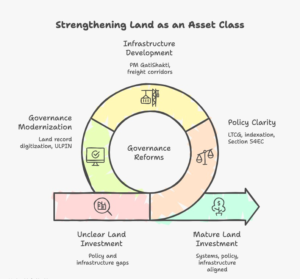
The 7 Structural Advantages Supporting Land Investment in India 2026
1. Capital Gains Clarity: The Shift Toward a More Predictable LTCG Framework
For long-term investors, the entry price is only half the story. Exit taxation determines real wealth outcomes.
Recent capital gains amendments reflect a shift toward a more uniform 12.5% long-term capital gains (LTCG) rate for certain long-term assets transferred after 23 July 2024.
Why does this matter for Land Investment in India 2026?
Because clarity reduces hesitation.
When tax treatment becomes easier to understand, investors can:
- Plan holding periods
- Structure exists rationally
- Avoid reactionary sales
- Model outcomes with greater confidence
For sophisticated investors considering land investment in India 2026, the key shift is not whether tax is “low” or “high”—it is that taxation is becoming more transparent and standardized.
Predictability encourages patience. And patience is the foundation of land wealth.
2. Indexation Adjustments: Exit Strategy Now Requires Greater Precision
The capital gains landscape has evolved further with changes around indexation benefits in specific contexts. Amendments under the Finance Act 2024 altered the tax treatment structure for certain assets, requiring investors to assess scenarios carefully.
For seasoned investors evaluating land investment in India 2026, this means:
- Documentation is no longer secondary.
- Holding period analysis becomes critical.
- Inflation-adjusted modeling must be reviewed carefully.
- Exit planning begins at acquisition—not at sale.
This evolution does not reduce the attractiveness of land. It elevates the importance of structured planning.
And structured planning is precisely what long-horizon investors value.
3. Section 54EC Bonds: Policy Continues to Encourage Reinvestment
India’s tax structure still provides reinvestment-linked exemptions in specific cases under Section 54EC.
Under prescribed conditions, capital gains arising from the transfer of land/building may be invested into specified bonds within a defined timeline, subject to caps and lock-in provisions.
For those studying land investment in India 2026, this reinforces a consistent policy theme:
India encourages compliant, long-term capital recycling.
It signals that land is not viewed merely as speculative capital—it is considered part of broader economic circulation.
For multi-generational investors and NRIs evaluating land investment in India 2026, structured reinvestment pathways enhance strategic flexibility.
4. PM GatiShakti: Integrated Infrastructure Planning Changes Land Utility
Perhaps the most consequential development supporting land investment in India 2026 is the continued execution of PM GatiShakti.
GatiShakti aims to integrate infrastructure planning across ministries, improving multimodal connectivity and logistics efficiency.
Why this matters:
Land appreciates when the utility improves.
Utility improves when:
- Roads connect faster.
- Rail corridors reduce freight time.
- Industrial nodes expand.
- Supply chains stabilize.
For mature investors assessing land investment in India 2026, the focus shifts from “where is buzz?” to “where is connectivity improving?”
Corridor-led development historically generates:
- Industrial demand
- Workforce housing demand
- Ancillary services
- Long-term capital allocation
Land adjacent to meaningful infrastructure is fundamentally different from land dependent solely on sentiment.
5. Dedicated Freight Corridors (DFC): Logistics Efficiency as a Wealth Catalyst
The Dedicated Freight Corridor initiative represents one of the most tangible infrastructure transformations underway.
DFCs allow:
- Double-stack container movement
- Higher axle loads
- Faster freight throughput
- Improved port connectivity
For land investment in India 2026, logistics reform changes economic gravity.
Industrial activity clusters around efficiency.
Manufacturing follows freight corridors.
Employment follows manufacturing.
Residential and service ecosystems follow employment.
This layered growth is not speculative—it is structural.
However, prudent investors must recognize:
- Impact varies by micro-location.
- Connectivity nodes matter more than general proximity.
- Execution timelines can evolve.
Disciplined investors treat DFC corridors as research maps—not marketing headlines.
6. Land Records Digitisation (DILRMP): Transparency Reduces Structural Risk
One of the quietest yet most powerful reforms influencing land investment in India 2026 is the digitisation of land records under DILRMP.
Land disputes historically stemmed from:
- Incomplete records
- Manual mutation gaps
- Inconsistent mapping
- Fragmented data
Digitisation improves:
- Verification processes
- Ownership traceability
- Public access to records
- Institutional confidence
For HNIs and NRIs considering land investment in India 2026, transparency reduces friction.
Land becomes less about “trust” and more about documentation.
This does not eliminate risk—but it systematically lowers structural opacity.
7. ULPIN: Toward Unique Parcel Identity in India
Unique Land Parcel Identification Numbers (ULPIN) aim to assign distinct IDs to land parcels, improving traceability.
The implications for land investment in India 2026 are profound:
- Clearer mapping.
- Reduced duplication disputes.
- Easier digital verification.
- Improved institutional comfort.
In mature markets globally, parcel traceability significantly reduces transaction risk. India’s direction suggests a similar long-term ambition.
For senior investors evaluating land investment in India 2026, governance improvement is a key macro signal.
Due Diligence Framework for Land Investment India 2026
Policy tailwinds are helpful. Discipline is essential.
Before committing capital toward land investment in India 2026, consider the following checklist:
Title & Ownership Chain
Verify the historical ownership trail thoroughly.
Encumbrance & Litigation Review
Check for:
- Liens
- Pending disputes
- Mortgage entries
Mutation Status
Ensure ownership updates reflect the current reality.
Land Use & Zoning Compliance
Understand permissible usage under local regulations.
Access & Utility Feasibility
Road access, electricity feasibility, water sourcing—practical considerations determine real value.
Corridor Logic
If infrastructure is your thesis, validate the actual project execution status.
Exit Modeling
Simulate post-tax outcomes under current LTCG structures.
Investors who approach land investment in India 2026 with institutional discipline typically outperform those driven by excitement.
The Psychological Shift: Why Mature Investors Are Revisiting Land
For individuals between 35 and 75—HNIs, NRIs, policymakers, legacy wealth holders—the appeal of land investment India 2026 lies in:
- Tangibility
- Limited supply
- Intergenerational transfer potential
- Hedge characteristics
- Sovereign alignment through infrastructure growth
Land is not volatile like equities.
It does not require daily tracking.
It demands patience, verification, and capital discipline.
And in 2026, the structural environment supports that discipline more than it did a decade ago.
A Mid-Article Reflection
Many sophisticated investors today are not seeking rapid flips. They are seeking clarity, asset-backed allocation, and documented security. Firms like Nine Divine have observed that the modern land investor is far more research-driven than before—evaluating governance shifts, taxation changes, and infrastructure maps before making decisions. This reflects a broader maturity in how land investment India 2026 is being approached across segments.
Common Misconceptions About Land Investment India 2026
“Infrastructure guarantees appreciation.”
Infrastructure creates opportunity—not certainty.
“Land is always safe.”
Poor documentation can erase perceived safety.
“Paperwork is secondary.”
In land, paperwork is the asset.
“Tax can be figured out later.”
Exit strategy defines real returns.
Experienced investors in land investment India 2026 understand that discipline outweighs optimism.
The Long View: What Makes 2026 Different?
The difference is not price acceleration.
It is a structural improvement.
- Simplified capital gains architecture.
- Integrated infrastructure planning.
- Freight corridor execution.
- Digitised land records.
- Parcel identification initiatives.
When systems strengthen, risk compresses.
When risk compresses, institutional capital gains confidence.
When confidence grows, long-horizon allocation increases.
That is the deeper thesis behind Land Investment in India 2026.
FAQ
1. Is land investment in India 2026 more tax-efficient than in previous years?
Land Investment in India 2026 operates within a revised long-term capital gains (LTCG) structure that provides more uniformity and clarity compared to prior frameworks. For certain long-term assets transferred after July 23, 2024, a 12.5% LTCG rate applies under updated tax provisions.
This matters not because it automatically reduces tax, but because it improves predictability. Predictability allows investors to structure holding periods and exit timing more rationally.
For serious participants in land investment India 2026, clarity in taxation is often more valuable than marginal rate differences.
2. How do indexation changes affect land investment in India 2026?
Indexation historically allowed investors to adjust purchase costs for inflation when calculating capital gains. Recent changes under the Finance Act 2024 have altered indexation applicability in certain cases, requiring careful evaluation of exit strategies.
This means land investment in India 2026 demands more structured financial modeling at the time of acquisition—not just at exit.
The takeaway: tax planning is now a forward-looking discipline.
3. Can capital gains from land investment in India 2026 be reinvested to reduce tax liability?
Yes, under certain conditions, Section 54EC allows reinvestment of long-term capital gains from land or building into specified bonds within defined limits and timelines.
This supports structured reinvestment behavior and aligns with long-term capital discipline.
For investors evaluating land investment in India 2026, understanding reinvestment pathways is part of holistic planning.
4. How does PM GatiShakti influence land investment in India 2026?
PM GatiShakti aims to integrate infrastructure planning across sectors to improve multimodal connectivity and logistics efficiency.
For the land investment in India 2026, infrastructure alignment improves land utility. When logistics corridors, highways, ports, and rail systems integrate, economic nodes expand—and land around productive ecosystems often becomes more viable over time.
Utility—not speculation—drives value.
5. What role do Dedicated Freight Corridors (DFC) play in land investment in India 2026?
Dedicated Freight Corridors improve freight speed, load capacity, and port connectivity. Government communications highlight improvements in efficiency and logistics capability.
For land investment India 2026, freight corridors can stimulate industrial clustering and employment zones—indirectly influencing land demand near functional nodes.
However, micro-location analysis remains critical.
6. Is digitisation reducing legal risks in land investment in India 2026?
India’s Digital India Land Records Modernization Programme (DILRMP) seeks to modernize land records, improve transparency, and integrate data systems.
Digitisation does not eliminate disputes overnight—but it reduces opacity. For investors in land investment India 2026, improved documentation systems enhance verification and reduce reliance on informal assurances.
Documentation discipline remains essential.
7. What is ULPIN and why does it matter for Land Investment India 2026?
ULPIN (Unique Land Parcel Identification Number) aims to assign a unique digital identity to each parcel of land, improving traceability and governance.
For land investment India 2026, parcel-level identification reduces ambiguity, supports mapping accuracy, and increases institutional confidence over time.
Traceability strengthens long-term asset credibility.
8. Is Land Investment in India 2026 suitable for NRIs?
Many NRIs view land as a long-term, intergenerational asset aligned with India’s infrastructure growth trajectory.
However, NRI participation requires:
- Compliance with FEMA regulations
- Verification of land classification
- Clear title documentation
- Tax consultation in both jurisdictions
While Land Investment in India 2026 presents structural improvements, cross-border investors must conduct enhanced due diligence and consult professionals.
9. How should HNIs approach land investment in India 2026 differently from retail buyers?
HNIs and family offices often approach land investment in India 2026 with:
- Multi-year capital allocation strategies
- Structured tax modeling
- Corridor-based location mapping
- Legal audit layers
- Portfolio diversification logic
Rather than chasing appreciation narratives, sophisticated investors evaluate governance signals, infrastructure execution, and documentation strength.
Land behaves best when approached as a disciplined allocation—not a tactical trade.
10. Is land investment in India 2026 speculative or strategic?
Speculation depends on intent. Strategy depends on structure.
If investors:
- Validate title
- Understand tax treatment
- Analyze infrastructure proximity
- Evaluate exit scenarios
- Verify zoning and compliance
Then land investment in India 2026 becomes strategic.
India’s ongoing reforms—tax simplification, freight corridors, land digitisation, integrated infrastructure planning—support structured, long-horizon thinking.
But land remains an asset that rewards patience and punishes complacency.
The system is strengthening. The discipline must match it.
A Mature Asset in a Maturing System
Land has always been a mature asset.
What is changing in 2026 is not the nature of land—it is the nature of the system around it.
For decades, land in India carried two parallel realities. On one hand, it represented permanence, legacy, and tangible security. On the other hand, it carried administrative opacity, documentation complexity, and fragmented governance. Serious investors navigated these contradictions through experience, networks, and patience.
In the context of Land Investment in India 2026, the shift is subtle but meaningful: the system itself is maturing.
Capital gains frameworks are becoming clearer. Infrastructure planning is increasingly integrated rather than isolated. Freight corridors are not conceptual—they are operational. Land records are being digitised. Parcel-level identification is being introduced. These may appear as bureaucratic reforms, but collectively they reshape the risk architecture of land.
And when risk architecture changes, asset perception changes.
For long-horizon capital—HNIs, NRIs, intergenerational wealth custodians, policymakers—land investment in India 2026 is less about rapid upside and more about structural alignment. It is about asking:
- Is connectivity improving in measurable ways?
- Is documentation verifiable?
- Is taxation predictable?
- Is governance strengthening?
- Is utility increasing over time?
Land does not demand constant monitoring. It demands conviction built on verification.
In a world of volatile financial markets and compressed investment cycles, land remains one of the few assets that still rewards patience over speed. But patience alone is no longer enough. In land investment in India 2026, patience must be paired with diligence.
This is not an era of blind accumulation. It is an era of informed allocation.
Mature investors understand that true wealth preservation does not depend on headlines. It depends on fundamentals—legal clarity, infrastructure relevance, and systemic transparency. As these elements strengthen, land transitions from being a relationship-driven asset to a documentation-driven asset.
That transition is significant.
It signals that the environment surrounding land investment in India 2026 is increasingly compatible with institutional thinking. Not because risk has disappeared—but because risk is becoming more measurable.
And measurable risk can be managed.
India’s infrastructure ambitions, tax simplifications, and digitisation initiatives are not overnight transformations. They are directional signals. They indicate that land, as an asset class, is operating within a more structured framework than before.
For investors evaluating capital allocation decisions in 2026 and beyond, the conversation is no longer “Is land safe?” It is “Is the system around land becoming stronger?”
Increasingly, the answer appears to be yes.
That does not remove the need for careful due diligence. It does not replace legal review. It does not guarantee appreciation. What it does provide is a more stable foundation for long-term ownership.
And stability is the quiet currency of serious wealth.
As discussions around land investment in India 2026 become more research-led and less rumor-driven, platforms such as Nine Divine emphasize structured evaluation, documentation discipline, and long-horizon thinking rather than impulse decisions. In a maturing system, informed participation becomes the true differentiator.
Land has always been mature.
In 2026, the ecosystem around it is beginning to reflect that maturity.
And when a mature asset meets a maturing system, the result is not excitement.
It is confidence.










No Comments