




 In 2026, clean air, space, and coastal resilience define true luxury living in Maha Goa.
Luxury Villa Plots in Maha Goa vs Delhi NCR: Why 2026 Redefined the Cost of Polluted Living
2026 is no longer about discovering India’s air pollution problem — it is about living with its consequences.
If 2025 was the year when denial ended, 2026 is the year when decisions began.
Table of Contents
- Luxury Villa Plots in Maha Goa vs Delhi NCR: Why 2026 Redefined the Cost of Polluted Living
- By 2026, Pollution Was No Longer a Shock — It Was Officially Normalised
- Why Delhi NCR’s Pollution Persists Into 2026: A Structural Reality
- The Long-Term Cost Felt Most in 2026: Health, Lifestyle & Productivity
- Why Coastal Living Matters More in 2026 (Without Overstatement)
- Maha Goa’s Rise by 2026: A Distinct Coastal Investment Belt
- Why Villa Plots Matter More Than Apartments in 2026
- In 2026, Investors Redefined What “Returns” Mean
- Quality-of-Life Yield
- Why Maha Goa Fits Long-Hold Capital Strategy
- Buyer Checklist for 2026 Investors
- 2026 and Beyond: Clean Air Is the New Asset Class
- FAQs
- 1. Why are luxury villa plots in Maha Goa important in 2026?
- 2. Why does Delhi NCR face recurring air pollution every year?
- 3. Is air pollution a serious long-term health concern?
- 4. Why are villa plots preferred over apartments after 2026?
- 5. Are luxury villa plots in Maha Goa suitable for full-time living?
- 6. How does coastal living improve lifestyle quality?
- 7. How is Maha Goa different from core Goa real estate?
- 8. Why are luxury villa plots in Maha Goa considered defensive investments?
- 9. What should buyers check before investing in Maha Goa?
- 10. Will demand for luxury villa plots in Maha Goa grow beyond 2026?
- The Nine Divine Group Perspective
- Final Thought
For over a decade, Delhi NCR residents were reassured that pollution was seasonal, manageable, or perpetually “on the verge of resolution.” Every winter arrived with fresh promises, revised action plans, and renewed optimism. Yet as 2026 unfolded, the narrative quietly but decisively shifted.
Air pollution was no longer viewed as a temporary disruption or an unfortunate phase.
It had become a permanent planning variable — something households, employers, and investors had to factor into everyday decisions.
Families stopped asking, “Will this winter be bad?”
They started asking, “Can we live like this every year?”
Professionals began measuring pollution in lost energy, declining focus, and chronic mental fatigue. Parents measured it in children growing up indoors, missing out on outdoor play, sunlight, and unrestricted movement. And investors — especially those with long-term horizons — began measuring pollution in risk exposure, asset longevity, and future desirability.
What changed in 2026 was not just awareness, but acceptance. The acceptance that air quality would continue to shape how cities function, how lifestyles evolve, and how capital must be positioned to protect both health and value.
It is within this evolved reality that luxury villa plots in Maha Goa have gained prominence — not as a passing lifestyle preference, but as a strategic counter-response to polluted density, compromised health, shrinking personal space, and declining urban liveability.
This blog is not about abandoning cities or rejecting urban growth.
It is about understanding what 2026 confirms through data, policy repetition, and lived experience — and why that confirmation is fundamentally reshaping where serious buyers, families, and investors choose to deploy capital for the long term.
By 2026, Pollution Was No Longer a Shock — It Was Officially Normalised
One of the most dangerous shifts between 2025 and 2026 was not a sudden worsening of air quality — it was normalisation.
India’s Central Pollution Control Board (CPCB) continued to record prolonged periods of “Very Poor” and “Severe” AQI across large parts of Delhi NCR during winter months. What truly changed in 2026 was not the data itself, but how society responded to it.
Emergency conditions no longer triggered alarm.
They triggered acceptance.
Emergency responses became expected
Restrictions became routine
Outdoor limitations became lifestyle adjustments
Residents began planning daily schedules, school routines, fitness activities, and even travel around pollution alerts. What was once considered an exception became baked into urban life.
The Commission for Air Quality Management (CAQM) continued invoking the Graded Response Action Plan (GRAP) — including construction bans, vehicular restrictions, school advisories, and public warnings to limit outdoor exposure. These measures are designed as short-term safeguards, not long-term solutions.
When emergency frameworks start functioning like seasonal calendars, it signals that pollution is no longer an anomaly.
It is a structural condition of the region.
From an investor’s perspective, this distinction is critical.
Markets can absorb short-term disruptions.
They struggle with permanent constraints.
As air quality alerts became predictable rather than surprising, families and long-horizon investors began reassessing a fundamental question: Does long-term living in high-density, high-pollution environments still make sense?
This reassessment accelerated interest in luxury villa plots in Maha Goa — not as reactionary escapes, but as calculated relocations and capital reallocations toward regions offering environmental resilience, better recovery cycles, and sustainable liveability.
In 2026, the decision was no longer driven by fear.
It was driven by clarity.
Why Delhi NCR’s Pollution Persists Into 2026: A Structural Reality
By 2026, it became increasingly clear that air pollution in Delhi NCR is not only a governance challenge — it is a geographical constraint.
Even the most aggressive policy interventions struggle to override the region’s natural limitations. Government-backed research from the Ministry of Earth Sciences (MoES) and the IITM-led Air Quality Early Warning System for Delhi consistently explains why winter smog repeats year after year.
The core factors remain unchanged:
Landlocked basin geography, which restricts natural air movement
Temperature inversion during colder months, where warm air traps cooler, polluted air near the surface
Low wind speeds, preventing effective dispersion of emissions
As a result, even when emissions are reduced temporarily through restrictions or bans, pollutants continue to accumulate rather than disperse.
This explains why pollution episodes in Delhi NCR are not random or isolated — they are predictable and recurring.
From an investment perspective, this distinction is crucial.
Some regions experience environmental stress and recover naturally once pressure eases.
Other regions store stress, allowing it to build season after season.
Delhi NCR increasingly falls into the second category.
When investors and end-users evaluate luxury villa plots in Maha Goa, they are responding to this structural difference. Coastal geographies benefit from natural circulation patterns that allow air quality to recover, rather than remain trapped.
This does not imply immunity from pollution — it implies resilience.
In 2026, buyers are no longer comparing cities on short-term livability scores. They are comparing them on long-term environmental behaviour.
And that is why regions with built-in recovery mechanisms, like Maha Goa, are being prioritised over environments that require perpetual emergency intervention just to remain habitable.
The Long-Term Cost Felt Most in 2026: Health, Lifestyle & Productivity
The real cost of pollution is not sudden illness or isolated medical emergencies — it is slow, cumulative lifestyle erosion.
The World Health Organization (WHO) has been unequivocal:
There is no safe level of long-term PM2.5 exposure.
By 2026, this message was no longer theoretical. It had been deeply internalised by urban households, employers, and decision-makers.
In Delhi NCR, pollution quietly reshaped daily life:
Balconies remained sealed for most of the year
Morning walks, outdoor workouts, and casual outdoor time disappeared
Air purifiers evolved from optional appliances into permanent household infrastructure
Children’s outdoor playtime reduced drastically, altering early lifestyle habits
These adaptations come at a cost that goes far beyond electricity bills and equipment purchases.
Financially, families absorbed recurring expenses on air filtration, healthcare consultations, and indoor climate control. Emotionally, they faced reduced mobility, limited outdoor freedom, and constant background stress. Professionally, many experienced fatigue, lower concentration, and productivity decline — especially in roles demanding sustained mental performance.
By 2026, pollution had begun influencing how people work, rest, and raise families, not just where they live.
In contrast, luxury villa plots in Maha Goa offer an environment where outdoor living does not require constant mitigation strategies. Open air, usable gardens, natural ventilation, and accessible green space are default conditions, not privileges.
Here, outdoor movement is part of daily life, not a calculated risk. Homes are designed to breathe naturally, lifestyles extend beyond enclosed interiors, and wellness is supported by the environment rather than defended against it.
In the post-2026 context, this difference is no longer a lifestyle preference.
It is a quality-of-life advantage with long-term health and productivity implications.
Why Coastal Living Matters More in 2026 (Without Overstatement)
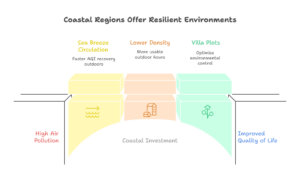
Coastal regions are not pollution-free — but they are structurally more resilient than landlocked urban basins.
Environmental and atmospheric studies consistently highlight the role of sea–land breeze circulation, a natural process where wind patterns shift between land and sea across the day. This continuous movement helps disperse airborne pollutants, reducing the chances of long-term accumulation near ground level.
In practical terms, this leads to:
Faster AQI recovery after pollution events
More usable outdoor hours across the year
Better natural ventilation within residential environments
Unlike stagnant inland regions, coastal areas rarely experience prolonged periods where polluted air remains trapped without relief.
Maha Goa benefits from this coastal dynamic while also maintaining lower industrial density and comparatively lower population concentration than major metropolitan regions. This combination is critical. Air circulation alone is not enough — reduced emission intensity strengthens the overall recovery cycle.
For residents and investors, this translates into predictability and balance. Outdoor spaces remain usable. Homes can rely more on natural airflow. Lifestyle planning does not revolve around daily air quality alerts.
For buyers evaluating luxury villa plots in Maha Goa, the value proposition is not the promise of “perfect air.” It is the assurance of air that moves, recovers, and supports outdoor living.
In the context of 2026, where pollution has become a permanent urban variable, this environmental resilience is no longer a lifestyle upgrade — it is a strategic advantage that directly influences long-term liveability and asset desirability.
Maha Goa’s Rise by 2026: A Distinct Coastal Investment Belt
By 2026, Maha Goa has emerged as its own category — neither traditional Goa, nor typical mainland Maharashtra.
As core Goa markets became increasingly saturated, tightly regulated, and priced at a significant premium, discerning buyers began looking slightly beyond the conventional boundaries. What they discovered was Maharashtra’s coastal stretch that retains Goa’s ecological character, cultural ease, and coastal lifestyle — but with more breathing room and long-term flexibility.
This shift was not driven by affordability alone.
It was driven by future-readiness.
Maha Goa offers a combination that is becoming rare across India’s coastline:
Proximity to Goa’s lifestyle ecosystem without its congestion
Cleaner air cycles supported by coastal circulation
Larger land parcels, enabling private villa development
Lower density planning, reducing long-term crowding
Greater regulatory and design flexibility for end-users
Unlike saturated tourist hubs, Maha Goa is increasingly shaped by end-user demand rather than speculative churn. Buyers are planning for year-round living, extended family use, and long-hold ownership — not short-term flips.
This evolution has positioned luxury villa plots in Maha Goa as preferred assets for NCR professionals, business owners, entrepreneurs, and families seeking full-time or semi-permanent coastal living with better environmental resilience.
By 2026, Maha Goa is no longer viewed as an “alternative” to Goa.
It is being recognised as a next-stage coastal investment belt — one that aligns land ownership, lifestyle quality, and long-term capital protection in a single geography.
Why Villa Plots Matter More Than Apartments in 2026
Apartments optimise density.
Villa plots optimise environmental control.
This distinction has become critical post-2026.
As cities grow vertically, apartments increasingly compromise on cross-ventilation, green buffers, and personal outdoor space. Residents remain dependent on mechanical air circulation, shared infrastructure, and common spaces — all of which reduce individual control over living conditions.
Post-2026 buyers are therefore prioritising:
Cross-ventilation for natural airflow
Private green buffers that separate living spaces from neighbours
Personal outdoor space for daily movement and wellness
In contrast, luxury villa plots in Maha Goa allow homes to be designed around the environment, not against it.
They enable:
Courtyards and gardens that enhance airflow and light
Open terraces for year-round outdoor use
Low neighbour density, reducing noise and pollution overlap
Wellness-focused architecture integrating sunlight, air, and greenery
In 2026, control over airflow, space, and surroundings is no longer an aesthetic preference.
It has become a core definition of modern luxury and long-term liveability.
In 2026, Investors Redefined What “Returns” Mean
For decades, real estate decisions revolved around two metrics:
Capital appreciation
Rental yield
By 2026, a third metric began to dominate decision-making:
Quality-of-Life Yield
Investors now ask deeper questions:
Will this location support long-term health and wellbeing?
Will demand for cleaner, low-density living increase over time?
Will this asset remain desirable 10–15 years from now?
These questions reflect a shift from speculative thinking to sustainability-driven investing.
From this perspective, luxury villa plots in Maha Goa function as defensive, future-aligned assets. They protect lifestyle quality while also safeguarding long-term value, making them fundamentally different from short-term speculative real estate plays.
Why Maha Goa Fits Long-Hold Capital Strategy
From a strategic investment lens, Maha Goa aligns with multiple long-term fundamentals:
Coastal land scarcity, making supply inherently limited
Lifestyle-led demand, driven by end-users rather than traders
Build-to-suit flexibility, allowing custom villa development
Lower volatility, due to stable demand and limited overbuilding
Intergenerational usability, supporting legacy ownership
Apartments depreciate structurally as buildings age and infrastructure strains.
Land, however, retains intrinsic value — regardless of construction cycles.
This is why luxury villa plots in Maha Goa are increasingly viewed as legacy assets, designed to outlast market fluctuations and evolving urban challenges.
Buyer Checklist for 2026 Investors
In a post-2026 environment, diligence is not optional — it is essential.
Before investing, serious buyers should evaluate:
Clear land titles and statutory approvals
Gated community planning with long-term maintenance vision
Water sustainability and drainage infrastructure
Flood-risk assessment and natural topography
Road and highway connectivity for year-round access
Plot orientation to maximise ventilation and sunlight
Developer credibility and execution track record
Exit liquidity and long-term infrastructure visibility
Diligence converts opportunity into longevity — ensuring that luxury villa plots in Maha Goa remain secure, compliant, and future-ready assets.
2026 and Beyond: Clean Air Is the New Asset Class
If 2025 ended denial, 2026 confirmed direction.
Clean air is not guaranteed.
Space is not replaceable.
Land is not infinite.
These realities are no longer philosophical observations — they are economic variables shaping how people live and how capital flows.
As cities continue to densify and pollution cycles repeat with increasing predictability, regions that offer environmental resilience will command lasting premiums. Not because they are fashionable, but because they are functionally superior for long-term living.
In this emerging hierarchy, luxury villa plots in Maha Goa occupy a unique position.
They sit at the intersection of:
Clean-air recovery, supported by coastal circulation
Coastal resilience, offering natural environmental balance
Land ownership, a finite and appreciating resource
Lifestyle sovereignty, where individuals control space, design, and daily living conditions
What sets these assets apart in the post-2026 context is not just appreciation potential — it is durability. Durability of health. Durability of lifestyle. Durability of demand.
Luxury is no longer defined by curated interiors, imported finishes, or vertical square footage.
It is defined by how freely life unfolds outside those walls — in open air, usable outdoor spaces, and environments that support long-term wellbeing.
As the next decade unfolds, the most valuable real estate will not merely be well-located.
It will be well-adapted.
And that is why, in a world recalibrating around air, space, and resilience, clean living has quietly become the most valuable asset class of all.
FAQs
1. Why are luxury villa plots in Maha Goa important in 2026?
In 2026, clean air and low-density living have become long-term priorities. Luxury villa plots in Maha Goa offer environmental resilience, land ownership, and better lifestyle sustainability compared to polluted metros.
2. Why does Delhi NCR face recurring air pollution every year?
Delhi NCR’s landlocked geography, winter temperature inversion, and low wind speeds trap pollutants, making pollution a structural issue rather than a seasonal one.
3. Is air pollution a serious long-term health concern?
Yes. The WHO confirms there is no safe level of long-term PM2.5 exposure, making air quality a critical factor in housing and investment decisions.
4. Why are villa plots preferred over apartments after 2026?
Villa plots allow cross-ventilation, private green spaces, and environmental control, unlike apartments that prioritise density and shared infrastructure.
5. Are luxury villa plots in Maha Goa suitable for full-time living?
Yes. Improved connectivity, gated developments, and year-round infrastructure make Maha Goa ideal for permanent coastal living.
6. How does coastal living improve lifestyle quality?
Natural sea–land breeze circulation improves air dispersion, increases outdoor usability, and supports healthier daily routines.
7. How is Maha Goa different from core Goa real estate?
Maha Goa offers similar coastal benefits with larger plots, lower density, and more flexibility than saturated and expensive core Goa markets.
8. Why are luxury villa plots in Maha Goa considered defensive investments?
They are land-led assets in a scarce coastal region, offering lower volatility, lifestyle demand, and long-term value protection.
9. What should buyers check before investing in Maha Goa?
Verify land titles, approvals, water sustainability, flood risk, connectivity, and developer credibility.
10. Will demand for luxury villa plots in Maha Goa grow beyond 2026?
Yes. Environmental resilience, clean-air living, and land scarcity are long-term drivers, not short-term trends.
The Nine Divine Group Perspective
At Nine Divine Group, we view luxury land as future-ready capital.
Our focus is on:
Environmental intelligence
Long-term liveability
Coastal resilience
Responsible land curation
The coming decade will reward those who invested not just in property — but in places that protect life, health, and freedom.
This is not about leaving cities.
It is about choosing environments that evolve better than they do.
Final Thought
By 2026, real estate decisions are no longer driven by price alone — they are driven by preservation.
Preservation of health.
Preservation of space.
Preservation of lifestyle.
As pollution becomes structural in dense metros, regions that offer natural recovery, low density, and land ownership gain lasting relevance. Luxury villa plots in Maha Goa are not about escaping the city — they are about choosing a future that sustains itself.
In the years ahead, clean air will behave like a premium asset, space like a privilege, and land like legacy.
Those who recognise this shift early are not just investing in property — they are investing in how life is lived.









No Comments