




 Infrastructure continuity is shaping the best place to invest in land in India 2026.
Capex strength. Policy stability. Corridor expansion.
Movement becomes market.
Infrastructure continuity is shaping the best place to invest in land in India 2026.
Capex strength. Policy stability. Corridor expansion.
Movement becomes market.Best Place to Invest in Land in India 2026: How Budget Capex and Policy Stability Are Shaping the Next Premium Corridors
Land has always required a different temperament than built real estate. It does not generate monthly rent on day one. It does not offer brochure-led lifestyle positioning. It demands patience, clarity of vision, and an understanding of how cities evolve.
Table of Contents
- Best Place to Invest in Land in India 2026: How Budget Capex and Policy Stability Are Shaping the Next Premium Corridors
- Why 2026 Is a Corridor-Led Year for Land Investing
- Understanding How Budget Capex Translates Into Land Value
- RBI Stability and Its Indirect Impact on Land
- The Freight and Logistics Thesis: Movement Markets
- National Infrastructure Pipeline (NIP) and Project Visibility
- NCR and Peripheral Corridors: A Case of Connectivity Translation
- Airport Influence Zones: Opportunity with Phasing
- Due Diligence: Where Capital Preservation Is Won or Lost
- Common Mistakes in 2026 Land Investing
- Midpoint Perspective
- The Strategic Investor Framework for 2026
- FAQ
- 8. How important is documentation when selecting the best place to invest in land in India 2026?
- 9. What holding period is realistic when targeting the best place to invest in land in India 2026?
- Movement Becomes Market
In 2026, that evolution is being shaped by one dominant force: infrastructure continuity. Which is why, for serious investors, the conversation is increasingly centred around one question — what is the best place to invest in land in India 2026 if the goal is disciplined long-term capital appreciation rather than speculative upside?
This is not a year driven by hype. It is a year driven by corridors.
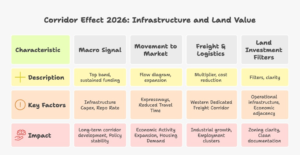
Union Budget 2026 has continued India’s infrastructure-led growth strategy, with public capital expenditure (capex) increased to ₹12.2 lakh crore for FY 2026–27, up from ₹11.2 lakh crore in the previous year. This sustained allocation reflects a structural commitment to roads, rail, logistics, and urban connectivity.
Simultaneously, the Reserve Bank of India’s Monetary Policy Committee held the policy repo rate at 5.25% in its February 2026 meeting, signalling stability in the credit environment.
For HNIs, NRIs, long-horizon investors, and policymakers observing macro cycles, these two signals together are significant. They indicate that infrastructure and stability remain core pillars of India’s 2026 growth framework.
Against this backdrop, identifying the best place to invest in land in India 2026 requires a corridor-based lens, not a city-based one. This blog takes a fact-led, research-backed approach to understanding where land markets are structurally supported, without promoting hype or criticizing any region, project, or legality.
Why 2026 Is a Corridor-Led Year for Land Investing
Land responds to movement.
When commute times shrink, when freight routes accelerate, when airports become operational, and when rail connectivity improves, land begins to transition from “potential” to “utility.” Utility creates demand. Demand creates liquidity. Liquidity creates valuation stability.
The best place to invest in land in India 2026 is therefore not necessarily the most talked-about location. It is typically the micro-market where movement infrastructure is either operational or near commissioning — and where economic activity can realistically expand.
Infrastructure-led growth is not new in India. What is notable in 2026 is continuity. Capex has not been cut. It has been expanded. This suggests project pipelines are being sustained rather than paused.
For land investors, continuity matters more than announcement size. Projects that continue to receive funding are more likely to reach operational stages. And operational infrastructure is what transforms land markets.
Thus, when evaluating the best place to invest in land in India 2026, the first question is simple:
Is the corridor real, funded, and progressing?
Understanding How Budget Capex Translates Into Land Value
Public capital expenditure does not automatically double land prices. But it does something more important — it reduces uncertainty.
1. Capex Creates Credible Timelines
When capex allocations rise from ₹11.2 lakh crore to ₹12.2 lakh crore, as announced in Budget 2026, it signals that infrastructure projects remain a national priority.
For land investors evaluating the best place to invest in land in India 2026, this means corridors under active development are less likely to stall midway.
2. Capex Expands Economic Geography
Infrastructure spending not only enhances metros. It expands connectivity into peripheral nodes and tier-2 clusters. These nodes often host early-stage land appreciation cycles because they are priced before full economic translation occurs.
The best place to invest in land in India 2026 often lies in these transitional zones — where connectivity improves access but pricing has not yet caught up to functionality.
3. Capex Strengthens Multi-Use Potential
Land near infrastructure corridors can eventually support multiple uses:
- Residential
- Warehousing
- Industrial
- Institutional
- Mixed-use services
This flexibility is critical for capital preservation. A single-use micro-market is riskier than a multi-use corridor.
RBI Stability and Its Indirect Impact on Land
While land purchases are often equity-driven among HNIs and NRIs, broader monetary stability still plays a role.
With the repo rate held at 5.25% (February 2026 MPC decision), borrowing conditions remain predictable.
Predictability matters because:
- Developers plan launches more confidently.
- End-user affordability remains steady.
- Housing markets remain active.
- Liquidity ecosystems remain functional.
Land investors do not operate in isolation. The best place to invest in land in India 2026 will ultimately be influenced by how the broader real estate ecosystem performs.
When the rate policy is stable, transaction activity tends to remain healthier than in volatile credit environments.
The Freight and Logistics Thesis: Movement Markets
One of the most structurally important infrastructure stories in India is the Dedicated Freight Corridor (DFC).
Financial Express has reported that the final stretch of the Western DFC, including the Vaitarna–JNPT section, is expected to be commissioned by March 2026.
Why does this matter for identifying the best place to invest in land in India 2026?
Freight corridors:
- Reduce logistics costs.
- Increase industrial competitiveness.
- Encourage warehousing clusters.
- Generate employment density.
- Stimulate peripheral housing demand.
Land located strategically near logistics nodes may benefit from diversified demand drivers over time. However, proximity alone is insufficient. Access roads, zoning clarity, and infrastructure readiness remain critical filters.
The best place to invest in land in India 2026 within a freight corridor is not simply “near the railway line.” It is near operational nodes where activity translates into human settlement and services.
National Infrastructure Pipeline (NIP) and Project Visibility
The National Infrastructure Pipeline provides a structured view of planned and ongoing infrastructure projects across sectors.
For serious investors evaluating the best place to invest in land in India 2026, referencing project visibility tools adds discipline. The NIP framework and related documentation explain how infrastructure projects are prioritized and financed.
The key takeaway is not to chase announcements. It is to track execution stages.
Corridors supported by documented pipeline inclusion, funding visibility, and construction progress are structurally stronger candidates when identifying the best place to invest in land in India 2026.
NCR and Peripheral Corridors: A Case of Connectivity Translation
National Capital Region corridors have historically demonstrated how connectivity can reprice land micro-markets.
Without critiquing any specific project or location, it is observable that infrastructure expansion in NCR — expressways, connector roads, metro extensions — has repeatedly translated into demand shifts over the past two decades.
For investors assessing the best place to invest in land in India 2026, NCR corridors present a layered landscape:
- Mature nodes with pricing stability.
- Transitional nodes with growth potential.
- Oversupplied zones requiring caution.
The key is differentiation.
The best place to invest in land in India 2026 within NCR is likely to be:
- Within reach of employment clusters.
- Supported by operational or near-operational connectivity.
- Backed by genuine end-user movement rather than speculative bulk buying.
Airport Influence Zones: Opportunity with Phasing
Airports transform regional dynamics, but they do so in phases.
Land markets near airports typically move through:
- Announcement phase (high speculation).
- Construction phase (volatile pricing).
- Commissioning phase (real demand emergence).
- Ecosystem phase (hotels, logistics, housing, commercial services).
When determining the best place to invest in land in India 2026, airport corridors should be evaluated based on where they are within this cycle.
If operational visibility is high and ancillary infrastructure is progressing, long-term viability strengthens. However, disciplined pricing remains essential.
The principle remains unchanged: the best place to invest in land in India 2026 is supported by functional infrastructure, not projected headlines.
Due Diligence: Where Capital Preservation Is Won or Lost
For HNIs, NRIs, policymakers, and long-horizon investors, due diligence is not a procedural checkbox. It is capital insurance.
When evaluating the best place to invest in land in India 2026, key checks include:
- Clear title chain verification.
- Encumbrance certificate review.
- Zoning and permissible land-use confirmation.
- Physical access and demarcation.
- Infrastructure alignment with long-term development plans.
- Supply pipeline analysis to avoid saturation.
Liquidity is documentation-dependent. Even the best place to invest in land in India 2026 will underperform if paperwork clarity is weak.
Common Mistakes in 2026 Land Investing
Even experienced investors can misstep.
- Buying purely on future infrastructure announcements.
- Ignoring local absorption patterns.
- Underestimating holding timelines.
- Overpaying during speculative spikes.
Avoiding these pitfalls ensures that your selection truly qualifies as the best place to invest in land in India 2026 for your portfolio structure.
Midpoint Perspective
At this stage, it becomes evident that identifying the best place to invest in land in India 2026 is not about chasing the loudest narrative. It is about matching corridor economics with patient capital.
This is also where research-oriented advisory perspectives — such as those taken by firms like Nine Divine, which emphasise evidence-based land evaluation and long-term value alignment — can help investors filter signal from noise. Not as a sales intervention, but as an analytical discipline.
Land is not about speed. It is about sequencing.
The Strategic Investor Framework for 2026
For investors aged 35–75 with capital preservation in mind, the best place to invest in land in India 2026 is defined by five characteristics:
- Infrastructure reality.
- Economic adjacency.
- Documentation strength.
- Exit optionality.
- Time alignment with personal liquidity goals.
If any of these elements are missing, risk rises.
FAQ
1. Why is 2026 considered a strategic year to identify the best place to invest in land in India 2026?
2026 is significant because infrastructure capital expenditure has been increased to ₹12.2 lakh crore in the Union Budget 2026–27, reinforcing the government’s infrastructure-led growth strategy. Sustained capex signals project continuity, which reduces execution risk in corridor-led micro-markets.
For investors evaluating the best place to invest in land in India 2026, this matters because operational infrastructure — not announcements — drives real appreciation cycles.
2. How does RBI’s repo rate stability influence the best place to invest in land in India 2026?
In February 2026, the Reserve Bank of India held the repo rate at 5.25%, signalling monetary stability. Even if land is purchased outright without leverage, rate stability influences broader real estate liquidity, developer confidence, and end-user housing demand.
When evaluating the best place to invest in land in India 2026, investors should consider macro stability because future exit liquidity often depends on housing and commercial absorption.
3. Why are infrastructure corridors more important than city names when choosing the best place to invest in land in India 2026?
Land appreciates when movement improves — through expressways, freight corridors, airports, and metro expansions. Corridors create economic adjacency, job density, and demand translation.
For instance, the Western Dedicated Freight Corridor (WDFC) is expected to see final commissioning progress by March 2026, reinforcing logistics-led economic expansion.
When identifying the best place to invest in land in India 2026, corridor functionality often matters more than city branding.
4. How can investors verify whether a location truly qualifies as the best place to invest in land in India 2026?
Serious investors should:
- Track infrastructure inclusion under the National Infrastructure Pipeline (NIP).
- Verify funding and execution stages.
- Assess zoning and documentation clarity.
The NIP provides structured insight into large-scale infrastructure projects and helps distinguish announcements from implementation.
5. Do freight corridors increase the probability of finding the best place to invest in land in India 2026?
Freight corridors reduce logistics costs and stimulate warehousing, industrial parks, and employment clusters. Over time, this can support residential and service-sector growth.
However, not every parcel near a freight route benefits equally. Access roads, zoning compatibility, and node proximity are critical.
Therefore, within freight themes, the best place to invest in land in India 2026 is typically near operational nodes rather than along undeveloped stretches.
6. How does infrastructure capex directly impact land valuation cycles in 2026?
Increased capex strengthens execution probability and reduces stalled-project risk. Infrastructure upgrades compress travel time, expand economic geography, and create demand depth.
Budget 2026’s continued capex expansion strengthens corridor-led land thesis, making execution-backed zones stronger candidates for the best place to invest in land in India 2026.
7. Are airport influence zones automatically the best place to invest in land in India 2026?
Not automatically. Airport markets move in phases — announcement, construction, commissioning, and ecosystem expansion.
The best place to invest in land in India 2026 within an airport corridor, depends on:
- Commissioning visibility
- Supporting road connectivity
- Commercial and hospitality ecosystem growth
Investors should evaluate phasing carefully rather than pricing land based purely on future projections.
8. How important is documentation when selecting the best place to invest in land in India 2026?
Documentation clarity directly impacts liquidity and resale value. Investors should verify:
- Clear title chain
- Encumbrance certificate
- Land-use permissions
- Physical demarcation
- Access road legality
Even if a corridor is promising, weak documentation can compromise capital preservation. Therefore, the best place to invest in land in India 2026 must combine infrastructure potential with legal clarity.
9. What holding period is realistic when targeting the best place to invest in land in India 2026?
Land typically requires a medium-to-long holding horizon (3–7 years or more), depending on corridor maturity. Infrastructure timelines influence appreciation cycles.
Investors aligning holding periods with project execution milestones are better positioned to capture structural gains.
The best place to invest in land in India 2026 is often aligned with patient capital rather than short-term speculation.
10. How should HNIs and NRIs structure their evaluation when selecting the best place to invest in land in India 2026?
A disciplined framework should include:
- Infrastructure verification (operational vs announced).
- Economic adjacency assessment (jobs, logistics, institutions).
- Documentation clarity.
- Supply-demand balance review.
- Exit optionality planning.
Public infrastructure databases and budget transparency tools help validate corridor strength.
Movement Becomes Market
Land has always rewarded patience. But in 2026, patience alone is not enough. Precision matters just as much. The difference between speculative holding and strategic allocation lies in understanding one structural truth: movement creates markets.
Across India, infrastructure continuity is no longer episodic — it is sustained. Union Budget 2026 increased capital expenditure to ₹12.2 lakh crore, reinforcing roads, railways, logistics corridors, and urban connectivity as long-term growth anchors.
When capital flows consistently into infrastructure, corridors mature. When corridors mature, human movement increases. When human movement increases, land transitions from a static asset into a functional one. That transition — from theoretical to usable — is what ultimately defines the best place to invest in land in India 2026.
It is important to emphasize that movement does not mean speculation. It means functionality. A freight corridor that reduces logistics costs changes industrial viability. A highway that cuts commute time expands the residential catchment radius. A metro extension that connects job hubs to new zones transforms daily patterns of life. These are structural shifts — not temporary cycles.
The Western Dedicated Freight Corridor’s expected commissioning by March 2026 is one such example of infrastructure moving toward operational status.
Similarly, monetary stability — with the RBI holding the repo rate at 5.25% in February 2026 — supports predictability in the broader credit environment.
For seasoned investors — whether HNIs, NRIs, policymakers, or multi-generational wealth custodians — the lesson is not to chase geography. It is to evaluate utility.
The best place to invest in land in India 2026 is rarely the loudest corridor. It is typically the corridor where infrastructure is funded, progressing, and approaching usability. It is the location where demand can realistically translate into habitation, logistics, commerce, or institutional presence. It is the zone where documentation is clean, access is practical, and holding power aligns with personal liquidity goals.
Land investing at this stage of India’s growth cycle is not about dramatic short-term multiples. It is about disciplined allocation aligned with structural momentum. Corridors that are real — not merely proposed — create the foundation for sustainable appreciation.
Movement becomes market when:
- Time-distance shrinks.
- Employment density rises.
- Services follow settlement.
- Liquidity improves.
That sequence is measurable. It is observable. And it is repeatable across growth economies.
For investors seeking the best place to invest in land in India 2026, the conclusion is clear: focus on functionality, not forecasts. Focus on corridors, not conversation. Focus on documentation, not drama.
In that quiet, structured approach lies the real advantage.
Land remains one of the most powerful instruments of long-term capital preservation and intergenerational planning when aligned with infrastructure continuity. The corridors of 2026 are not abstract ideas — they are visible on budget documents, policy releases, and project dashboards.
The opportunity is not about urgency. It is about alignment.
And when alignment meets patience, movement becomes market.










No Comments