




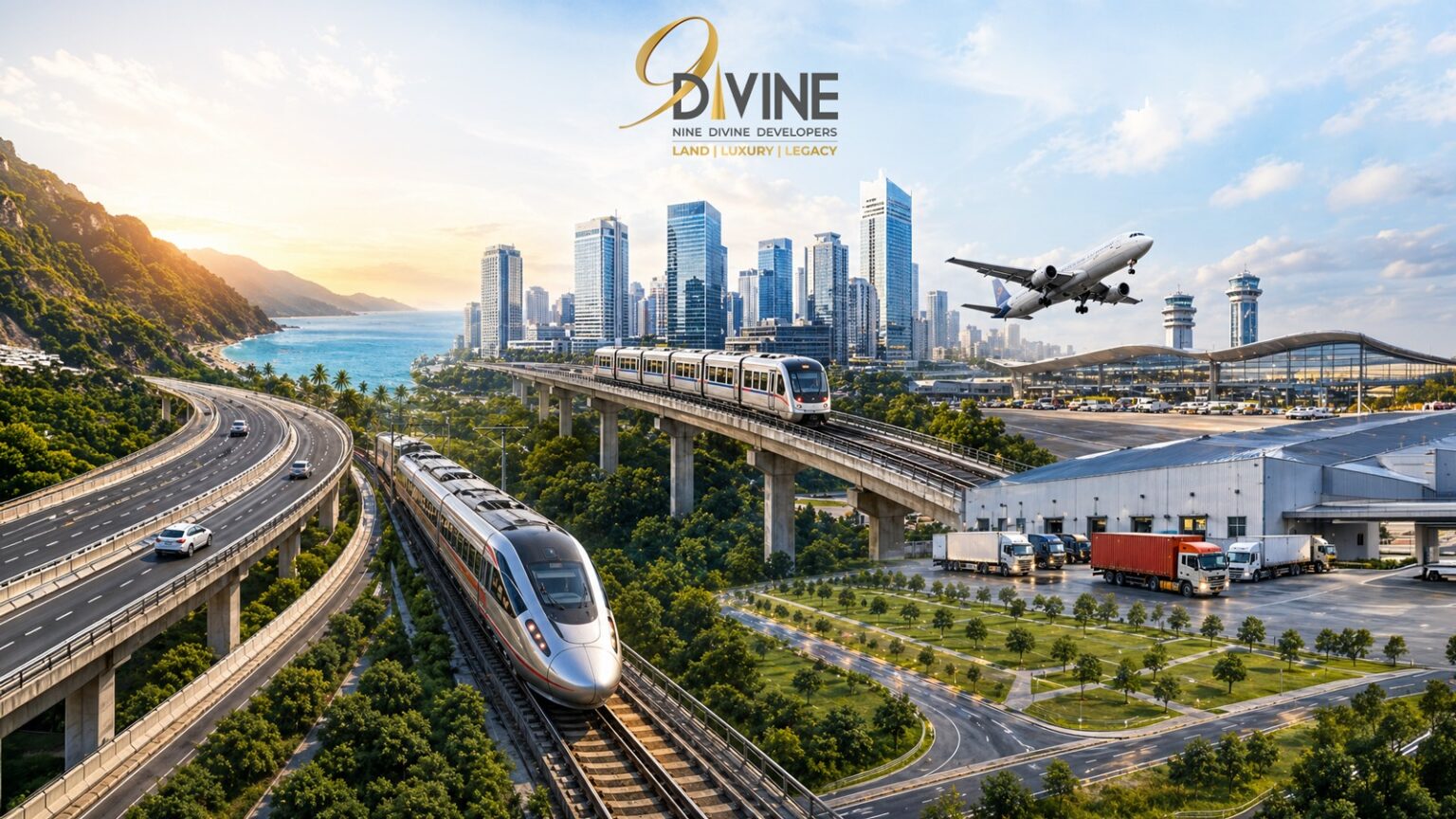
 From highways to high-speed rail and airports—India’s infrastructure boom is unlocking new real estate investment corridors.
Infrastructure Growth in India: 7 Real Estate Investment Corridors Defining the Next Decade
India’s Infrastructure Decade Has Begun
Table of Contents
- Infrastructure Growth in India: 7 Real Estate Investment Corridors Defining the Next Decade
- The Policy Backbone: PM GatiShakti and National Infrastructure Pipeline
- Highways and Expressways: The New Real Estate Value Creators
- Rapid Rail and Regional Mobility: Redefining Commutable Real Estate
- Metro Expansion and Urban Real Estate Densification
- Airports and Tourism-Led Infrastructure Growth
- Logistics, Industrial Corridors, and Warehousing Growth
- Infrastructure-Led Real Estate Growth: The Value Cycle
- Key Indian Regions to Watch
- What This Means for HNIs, NRIs, and Investors
- FAQs
- Infrastructure Growth in India Is Redefining the Investment Landscape
India is entering a decisive phase where infrastructure growth in India is no longer incremental—it is transformational. The country is not just building roads, railways, and airports; it is designing integrated economic corridors that are reshaping how people live, work, travel, and invest.
Over the last decade, the focus has shifted from isolated infrastructure projects to a multi-modal connectivity ecosystem. This includes highways, expressways, rapid rail systems, metro networks, airports, logistics parks, and industrial corridors working in sync. The result is a structural shift in how real estate markets behave.
For investors, particularly HNIs, NRIs, policymakers, and business leaders, infrastructure growth in India has become the single most important indicator of long-term real estate appreciation. The logic is simple: wherever connectivity improves, economic activity follows—and real estate values adjust accordingly.
Government-led initiatives like the PM GatiShakti National Master Plan have accelerated this transformation by integrating infrastructure planning across sectors.
This is not just development—it is the foundation of India’s next investment cycle.
The Policy Backbone: PM GatiShakti and National Infrastructure Pipeline
PM GatiShakti: Integrated Infrastructure Planning
At the core of infrastructure growth in India lies PM GatiShakti, a master plan designed to break silos between ministries and align infrastructure development across the country. Instead of fragmented projects, India is now building connected growth corridors.
The plan integrates:
- Roads and highways
- Railways
- Airports
- Ports
- Mass transit systems
- Logistics infrastructure
This integrated approach ensures that infrastructure investments deliver maximum economic impact, especially in emerging regions.
National Infrastructure Pipeline (NIP): Scale of Investment
India’s infrastructure push is backed by unprecedented capital allocation. The National Infrastructure Pipeline (NIP) outlines investments of over ₹111 lakh crore between 2020–2025, covering sectors like transportation, energy, and urban development.
This level of investment is critical because infrastructure growth in India is capital-intensive and long-term in nature. It creates a predictable environment for:
- Real estate developers
- Institutional investors
- Land investors
- Industrial and logistics players
Why This Matters for Real Estate
When infrastructure is backed by policy and capital:
- Risk perception reduces
- Investor confidence increases
- Demand shifts toward new corridors
- Land becomes a strategic asset
This is where infrastructure growth in India directly translates into real estate opportunity.
Highways and Expressways: The New Real Estate Value Creators
Roads as the Foundation of Real Estate Expansion
Historically, road connectivity has always influenced land value. Today, with high-speed expressways and multi-lane corridors, the impact is significantly amplified.
Infrastructure growth in India through highways has:
- Reduced travel time between cities
- Opened previously inaccessible regions
- Enabled weekend and second-home living
- Boosted logistics and warehousing demand
Bharatmala Pariyojana: Transforming Connectivity
The Bharatmala Pariyojana focuses on developing economic corridors, feeder routes, and border roads to improve logistics efficiency across the country.
This initiative is a key driver of infrastructure growth in India, especially for historically underdeveloped regions.
Key Expressway Corridors
Several corridors are redefining real estate markets:
- Delhi–Mumbai Expressway
A mega corridor linking key economic hubs across North and West India. - Dwarka Expressway (NCR)
Property prices nearly doubled within four years due to improved connectivity. - Mumbai–Goa Highway (NH-66)
A major catalyst for coastal tourism and second-home markets. - Samruddhi Mahamarg (Maharashtra)
Connecting Mumbai to Nagpur, unlocking new growth zones. - Bengaluru–Chennai Expressway
Driving industrial and logistics expansion in South India.
Investor Perspective
From an investment standpoint, infrastructure growth in India through expressways leads to:
- Early-stage land appreciation
- Growth of plotted developments
- Rise in weekend-home destinations
- Expansion of logistics and warehousing
- Increased tourism-driven demand
The key insight: expressways don’t just connect cities—they create new ones.
Rapid Rail and Regional Mobility: Redefining Commutable Real Estate
The Rise of RRTS
India’s Regional Rapid Transit System (RRTS) is redefining intercity travel. Unlike conventional rail, RRTS offers high-speed connectivity between urban and semi-urban regions.
This marks a new phase in infrastructure growth in India, where distance is no longer a barrier to real estate development.
Delhi–Meerut RRTS: A Case Study
The Delhi–Ghaziabad–Meerut corridor, spanning 82 km, is one of the most advanced RRTS projects.
This project is transforming:
- Ghaziabad
- Modinagar
- Meerut
These locations are now becoming viable for residential and commercial development due to reduced commute times.
Future Corridors
Upcoming RRTS corridors include:
- Delhi–Panipat–Karnal
- Delhi–Gurugram–SNB–Alwar
These will further strengthen infrastructure growth in India by expanding the radius of urban influence.
Investment Insight
Rapid rail systems allow investors to look beyond metro cities. Regions once considered distant are now becoming:
- Residential hubs
- Rental markets
- Commercial zones
Metro Expansion and Urban Real Estate Densification
Metro as an Urban Multiplier
Metro connectivity is one of the strongest drivers of urban real estate value. It enhances accessibility, reduces travel time, and increases demand across residential and commercial segments.
Infrastructure growth in India through metro expansion has transformed cities like:
- Delhi
- Mumbai
- Bengaluru
- Hyderabad
- Pune
Real Estate Impact
Metro connectivity leads to:
- Higher rental yields
- Increased commercial footfall
- Premium pricing near stations
- Improved absorption rates
For investors, metro-linked properties often offer stable and predictable returns.
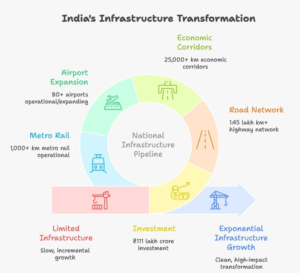
Airports and Tourism-Led Infrastructure Growth
Airports as Economic Catalysts
Airports play a crucial role in infrastructure growth in India, especially in driving tourism and second-home demand.
They enhance:
- National and international accessibility
- Business travel
- Hospitality growth
- Luxury real estate demand
Key Airport Corridors
- Jewar Airport (NCR)
- Mopa Airport (Goa)
- Navi Mumbai International Airport
- Ayodhya Airport
These developments are creating new real estate hotspots across India.
Tourism and Second-Home Markets
Airports enable:
- Weekend travel
- Luxury villa demand
- Airbnb and rental markets
- Coastal and hill destination growth
This makes infrastructure growth in India particularly relevant for lifestyle and second-home investments.
Logistics, Industrial Corridors, and Warehousing Growth
Beyond Residential Real Estate
Infrastructure is not limited to housing—it drives industrial and logistics ecosystems.
Infrastructure growth in India has led to:
- Expansion of warehousing
- Growth of logistics parks
- Rise in industrial corridors
Multi-Modal Logistics Parks
Integrated logistics hubs combine:
- Road connectivity
- Rail access
- Port connectivity
- Warehousing facilities
These hubs create demand for:
- Worker housing
- Rental properties
- Commercial developments
Investment Perspective
Industrial growth fuels:
- Job creation
- Population movement
- Urban expansion
This creates long-term real estate demand in surrounding areas.
Infrastructure-Led Real Estate Growth: The Value Cycle
One of the most important insights for investors is understanding the value cycle driven by infrastructure growth in India.
The 7-Stage Cycle
- Project announcement
- Land acquisition
- Construction begins
- Early investor entry
- Connectivity improves
- Demand increases
- Prices appreciate
Why Early Entry Matters
By the time infrastructure is completed, prices are often significantly higher. Early investors benefit from:
- Lower entry cost
- Higher appreciation potential
- First-mover advantage
What Smart Investors Track
- Government approvals
- Project timelines
- Connectivity maps
- Tourism trends
- Industrial activity
Key Indian Regions to Watch
NCR Growth Belt
Driven by:
- Dwarka Expressway
- RRTS corridors
- Jewar Airport
- Delhi–Mumbai Expressway
Goa–Maha Goa–Sindhudurg Belt
Driven by:
- Mopa Airport
- NH-66
- Coastal tourism
- Second-home demand
This region is emerging as a strong example of infrastructure growth in India translating into real estate opportunity.
Maharashtra Growth Belt
Driven by:
- Samruddhi Mahamarg
- Navi Mumbai Airport
- Industrial corridors
Uttar Pradesh Growth Belt
Driven by:
- Expressways
- Defence corridor
- Jewar Airport
South India Industrial Corridors
Driven by:
- Bengaluru–Chennai corridor
- Hyderabad expansion
- Port-led development
What This Means for HNIs, NRIs, and Investors
Land as a Strategic Asset
Land near infrastructure corridors is becoming one of the most attractive investment options due to:
- Limited supply
- High appreciation potential
- Flexibility in development
Second Homes and Lifestyle Investments
Improved connectivity is enabling:
- Weekend homes
- Remote work living
- Luxury plotted developments
Strategic Investment Thinking
Infrastructure growth in India is not about speculation—it is about understanding economic movement and positioning investments accordingly.
Connectivity Is the New Currency
The future of real estate in India will not be defined by city names alone. It will be defined by:
- Connectivity
- Accessibility
- Infrastructure readiness
- Economic activity
Infrastructure growth in India is creating a new investment landscape where emerging corridors offer better opportunities than saturated markets.
FAQs
1. Why is infrastructure growth in India important for real estate investment?
Infrastructure growth in India plays a critical role in determining real estate value because connectivity directly impacts accessibility, demand, and economic activity. When highways, airports, or rail systems are developed, previously underdeveloped regions become viable for residential, commercial, and industrial use.
For investors, this means:
- Early entry opportunities
- Higher appreciation potential
- Increased rental demand
Government-led initiatives like PM GatiShakti are designed to integrate infrastructure planning and maximize economic impact.
2. How does infrastructure growth in India affect land prices?
Infrastructure growth in India typically leads to a structured increase in land prices through a predictable cycle—announcement, construction, connectivity improvement, and demand surge.
Land near upcoming infrastructure projects often appreciates faster because:
- Accessibility improves
- Demand increases
- Commercial activity expands
A strong example is the Dwarka Expressway, where property prices nearly doubled due to improved connectivity.
3. What are the major drivers of infrastructure growth in India today?
The primary drivers of infrastructure growth in India include:
- Highways and expressways (Bharatmala Pariyojana)
- Rapid rail systems (RRTS)
- Airport expansion
- Metro rail networks
- Logistics and industrial corridors
The Bharatmala project alone focuses on building economic corridors and improving logistics efficiency across India.
4. How do expressways influence real estate markets in India?
Expressways are among the most powerful contributors to infrastructure growth in India because they reduce travel time and unlock new regions for development.
They influence real estate by:
- Increasing land demand along corridors
- Boosting logistics and warehousing
- Encouraging second-home investments
- Creating new urban clusters
Projects like the Delhi–Mumbai Expressway are expected to redefine multiple real estate markets across states.
5. What is the role of rapid rail systems in infrastructure growth in India?
Rapid rail systems such as the Delhi–Meerut RRTS are transforming regional mobility and expanding real estate opportunities beyond metro cities.
This form of infrastructure growth in India enables:
- Faster intercity travel
- Expansion of residential zones
- Growth of rental markets
The Delhi–Meerut corridor connects key urban and semi-urban regions, making them more investable.
6. How do airports contribute to infrastructure growth in India and real estate demand?
Airports act as major catalysts in infrastructure growth in India, especially for tourism, business travel, and second-home markets.
They drive:
- Hospitality development
- Luxury real estate demand
- NRI investments
- Commercial expansion
New airports like Jewar and Mopa are already creating real estate growth corridors in their respective regions.
7. What is the National Infrastructure Pipeline and why is it important?
The National Infrastructure Pipeline (NIP) is a government initiative outlining infrastructure investments worth over ₹111 lakh crore across key sectors.
It is crucial for infrastructure growth in India because it:
- Provides long-term investment visibility
- Encourages private sector participation
- Drives economic growth
8. Which regions in India are benefiting the most from infrastructure growth?
Several regions are experiencing strong real estate momentum due to infrastructure growth in India, including:
- NCR (RRTS, expressways, Jewar Airport)
- Maharashtra (Samruddhi Mahamarg, Navi Mumbai Airport)
- Goa–Sindhudurg (Mopa Airport, NH-66)
- Uttar Pradesh (expressways and industrial corridors)
- South India (Bengaluru–Chennai corridor)
These regions are becoming key investment destinations due to improved connectivity and economic activity.
9. How can investors identify opportunities from infrastructure growth in India?
To benefit from infrastructure growth in India, investors should track:
- Government announcements
- Infrastructure project timelines
- Connectivity improvements
- Tourism and industrial growth
- Land-use changes
Early-stage investment near upcoming infrastructure projects often provides the highest returns.
10. Is infrastructure-led real estate investment a long-term strategy in India?
Yes, infrastructure growth in India supports long-term real estate investment strategies because infrastructure projects have a lasting economic impact.
Unlike short-term market trends, infrastructure:
- Creates sustained demand
- Improves livability
- Enhances regional economies
This makes infrastructure-linked real estate a stable and strategic investment approach for HNIs, NRIs, and institutional investors.
Infrastructure Growth in India Is Redefining the Investment Landscape
India is at a pivotal point where infrastructure growth in India is no longer just a developmental priority—it is the foundation of long-term economic transformation. What we are witnessing today is not a short-term surge in construction activity, but a systematic, policy-backed expansion of connectivity networks that will shape how the country evolves over the next two decades.
The scale, speed, and strategic alignment of projects under initiatives like the PM GatiShakti National Master Plan clearly indicate that infrastructure is being built with a long-term vision of integrated economic growth. By synchronizing highways, railways, airports, ports, and logistics systems, India is creating multi-layered growth corridors rather than isolated infrastructure assets.
At the same time, the financial commitment through the National Infrastructure Pipeline, which outlines investments exceeding ₹111 lakh crore, reinforces the seriousness of this transformation. Such large-scale capital deployment ensures that infrastructure growth in India is sustained, structured, and capable of delivering consistent economic impact across sectors.
For investors, this shift carries a very important implication:
real estate decisions can no longer be based solely on current location value—they must be based on future connectivity potential.
Historically, the most successful investments have emerged from regions where infrastructure was still under development. As highways expand, rapid rail corridors become operational, and airports enhance accessibility, these locations transition from peripheral zones to high-demand economic hubs. This is the direct outcome of infrastructure growth in India, where connectivity acts as the catalyst for:
- Population movement
- Industrial expansion
- Tourism growth
- Rental demand
- Commercial activity
The rise of expressways like the Delhi–Mumbai corridor, the expansion of regional rapid rail systems such as the Delhi–Meerut RRTS, and the development of new airports across emerging regions are all part of a larger narrative—India is reducing distances and unlocking new geographies for growth.
This transformation is also changing the psychology of investment. Earlier, real estate was largely city-centric. Today, due to infrastructure growth in India, investors are increasingly evaluating opportunities across corridors, regions, and emerging destinations that were previously overlooked. This includes:
- Peripheral urban zones
- Tourism-driven coastal regions
- Industrial corridors
- Logistics hubs
- Second-home destinations
Another critical shift is the growing importance of time efficiency as a value driver. When infrastructure reduces travel time, it effectively increases the usability of a location. A destination that was once considered “far” becomes “accessible,” and that shift alone can redefine its real estate potential.
From a strategic standpoint, infrastructure growth in India is also creating a more transparent and predictable investment environment. With government-backed projects, publicly available timelines, and increased private sector participation, investors today have access to clearer signals for decision-making.
For HNIs, NRIs, bureaucrats, and business leaders, the key takeaway is not just to invest in real estate, but to align investments with infrastructure trajectories. This means identifying:
- Regions with upcoming connectivity
- Corridors with economic activity
- Locations supported by policy and capital investment
Because ultimately, infrastructure growth in India is not just building roads—it is building the future map of opportunity.
As India continues to evolve into a globally competitive economy, infrastructure will remain the backbone of its growth story. And for those who understand how to read this transformation, it presents one of the most powerful, long-term investment opportunities of this decade.
In simple terms: follow the infrastructure, and you will discover where the next wave of real estate growth will emerge.









[…] is relevant to Goa real estate investment 2026 because a stronger maritime economy can support logistics, employment, trade, commercial services […]