




 A premium visual representation of India’s evolving investment mindset, where infrastructure growth, finite land ownership, and future-focused wealth planning are reshaping long-term investment strategies.
Land Investment in India: Why Smart Wealth Is Moving Beyond Gold in 2026
India’s investment landscape is entering a transformational phase. For decades, Indian households have traditionally relied on gold as a symbol of financial security, cultural value, and wealth preservation. But as India moves deeper into an infrastructure-led economic cycle, investors are increasingly exploring assets that not only preserve wealth but also participate in the nation’s growth story.
Table of Contents
- Land Investment in India: Why Smart Wealth Is Moving Beyond Gold in 2026
- India’s Investment Mindset Is Changing
- Understanding PM Modi’s Economic Perspective on Gold
- Real Estate vs Gold Investment: Understanding the Core Difference
- Gold: A Traditional Wealth Preservation Asset
- Land: A Growth-Driven and Finite Asset
- Passive Wealth Storage vs Active Wealth Creation
- Why Land Investment in India Is Gaining Momentum
- Infrastructure Is Repricing Land Across India
- Tourism Expansion Is Creating New Investment Corridors
- Urban Migration Is Expanding Beyond Metros
- The Rise of Second Home Investment in India
- The Evolution of Premium Land Investment
- Why HNIs and NRIs Are Increasingly Exploring Land Ownership
- Why Land Is Emerging as a Never-Ending Return Asset
- Strategic Wealth Planning and the Future of Land Ownership
- The Future of Land Investment in India
- FAQs
The recent statement by Narendra Modi advising citizens to avoid excessive gold purchases next year sparked an important conversation about productive capital allocation, forex preservation, and long-term wealth creation. Reports from Business Standard and The Economic Times highlighted that India’s rising gold imports continue to affect forex outflows and the trade balance.
This evolving economic backdrop is encouraging many investors to reconsider how they build and protect wealth. Increasingly, affluent investors, NRIs, businessmen, and long-term wealth planners are exploring land investment in India as a strategic real asset aligned with infrastructure growth, urban expansion, tourism development, and future lifestyle trends.
Unlike passive wealth storage assets, land ownership participates directly in economic activity. Roads, airports, expressways, tourism corridors, industrial development, and second-home demand can fundamentally reshape land values over time. As India enters what many economists describe as its “infrastructure decade,” the conversation around land investment in India is becoming more relevant than ever.
This shift is not about replacing gold entirely. Instead, it reflects a broader transformation in investment psychology — from passive preservation toward active wealth creation through finite, appreciating, and utility-driven assets.
India’s Investment Mindset Is Changing
For generations, Indian families prioritized investments that offered emotional reassurance and long-term stability. Gold, fixed deposits, and residential homes formed the foundation of wealth planning across households. Gold especially held deep cultural significance, often viewed as both an emotional and financial safeguard during uncertain times.
However, the economic realities of 2025–2026 are reshaping investor behavior.
Today’s investors are increasingly focused on:
- Long-term appreciation
- Tangible ownership
- Portfolio diversification
- Inflation resilience
- Infrastructure-led value creation
- Lifestyle-linked investments
This transition is particularly visible among HNIs, NRIs, entrepreneurs, senior professionals, and multi-generational wealth creators who are now looking beyond traditional asset classes.
According to reports from the Reserve Bank of India and the Economic Survey of India, India’s economy continues to witness rapid infrastructure expansion, urban development, tourism investments, and industrial corridor growth. These macroeconomic shifts are directly influencing the future potential of land investment in India.
At the same time, rising global volatility, inflation concerns, and geopolitical uncertainty have encouraged investors to seek real assets that combine scarcity with long-term utility. This is where land investment in India is increasingly emerging as a strategic consideration.
Unlike financial assets that are heavily influenced by global markets, premium land assets are often connected to local development, infrastructure expansion, and regional economic growth. Investors are no longer evaluating investments purely on short-term returns. Instead, they are focusing on long-term value creation, future geography, and sustainable wealth positioning.
This changing mindset represents one of the biggest structural shifts in Indian investing over the past decade.
Understanding PM Modi’s Economic Perspective on Gold
The Prime Minister’s recent remarks regarding excessive gold purchases should be viewed through a macroeconomic lens rather than as criticism of gold ownership.
India remains one of the world’s largest importers of gold. According to the World Gold Council, India’s gold demand continues to remain among the highest globally, especially during periods of uncertainty and inflation. However, large-scale gold imports also contribute to:
- Increased forex outflows
- Trade deficit pressure
- Currency volatility
- Import dependency
When global commodity prices rise or geopolitical tensions increase, excessive gold imports can place additional pressure on the Indian rupee.
This explains why policymakers increasingly emphasize productive economic participation and domestic asset creation. Infrastructure development, manufacturing growth, tourism expansion, and regional connectivity projects are central to India’s economic vision over the next decade.
As a result, investors are gradually shifting attention toward assets that directly participate in India’s growth ecosystem. This is one of the reasons why land investment in India is gaining significant traction among strategic investors.
Land connected to future infrastructure, tourism corridors, expressways, and emerging urban clusters has the potential to appreciate alongside economic development itself.
The shift is subtle but important:
- Gold traditionally preserves purchasing power.
- Land can participate in long-term economic expansion.
This distinction is driving new conversations around wealth creation in India.
Real Estate vs Gold Investment: Understanding the Core Difference
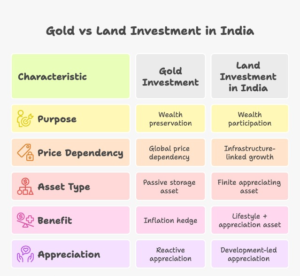
The debate around real estate vs gold investment has become increasingly relevant in recent years. Both assets serve important roles within diversified portfolios, but they operate very differently in terms of value creation.
Gold: A Traditional Wealth Preservation Asset
Gold has historically functioned as:
- A hedge against inflation
- A safe-haven asset during uncertainty
- A globally recognized store of value
- A liquid emergency reserve
Its appeal lies in stability and emotional trust. Gold often performs strongly during periods of economic instability, global conflict, or currency weakness.
However, gold appreciation is largely dependent on:
- International commodity markets
- Central bank policies
- Inflation expectations
- Geopolitical uncertainty
In many cases, gold appreciation is reactive rather than growth-linked.
Land: A Growth-Driven and Finite Asset
By comparison, land investment in India is increasingly being viewed as a development-linked and scarcity-driven asset class.
Land appreciation is often influenced by:
- Infrastructure expansion
- Tourism growth
- Population migration
- Urbanization
- Connectivity improvements
- Commercial ecosystem development
Unlike gold, land is finite. It cannot be manufactured or replicated.
This scarcity becomes even more valuable when connected to:
- Coastal zones
- Tourism destinations
- Airport corridors
- Expressway belts
- Emerging second-home regions
- Nature-centric investment zones
One of the strongest advantages of land investment in India is that infrastructure can permanently transform surrounding land values. When a new airport, highway, tourism circuit, or industrial corridor emerges, nearby land often experiences long-term appreciation due to increasing economic activity.
This is one reason many investors increasingly consider premium land ownership a potentially better investment than gold for long-term strategic wealth creation.
Passive Wealth Storage vs Active Wealth Creation
A major psychological shift is now visible among modern investors.
Traditional wealth strategies focused heavily on preservation:
- Protect capital
- Store value
- Maintain liquidity
Modern investors increasingly seek:
- Asset participation in economic growth
- Lifestyle integration
- Appreciation potential
- Legacy ownership
- Scarcity-driven value
This shift explains the rising attention toward land investment in India.
Land does not simply sit as a passive asset. It often evolves alongside regional growth patterns. Roads, airports, tourism demand, and urban migration can directly impact its value trajectory over time.
In many emerging regions, land appreciation is tied to actual economic development rather than global commodity cycles. This creates a fundamentally different investment dynamic compared to gold.
The conversation is therefore not about choosing one asset over another. Instead, it is about understanding how different assets function within long-term wealth strategies.
Why Land Investment in India Is Gaining Momentum
India’s infrastructure expansion is fundamentally reshaping the country’s investment geography.
Government initiatives such as:
- PM Gati Shakti
- Bharatmala Project
- Sagarmala Programme
- Regional airport expansion
- Vande Bharat rail connectivity
- Smart city initiatives
…are improving connectivity across multiple emerging regions.
This infrastructure boom is directly influencing land investment in India.
Historically, land appreciation was concentrated around major metropolitan cities. Today, infrastructure projects are creating entirely new growth corridors beyond traditional urban centers.
Investors are increasingly exploring:
- Coastal regions
- Tourism destinations
- Nature-driven zones
- Highway influence corridors
- Emerging Tier-2 and Tier-3 markets
The logic is straightforward:
Infrastructure creates accessibility.
Accessibility creates economic activity.
Economic activity drives land demand.
This cycle is becoming one of the strongest drivers of land investment in India.
Infrastructure Is Repricing Land Across India
One of the most important investment trends of 2025–2026 is infrastructure-led land repricing.
When major infrastructure enters a region, it changes:
- Travel accessibility
- Tourism inflow
- Commercial opportunities
- Hospitality demand
- Residential expansion
- Investor perception
Examples across India include:
- The Noida International Airport corridor
- Coastal infrastructure in Goa
- Tourism-led development in Sindhudurg
- Expressway influence zones near Delhi and Mumbai
- Peripheral growth around Bengaluru and Hyderabad
According to NITI Aayog and infrastructure ministry reports, India’s logistics and transportation expansion over the next decade is expected to significantly reshape regional economies.
This is one reason why land investment in India is increasingly being analyzed through a long-term infrastructure lens rather than short-term speculation.
Investors today are not just buying land.
They are buying future connectivity.
Tourism Expansion Is Creating New Investment Corridors
Tourism is becoming another major driver of land investment in India.
The Ministry of Tourism India continues to promote:
- Coastal tourism
- Eco-tourism
- Wellness tourism
- Heritage tourism
- Spiritual tourism
- Rural tourism circuits
These initiatives create demand for:
- Hospitality infrastructure
- Vacation homes
- Rental properties
- Premium plotted developments
- Lifestyle communities
As tourism ecosystems expand, nearby land values often rise alongside hospitality and commercial demand.
Regions such as:
- Goa
- Sindhudurg
- Alibaug
- Uttarakhand
- Himachal Pradesh
…have increasingly attracted investors looking for long-term appreciation linked to tourism and lifestyle growth.
This tourism-led economic activity is another reason many investors now view land investment in India as a future-oriented asset class.
Urban Migration Is Expanding Beyond Metros
India’s urban lifestyle preferences are also evolving rapidly.
The pandemic accelerated:
- Remote work culture
- Hybrid work models
- Wellness-focused living
- Demand for lower-density environments
- Weekend and second-home culture
As a result, affluent professionals increasingly seek:
- Nature-connected living
- Coastal retreats
- Hill destinations
- Wellness communities
- Flexible lifestyle locations
This has significantly boosted demand for premium land investment opportunities in emerging regions.
Many investors now prioritize:
- Open spaces
- Sustainable environments
- Lifestyle quality
- Privacy
- Long-term liveability
This trend is reshaping the future of land investment in India.
The Rise of Second Home Investment in India
One of the strongest wealth and lifestyle trends today is the growth of second home investment in India.
Second homes are no longer viewed only as luxury purchases. They increasingly function as:
- Lifestyle assets
- Appreciation assets
- Rental assets
- Retirement assets
- Legacy assets
According to multiple financial and real estate reports published in 2025–2026, demand for second homes has risen significantly among:
- HNIs
- NRIs
- Entrepreneurs
- Senior executives
- Multi-generational families
The appeal of second home investment in India lies in its dual value:
- Emotional and lifestyle fulfillment
- Long-term asset appreciation
Many premium plotted developments today are designed around:
- Wellness living
- Eco-conscious planning
- Gated infrastructure
- Sustainable communities
- Nature-centric experiences
This evolution is changing how investors perceive land ownership.
The Evolution of Premium Land Investment
The perception of plotted developments has changed dramatically over the past decade.
Earlier, land investments were often viewed as:
- Speculative
- Unorganized
- Long waiting-cycle assets
Today, modern premium land investment projects increasingly focus on:
- Planned infrastructure
- Sustainability
- Managed communities
- Green living
- Long-term value creation
This is especially important for investors seeking:
- Tangible ownership
- Lower maintenance compared to built properties
- Flexible future usage
- Lifestyle integration
Modern investors increasingly understand that strategically located land can benefit from multiple future growth drivers simultaneously:
- Tourism
- Infrastructure
- Population migration
- Hospitality demand
- Regional development
This multi-dimensional appreciation potential is one reason why land investment in India continues gaining momentum.
Why HNIs and NRIs Are Increasingly Exploring Land Ownership
High-net-worth individuals and global Indian investors increasingly seek asset classes that combine:
- Stability
- Scarcity
- Tangibility
- Long-term appreciation
- Legacy value
For many investors, land ownership offers psychological reassurance that purely financial instruments cannot provide.
Unlike market-linked investments, land ownership often carries:
- Emotional permanence
- Family legacy significance
- Physical utility
- Generational transfer value
This is especially true in premium lifestyle and tourism-driven locations.
As India’s infrastructure network expands, many investors believe strategically selected land investment in India opportunities may continue benefiting from long-term economic transformation.
Why Land Is Emerging as a Never-Ending Return Asset
One of the strongest arguments supporting land investment in India is scarcity.
Infrastructure expands.
Population grows.
Tourism increases.
Urbanization continues.
But land supply remains limited.
This creates a long-term imbalance between demand and availability, particularly in premium and strategically located regions.
Unlike apartments or commercial inventory that can be replicated vertically, premium land parcels remain finite. This scarcity principle often strengthens over time as regions develop.
Many investors therefore view land ownership as:
- A long-term appreciation asset
- A strategic inflation hedge
- A future development opportunity
- A legacy wealth tool
The concept of “never-ending returns” is not merely about immediate monetary appreciation. It also includes:
- Lifestyle ROI
- Wellness value
- Flexibility
- Emotional ownership
- Future adaptability
This broader perspective is redefining the future of land investment in India.
Strategic Wealth Planning and the Future of Land Ownership
Modern wealth planning increasingly focuses on diversification across:
- Financial assets
- Real assets
- Growth assets
- Lifestyle assets
As India continues its economic transformation, investors are looking beyond traditional metropolitan investments and exploring emerging growth corridors linked to:
- Infrastructure
- Tourism
- Wellness
- Sustainability
- Lifestyle migration
This shift is shaping the future of land investment in India.
The next decade may witness increasing demand for:
- Premium plotted developments
- Nature-centric communities
- Sustainable second homes
- Wellness-focused living environments
Investors are no longer evaluating land purely through speculative lenses. Instead, they are analyzing:
- Long-term regional development
- Infrastructure potential
- Scarcity economics
- Lifestyle trends
- Generational value creation
The Future of Land Investment in India
India’s economic trajectory over the next decade is expected to remain heavily infrastructure-driven.
According to reports from Invest India and the National Infrastructure Pipeline, massive investments are being directed toward:
- Roads
- Airports
- Ports
- Tourism
- Railways
- Industrial corridors
- Smart urban expansion
These developments are likely to continue influencing land investment in India across emerging regions.
At the same time, rising interest in:
- Sustainable living
- Nature-driven lifestyles
- Flexible work culture
- Wellness investments
…is strengthening demand for premium land ownership and second-home ecosystems.
This combination of scarcity, infrastructure growth, tourism expansion, and changing lifestyle preferences may position land as one of the most strategically important real assets of the coming decade.
FAQs
1. Why is land investment in India becoming popular in 2026?
Land investment in India is gaining momentum because investors are increasingly looking for finite, appreciating, and infrastructure-linked assets. Unlike many traditional investments, land often benefits directly from highways, airports, tourism growth, industrial expansion, and urban migration. Government initiatives like PM Gati Shakti and the National Infrastructure Pipeline are accelerating regional connectivity, which can significantly influence land appreciation across emerging corridors.
Additionally, changing lifestyle preferences, second-home demand, and wellness-focused living are encouraging affluent investors to explore premium plotted developments and nature-centric communities.
2. Is land investment in India a better investment than gold?
The comparison between gold and land depends on investment objectives. Gold has traditionally served as a wealth preservation and liquidity asset, while land investment in India is increasingly viewed as a long-term growth and appreciation asset.
Gold prices are largely influenced by global economic uncertainty, inflation, and geopolitical events. Land, on the other hand, often appreciates through infrastructure development, tourism expansion, urbanization, and local economic growth.
According to insights from the World Gold Council and Reserve Bank of India, investors today are gradually balancing traditional wealth storage assets with productive real assets linked to economic participation.
3. Why is land considered a finite asset in India?
One of the biggest advantages of land investment in India is scarcity. Land cannot be manufactured or expanded like financial instruments or vertical real estate inventory. Premium locations connected to:
- Coastal tourism
- Expressways
- Airports
- Nature destinations
- Urban expansion corridors
…have limited availability, which can strengthen long-term appreciation potential.
As infrastructure expands and population demand rises, strategically located land parcels may become increasingly valuable due to limited supply.
4. How do infrastructure projects increase land value in India?
Infrastructure projects improve accessibility, connectivity, economic activity, and investor confidence in surrounding regions. This directly impacts land investment in India.
Projects such as:
- Expressways
- Airports
- Coastal highways
- Smart cities
- Industrial corridors
- Railway modernization
…often create new commercial, tourism, and residential demand zones.
Government initiatives like Bharatmala Pariyojana and Sagarmala Programme are examples of infrastructure-led development strategies influencing future land appreciation across India.
5. What is the future of land investment in India?
The future of land investment in India appears strongly connected to infrastructure growth, tourism expansion, second-home demand, and urban decentralization.
India’s economic growth over the next decade is expected to focus heavily on:
- Connectivity
- Regional development
- Logistics
- Tourism ecosystems
- Smart urban expansion
According to Invest India and NITI Aayog, emerging infrastructure corridors and Tier-2 growth regions may continue attracting long-term investor attention.
This is one reason many investors increasingly view land as a strategic generational asset rather than a short-term speculative investment.
6. Why are second home investments increasing in India?
Second home investment in India has grown significantly due to changing lifestyle preferences after the pandemic. Investors increasingly seek:
- Wellness-focused living
- Nature-connected environments
- Flexible work-life balance
- Weekend homes
- Long-term lifestyle assets
The rise of hybrid work culture and demand for low-density living has strengthened interest in coastal, hill, and eco-tourism regions.
Reports from the Ministry of Tourism India also show growing investment in tourism infrastructure and wellness tourism, which further supports second-home demand across multiple emerging regions.
7. What factors should investors consider before land investment in India?
Before making a land investment in India, investors should evaluate:
- Legal title verification
- Zoning regulations
- Infrastructure connectivity
- Future development plans
- Road access
- Tourism potential
- Water and electricity availability
- Developer credibility
- Long-term regional growth trends
It is also advisable to review government planning documents and infrastructure announcements through portals like Ministry of Road Transport & Highways and local development authorities.
Strategic land investing requires long-term thinking rather than short-term speculation.
8. Why are HNIs and NRIs increasingly investing in premium land investment opportunities?
HNIs and NRIs are increasingly exploring premium land investment because it offers:
- Tangible ownership
- Scarcity-driven appreciation
- Legacy value
- Portfolio diversification
- Long-term flexibility
Premium plotted developments in tourism and infrastructure-driven locations also provide lifestyle advantages alongside financial potential.
Many investors now prefer real assets that combine:
- Appreciation
- Emotional ownership
- Wellness value
- Future development possibilities
This trend is particularly visible in second-home and nature-centric investment markets across India.
9. How does tourism impact land investment in India?
Tourism creates economic ecosystems that influence hospitality demand, rental markets, commercial activity, and regional development. This can positively affect land investment in India.
Government support for:
- Coastal tourism
- Eco-tourism
- Spiritual tourism
- Heritage tourism
- Wellness tourism
…is expanding investment opportunities beyond metropolitan cities.
According to the Ministry of Tourism India, tourism infrastructure investments continue increasing across emerging destinations, contributing to long-term regional growth and land demand.
10. Why is land investment in India considered a long-term wealth creation strategy?
Many investors view land investment in India as a long-term wealth creation strategy because it combines:
- Scarcity economics
- Infrastructure-linked appreciation
- Future utility
- Generational ownership
- Lifestyle value
Unlike assets that rely primarily on market sentiment, land often evolves alongside regional economic growth and physical development.
As India enters an infrastructure-led growth decade, strategically located land connected to tourism, connectivity, and urban expansion may continue benefiting from long-term appreciation trends.
For investors focused on sustainable we
India’s investment mindset is evolving from passive wealth storage toward active participation in long-term economic growth. While gold continues to remain an important component of wealth preservation, many investors are increasingly exploring how real assets aligned with infrastructure, tourism, and lifestyle evolution can contribute to future wealth creation.
This is one of the reasons why land investment in India is gaining stronger relevance among HNIs, NRIs, entrepreneurs, and long-term investors seeking finite, appreciating, and utility-driven assets.
The future of wealth creation may not rely solely on financial instruments or commodity cycles. It may increasingly belong to assets connected to:
- Infrastructure expansion
- Emerging growth corridors
- Tourism ecosystems
- Sustainable living
- Scarcity economics
As premium plotted developments and second-home communities continue evolving across India, developers focused on long-term sustainability, nature-centric planning, and strategic growth locations are becoming increasingly relevant.
Nine Divine Group represents this evolving philosophy through its focus on premium land investments, future-ready plotted developments, and sustainable second-home ecosystems designed around long-term value creation rather than short-term speculation.
In an era where investors increasingly seek both financial appreciation and meaningful ownership experiences, strategically planned land assets may continue shaping the next chapter of India’s long-term wealth journey.










No Comments