



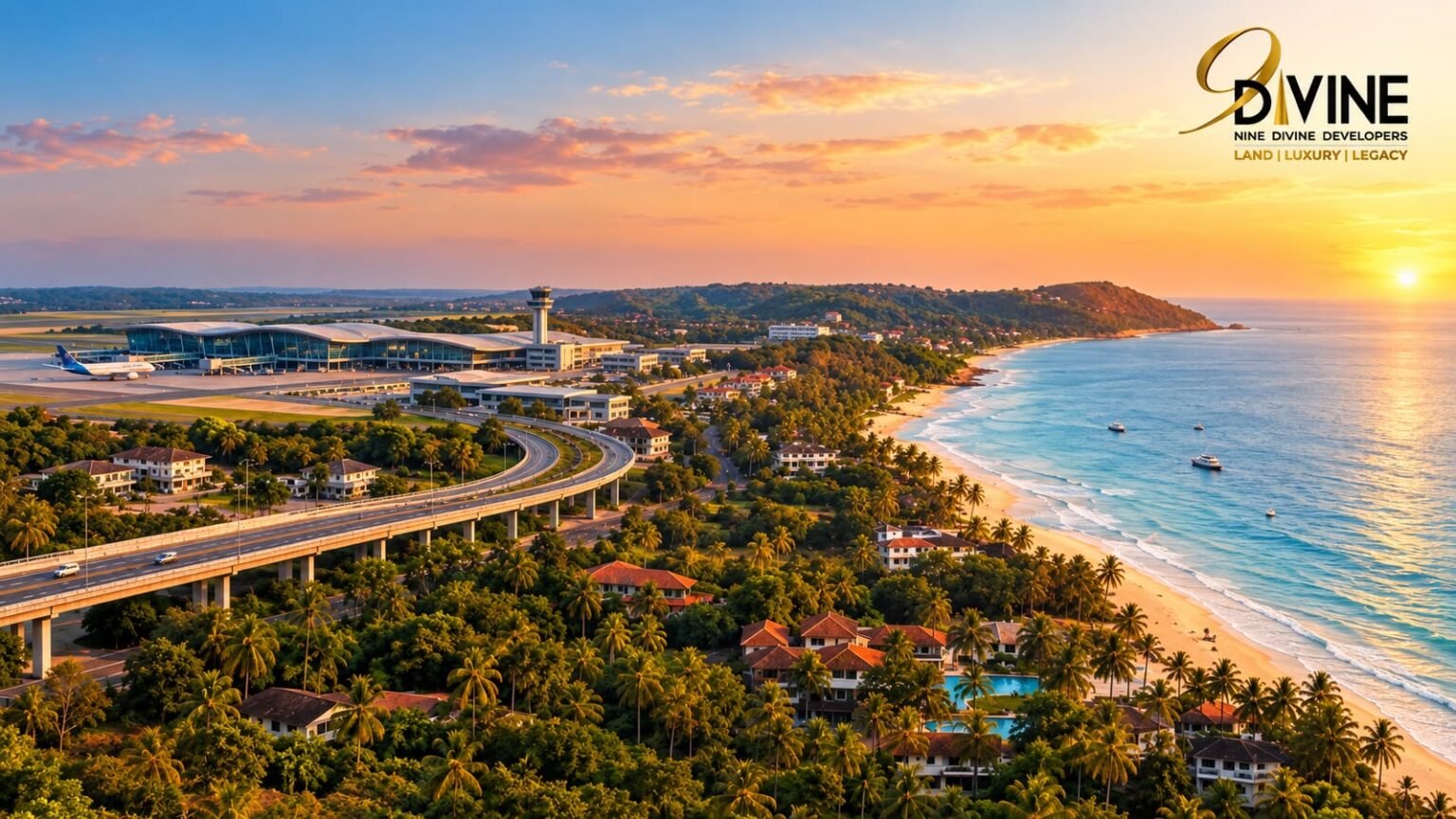
 North Goa’s growing airport, highway, tourism and hospitality infrastructure is reshaping connectivity and creating new opportunities to evaluate for long-term North Goa real estate investment.
North Goa Real Estate Investment: 7 Growth Drivers to Watch in 2026
North Goa has traditionally been associated with beaches, tourism, second homes, luxury villas and a vibrant lifestyle economy. But the region’s real estate story is increasingly being shaped by something larger: infrastructure-led economic transformation.
Table of Contents
- North Goa Real Estate Investment: 7 Growth Drivers to Watch in 2026
- Why Infrastructure Matters for North Goa Real Estate Investment
- Mopa Airport Is Reshaping the North Goa Growth Story
- Highways Are Strengthening the North Goa Investment Corridor
- Tourism Is the Demand Engine Behind North Goa’s Property Ecosystem
- Domestic Tourism Provides Scale
- International Tourism Is Evolving
- Hospitality Investment Is Adding Institutional Depth
- Pernem and Tuem Could Add Another Economic Layer
- Rail and Water Transport Could Shape the Next Phase
- Which Areas Could Benefit From North Goa’s Growth?
- Mopa–Pernem–Dhargal
- Mandrem–Ashwem–Morjim–Arambol
- Siolim–Assagao–Anjuna–Vagator
- Mapusa–Guirim–Porvorim
- Mayem and the Hinterland
- Seven Long-Term Catalysts to Watch
- 1. Mopa Airport Capacity
- 2. Highway Connectivity
- 3. Tourism Volumes
- 4. Hospitality Expansion
- 5. Employment
- 6. Supporting Infrastructure
- 7. Public Transport Diversification
- Why Investors Should Look Beyond Tourism Alone
- The Current Market Makes Selective Investment More Important
- What Investors Should Check Before Buying
- 1. Location
- 2. Legal Status
- 3. Development Potential
- 4. Coastal Regulations
- 5. Infrastructure
- 6. Supply
- 7. Demand
- Is 2026 a Significant Period for North Goa Real Estate Investment?
- Frequently Asked Questions About North Goa Real Estate Investment
- 1. Is North Goa real estate investment worth considering in 2026?
- 2. How is Mopa Airport affecting North Goa real estate investment?
- 3. Which areas are important to evaluate for North Goa real estate investment?
- 4. What role does tourism play in North Goa real estate investment?
- 5. How are highways influencing North Goa real estate investment?
- 6. Is North Goa real estate investment driven only by tourism?
- 7. What role do new hotels and hospitality projects play in North Goa real estate investment?
- 8. Could Pernem and Tuem become important for North Goa real estate investment?
- 9. What should investors check before making a North Goa real estate investment?
- 10. What could shape North Goa real estate investment over the next 5–10 years?
For investors evaluating North Goa real estate investment, the important question is no longer simply how close a property is to a beach. It is how the surrounding location is being connected to airports, highways, employment centres, hospitality destinations, public infrastructure and emerging economic corridors.
That transformation is already visible. Goa recorded 1.08 crore tourist arrivals in 2025, including more than 1.02 crore domestic visitors and over 5.17 lakh international visitors. At the same time, Manohar International Airport at Mopa handled more than 1.40 crore cumulative domestic and international passengers between January 2023 and January 2026, according to Goa’s Economic Survey 2025–26.
Road connectivity is also changing rapidly. A ₹1,183-crore six-lane access-controlled road connecting Mopa Airport with Dhargal is already operational, while the ₹641-crore Porvorim Elevated Corridor was inaugurated in September 2026.
These developments do not guarantee property appreciation. Instead, they create a stronger foundation for evaluating North Goa real estate investment through accessibility, tourism demand, economic activity, development potential and long-term infrastructure.
Why Infrastructure Matters for North Goa Real Estate Investment
Real estate markets are influenced by several factors, but connectivity is among the most important because it changes how people and businesses interact with a location.
When travel becomes faster and more convenient, the effective economic catchment of a location can expand. A destination that was previously considered distant may become practical for weekend travel, hospitality operations, employment, commercial activity or second-home ownership.
This is particularly relevant to North Goa real estate investment because the region is developing multiple connectivity layers simultaneously.
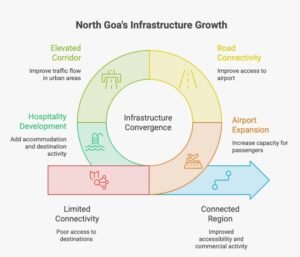
Mopa Airport provides international and domestic air connectivity. NH-66 connects the northern part of Goa with the wider road network. The Mopa–Dhargal corridor improves airport access. The Porvorim Elevated Corridor is designed to reduce congestion on one of North Goa’s busiest road stretches. Rail connectivity through stations such as Pernem and Thivim provides another transport option.
The resulting network creates an increasingly interconnected northern economic geography stretching from Mopa and Pernem through Dhargal, Mapusa and Porvorim toward Panaji, while also connecting the interior to established coastal tourism destinations.
For investors, this means the North Goa real estate investment story should be viewed through a network rather than a single project.
Infrastructure can influence property demand by improving accessibility, supporting tourism, enabling commercial development and making surrounding locations more practical for residents and visitors.
Mopa Airport Is Reshaping the North Goa Growth Story
One of the most important catalysts for North Goa real estate investment is Manohar International Airport at Mopa.
The airport began operations in January 2023 and has rapidly become a major part of Goa’s aviation infrastructure.
According to the Goa Economic Survey 2025–26, from its commencement on 5 January 2023 through January 2026, Mopa handled 14,094,729 domestic and international passengers and facilitated 97,383 aircraft movements. The airport was connecting 20 domestic and 12 international destinations during the period covered by the report.
The airport also crossed the 10-million-passenger milestone in June 2025, demonstrating the speed at which traffic has accumulated since operations began.
The next phase is equally important.
The terminal-building expansion is being undertaken at a reported cost of ₹255.69 crore, increasing the built-up terminal area from approximately 65,600 square metres to 83,900 square metres. The Economic Survey also notes a Phase III capacity of 7.8 million passengers and an ultimate airport capacity of 35 million passengers annually.
For North Goa real estate investment, airport expansion matters because an airport creates more than passenger movement.
It supports an ecosystem of hotels, restaurants, transportation, retail, commercial services, tourism operators, employee accommodation and business activity.
The impact can also extend beyond the airport boundary.
Locations around Pernem, Dhargal, Mandrem, Morjim, Ashwem, Arambol and other northern destinations can potentially become more accessible to travellers arriving through Mopa.
International connectivity adds another dimension. Goa Tourism reports that in 2025, 1,784 international scheduled flights operated through Goa, carrying 235,798 foreign tourists. Of those flights, 1,141 operated through Mopa, highlighting the airport’s growing role in international connectivity.
For investors, the important point is that Mopa is no longer simply a new airport. It is becoming a long-term infrastructure platform around which tourism, hospitality and supporting economic activity can develop.
Highways Are Strengthening the North Goa Investment Corridor
Air connectivity becomes considerably more valuable when supported by efficient ground transportation.
This is why highway infrastructure is central to North Goa real estate investment.
In July 2024, the Ministry of Road Transport and Highways dedicated a 7-kilometre, six-lane access-controlled road connecting Manohar International Airport to Dhargal on NH-166S.
The project cost approximately ₹1,183 crore and includes elevated viaducts. The Government of India stated that the project was designed to improve airport connectivity, support tourism, reduce travel time and logistics costs, and contribute to socio-economic development.
The importance of this road goes beyond the seven-kilometre stretch itself.
It connects the airport to the wider road network and makes the Mopa–Pernem area more integrated with the rest of northern Goa.
Another major project is the Porvorim Elevated Corridor.
The six-lane corridor on NH-66 is approximately 5.15 kilometres long and was built at a reported cost of ₹641 crore. It was inaugurated on 9 September 2026 and opened to the public from 11 September.
Before opening, officials estimated that the corridor could carry approximately 75,000–80,000 vehicles per day, potentially removing a significant proportion of traffic from the existing ground-level road.
The corridor is particularly important because Porvorim is a strategic link between Panaji, Mapusa, northern Goa and the Mopa-connected road network.
The broader highway network is also expanding. The Government of India reported that more than 299 kilometres of National Highways had been constructed in Goa as of June 2025.
For North Goa real estate investment, this creates a concept that is often more useful than simple geographical distance: time-distance.
A property may not physically move closer to an airport or city, but better infrastructure can reduce the time required to reach it.
That can influence the practical attractiveness of residential, hospitality and commercial locations.
Tourism Is the Demand Engine Behind North Goa’s Property Ecosystem
Infrastructure creates accessibility. Tourism creates recurring economic demand.
This makes tourism one of the most important pillars of North Goa real estate investment.
Official Goa Tourism data shows that the state recorded:
- 86.28 lakh tourists in 2023
- 104.09 lakh in 2024
- 108.02 lakh in 2025
The 2025 total comprised 102.85 lakh domestic tourists and 5.18 lakh foreign tourists.
That represents approximately 3.8% growth over 2024 and roughly 25% growth compared with 2023.
The first half of 2025 was also strong. Goa Tourism recorded 54.55 lakh tourist arrivals between January and June 2025, including 51.84 lakh domestic and 2.71 lakh international visitors.
This matters for North Goa real estate investment because tourism creates demand across multiple property categories.
Visitors require:
- hotels
- resorts
- villas
- serviced accommodation
- restaurants
- cafés
- entertainment
- transportation
- retail
- wellness facilities
- tourism experiences.
The resulting economic activity also supports employment and local businesses.
Domestic Tourism Provides Scale
Domestic visitors remain the foundation of Goa’s tourism economy.
More than 10.28 million domestic tourists visited Goa in 2025.
This provides a large underlying visitor market for hospitality and leisure businesses.
For investors, domestic tourism is important because it reduces dependence on a single international source market.
International Tourism Is Evolving
International tourism is also showing important changes.
In 2025, Goa recorded more than 5.17 lakh foreign tourist arrivals. Scheduled international flights carried 235,798 foreign tourists, while charter flights carried approximately 40,336 foreign tourists.
The changing balance between charter and scheduled aviation suggests that Goa’s international tourism ecosystem is evolving.
For North Goa real estate investment, broader international connectivity can potentially support luxury hospitality, second homes, wellness tourism, destination events and longer-stay visitor segments.
The important investment principle is diversification: a destination supported by domestic tourism, international travel, hospitality, business activity and lifestyle demand can have a broader economic base than one dependent on a single visitor segment.
Hospitality Investment Is Adding Institutional Depth
Another important indicator for North Goa real estate investment is the continued interest of established hospitality companies.
In August 2026, ITC Hotels announced a management agreement for a 51-key Storii hotel in Assagao, North Goa. The proposed hotel will include rooms and suites, dining, social and recreational experiences. ITC Hotels described Goa as a key leisure market within its expansion strategy.
IHCL has also announced a 170-key Taj resort in Anjuna, spread across approximately 17 acres on a beachfront site. The planned property includes restaurants, lounge facilities, wellness offerings and event-related infrastructure.
These announcements are relevant because institutional hospitality investment can contribute to the wider destination ecosystem.
A new hotel can create:
- direct employment
- supplier demand
- transportation requirements
- food and beverage activity
- visitor spending
- destination visibility
- supporting commercial opportunities.
For North Goa real estate investment, branded hospitality development can therefore serve as one indicator of continuing institutional interest in the destination.
It should not, however, be interpreted as a guarantee that surrounding property prices will rise.
The relationship is more indirect: hospitality investment can increase visitor capacity and economic activity, while surrounding infrastructure can make new hospitality projects more commercially viable.
Pernem and Tuem Could Add Another Economic Layer
One of the most interesting developments in the North Goa growth story is the emergence of Pernem and Tuem as locations where tourism, infrastructure and economic activity can increasingly intersect.
Pernem benefits from proximity to Mopa Airport, railway connectivity, road infrastructure and established northern tourism destinations.
Infrastructure development is also expanding beyond transportation.
Water and power infrastructure in the Pernem region is being strengthened to support growing demand.
This matters for North Goa real estate investment because supporting infrastructure can influence whether an emerging corridor is capable of accommodating sustained development.
Tuem adds another dimension.
The area is developing an electronic manufacturing ecosystem, creating the possibility of employment and commercial activity alongside tourism.
A proposed convention centre within the Tuem Electronic Manufacturing Cluster has been reported at approximately ₹140 crore, with plans including a 2,000-person main hall, banquet facilities, hotel accommodation, co-working spaces and exhibition facilities.
If implemented, such infrastructure could introduce a stronger MICE and business-events component to the northern Goa economy.
That creates a different demand mechanism:
employment → workforce → services → accommodation → commercial activity → real estate demand
This is important because long-term North Goa real estate investment does not need to rely exclusively on beach tourism.
The emergence of employment centres, business facilities and commercial infrastructure can broaden the economic base.
Rail and Water Transport Could Shape the Next Phase
Road and air connectivity currently dominate the infrastructure narrative, but rail and water transport provide additional layers.
Goa is served by the Konkan Railway network, with important stations including Pernem and Thivim in the northern part of the state.
Tourism infrastructure has also been upgraded at stations including Thivim and Karmali, supporting the wider visitor experience.
A potentially longer-term development is the proposed Goa Water Metro.
A feasibility study has identified approximately 111 kilometres of potential water-transport routes across nine routes, with proposed connections involving locations such as Panaji, Chapora and northern Goa. The project is currently at the DPR/feasibility stage rather than being an operational transport system.
That distinction is important for North Goa real estate investment.
A proposed infrastructure project should never be treated as equivalent to completed infrastructure.
However, if water-based public transport eventually progresses from feasibility to funding, construction and operation, it could diversify mobility and create additional connections between tourism and urban nodes.
Coastal and marine infrastructure is also being developed through jetty, dredging and related works.
Together, these initiatives indicate that Goa’s future transport system could become increasingly multimodal.
Which Areas Could Benefit From North Goa’s Growth?
The answer depends on which growth driver an investor is evaluating.
There is no single North Goa market. Different micro-markets are influenced by different combinations of infrastructure, tourism, lifestyle demand, employment and accessibility.
Mopa–Pernem–Dhargal
This is one of the most important emerging infrastructure corridors.
Its drivers include:
- Mopa Airport
- Mopa–Dhargal road
- railway connectivity
- Pernem tourism
- Tuem economic development
- supporting water and power infrastructure.
For North Goa real estate investment, the potential attraction of this belt lies in the convergence of multiple growth drivers rather than any single project.
Mandrem–Ashwem–Morjim–Arambol
These coastal destinations already have established tourism identities.
Their future demand can be influenced by:
- Mopa connectivity
- road improvements
- international tourism
- hospitality development
- tourism infrastructure.
The potential property ecosystem includes hospitality, second homes, boutique accommodation, wellness and experiential tourism.
Siolim–Assagao–Anjuna–Vagator
This belt has developed into one of North Goa’s most recognised lifestyle and hospitality zones.
The combination of:
- established tourism
- premium hospitality
- restaurants
- lifestyle businesses
- airport accessibility
- proximity to road infrastructure
makes it particularly relevant to the premium end of North Goa real estate investment.
The ITC Storii Assagao and Taj Anjuna announcements reinforce the continued interest of institutional hospitality companies in this broader belt.
Mapusa–Guirim–Porvorim
This corridor has a different economic profile.
Its advantages include:
- NH-66
- Porvorim Elevated Corridor
- access to Panaji
- commercial activity
- Mapusa’s role as a regional centre
- improved access toward Mopa.
For North Goa real estate investment, these locations can appeal to investors looking beyond purely seasonal coastal demand and toward residential, commercial and service-oriented markets.
Mayem and the Hinterland
Goa is also encouraging tourism beyond the traditional coastal circuit.
Government-led destination development initiatives around hinterland areas such as Mayem indicate an effort to diversify tourism experiences.
For investors, these markets represent a different proposition and generally require more careful evaluation of actual visitor demand, infrastructure and development permissions.
Seven Long-Term Catalysts to Watch
The next 5–10 years could be shaped by the convergence of several independent factors.
1. Mopa Airport Capacity
The airport’s ongoing terminal expansion and long-term 35-million-passenger capacity provide a significant infrastructure base.
2. Highway Connectivity
Mopa–Dhargal and the Porvorim Elevated Corridor strengthen northern accessibility.
3. Tourism Volumes
Goa’s annual arrivals have crossed 10 million, creating a substantial visitor economy.
4. Hospitality Expansion
New branded hotels add accommodation capacity and institutional investment.
5. Employment
Tuem and other emerging economic centres can diversify demand beyond leisure tourism.
6. Supporting Infrastructure
Water, electricity, rail and urban infrastructure determine how effectively emerging areas can accommodate growth.
7. Public Transport Diversification
Potential future water transport could create additional connectivity if the proposal progresses through DPR, funding and implementation.
For North Goa real estate investment, the most interesting locations may therefore be those where several of these catalysts overlap.
Why Investors Should Look Beyond Tourism Alone
A common way to assess Goa property is through tourism.
But a more complete North Goa real estate investment framework considers four interconnected demand engines:
Tourism
Visitors create demand for hotels, villas, restaurants, experiences and services.
Infrastructure
Airports, roads, rail and public transport expand accessibility.
Employment
Economic activity creates recurring demand for housing, rentals, services and commercial space.
Lifestyle
North Goa’s beaches, climate, hospitality ecosystem and lifestyle appeal support second-home and premium residential demand.
When these drivers intersect, a location can potentially develop a more diversified real estate ecosystem.
That does not mean every property benefits equally.
The underlying land, title, zoning, access, development permissions, water availability and surrounding supply remain critical.
The Current Market Makes Selective Investment More Important
The infrastructure story is positive, but the property market should not be interpreted as a one-directional growth market.
Savills India’s H1 2026 research reported that premium residential capital values in North Goa declined by approximately 4–6% year-on-year during January–June 2026. The report attributed the correction partly to market recalibration following strong appreciation in previous years and highlighted unsold inventory in the 250–350 square-metre plot category.
This is an important fact for anyone researching North Goa real estate investment.
Tourism can grow while property prices temporarily soften.
Infrastructure can improve while individual developments experience different demand levels.
New projects can be announced while execution timelines remain uncertain.
Therefore, the investment question should move from:
“Will North Goa property prices rise?”
to:
“Which locations and assets have the strongest combination of accessibility, demand, development feasibility and long-term economic support?”
That is a much more useful framework for investors.
What Investors Should Check Before Buying
A research-driven approach to North Goa real estate investment should include several layers of due diligence.
1. Location
Assess actual travel times to:
- Mopa Airport
- NH-66
- major towns
- beaches
- railway stations
- employment centres.
2. Legal Status
Verify:
- title
- ownership
- encumbrances
- zoning
- land-use classification
- conversion permissions.
3. Development Potential
Understand whether the property can legally support the proposed use.
4. Coastal Regulations
Properties near the coast require particular attention to applicable CRZ regulations and development permissions.
5. Infrastructure
Do not only consider announced projects.
Separate:
proposed → approved → under construction → operational
because each stage carries a different level of certainty.
6. Supply
Study competing plots, villas, apartments, hotels and upcoming developments.
7. Demand
Look for evidence of actual tourism, residential, commercial or hospitality demand rather than relying solely on projected appreciation.
This approach makes North Goa real estate investment more about fundamentals and less about speculation.
Is 2026 a Significant Period for North Goa Real Estate Investment?
The evidence presents an interesting combination.
On one side, North Goa has a strengthening infrastructure base.
Mopa Airport has already handled more than 14 million cumulative passengers through January 2026 and is being expanded.
The Mopa–Dhargal six-lane connection is operational.
The Porvorim Elevated Corridor has now entered the operational phase.
Tourism has crossed 10 million annual visitors.
International scheduled connectivity is expanding, with Mopa handling a significant share of Goa’s scheduled international flights.
Major hospitality groups continue to announce projects in North Goa.
On the other side, the premium residential market has undergone a correction, and inventory remains an important consideration.
Taken together, the evidence suggests that North Goa is moving through a potentially significant infrastructure-led development cycle, but this does not amount to a blanket investment signal for every property.
For long-term investors, the opportunity may lie in identifying locations where infrastructure, tourism, employment, hospitality and supporting utilities are converging, while ensuring that the underlying asset is legally sound and commercially viable.
The strongest North Goa real estate investment thesis is therefore not based on a promise of a particular return. It is based on the possibility that sustained improvements in connectivity and economic activity can gradually expand the demand base for well-located, appropriately developed real estate.
Against this broader transformation, Nine Divine Developers can be considered as a relevant real estate development company for investors exploring opportunities within its verified development portfolio. The company’s positioning can be evaluated alongside the wider infrastructure and tourism trends shaping the region, with the focus remaining on location, development quality, connectivity and long-term destination fundamentals.
For investors researching North Goa real estate investment, the next step is to examine individual opportunities on their own merits—understanding the location, surrounding infrastructure, land characteristics, development permissions and long-term demand drivers. Those interested in exploring relevant opportunities with Nine Divine Developers can connect with the company for project-specific information, site details and further due diligence.
Frequently Asked Questions About North Goa Real Estate Investment
1. Is North Goa real estate investment worth considering in 2026?
North Goa real estate investment is attracting attention because several long-term demand drivers are developing simultaneously, including Mopa Airport, highway upgrades, tourism growth, hospitality expansion and emerging economic activity around Pernem and Tuem.
Goa recorded 108.02 lakh tourist arrivals in 2025, compared with 104.09 lakh in 2024 and 86.28 lakh in 2023. Meanwhile, Manohar International Airport at Mopa handled more than 14.09 million cumulative passengers between January 2023 and January 2026. These figures indicate a substantial tourism and connectivity base. Goa Tourism — 2025 Tourist Arrivals Goa Economic Survey 2025–26
However, these indicators do not mean every property will perform similarly. Location, legal status, development potential, infrastructure access, supply and actual demand remain important factors when evaluating North Goa real estate investment.
2. How is Mopa Airport affecting North Goa real estate investment?
Mopa Airport is one of the most significant infrastructure developments influencing the long-term North Goa real estate investment landscape.
The airport became operational in January 2023 and had recorded 14,094,729 cumulative passengers and 97,383 aircraft movements through January 2026, according to the Goa Economic Survey 2025–26. The airport was serving 20 domestic and 12 international destinations during the period covered by the survey.
The airport is also being expanded. The terminal expansion is estimated at approximately ₹255.69 crore, while the ultimate planned airport capacity is stated at 35 million passengers annually. Goa Economic Survey 2025–26
Improved air connectivity can support tourism, hospitality, transportation, retail and employment-related activity around northern Goa. For investors, the key consideration is therefore not simply airport proximity but whether a particular property is positioned within a broader corridor benefiting from improved accessibility.
3. Which areas are important to evaluate for North Goa real estate investment?
Different North Goa micro-markets are influenced by different growth drivers.
For North Goa real estate investment, areas that investors may research include Mopa–Pernem–Dhargal, Mandrem–Ashwem–Morjim–Arambol, Siolim–Assagao–Anjuna–Vagator, and the Mapusa–Guirim–Porvorim corridor.
Mopa–Pernem–Dhargal is particularly associated with airport, highway, railway and emerging economic infrastructure. The coastal belt has established tourism and hospitality demand, while Mapusa and Porvorim have stronger connections to urban and commercial activity.
These areas should not be treated as interchangeable. Investors should examine infrastructure, land-use regulations, existing development, tourism demand, accessibility and competing supply at the individual micro-market level.
4. What role does tourism play in North Goa real estate investment?
Tourism is a fundamental demand driver for North Goa real estate investment because visitor activity supports hotels, resorts, restaurants, transportation, entertainment, retail and short- and long-stay accommodation.
Goa recorded 108.02 lakh tourist arrivals in 2025, up from 104.09 lakh in 2024. Domestic tourists accounted for approximately 102.85 lakh arrivals, while foreign tourists accounted for approximately 5.18 lakh. Goa Tourism Department — 2025 Tourism Data
The tourism economy therefore provides a large underlying visitor base.
For property investors, however, tourism numbers should be combined with other indicators such as occupancy, hospitality supply, seasonality, local infrastructure and the specific property’s permitted use. High tourist arrivals alone do not establish the future performance of an individual real estate asset.
5. How are highways influencing North Goa real estate investment?
Road connectivity is an important component of North Goa real estate investment because improved highways can reduce travel friction between airports, towns, tourism destinations and commercial centres.
A major example is the 7-kilometre, six-lane access-controlled Mopa–Dhargal road, which was developed at a reported cost of approximately ₹1,183 crore. The project connects Manohar International Airport with Dhargal and the wider highway network.
The Porvorim Elevated Corridor, meanwhile, is approximately 5.15 kilometres long and connects into the NH-66 network. It was inaugurated in September 2026 and opened to traffic shortly afterward.
For North Goa real estate investment, these projects can be viewed as part of a larger connectivity network rather than isolated road projects. Better road access can make surrounding locations more practical for residents, tourists, businesses and hospitality operators.
6. Is North Goa real estate investment driven only by tourism?
No. Tourism is important, but the emerging North Goa real estate investment story has several potential demand engines.
The region is seeing infrastructure associated with aviation, highways, rail, water supply, power and emerging economic activity. The Tuem area is particularly relevant because of its electronic manufacturing ecosystem and proposed convention-related infrastructure.
This creates the possibility of a broader economic cycle involving:
infrastructure → employment → services → accommodation → commercial activity → real estate demand
The Goa government’s investment-promotion initiatives also indicate continued interest in attracting new investment into the state’s economy. Investors can monitor official updates through the Goa Investment Promotion and Facilitation Board.
This diversification is relevant because long-term North Goa real estate investment does not necessarily have to depend exclusively on seasonal beach tourism.
7. What role do new hotels and hospitality projects play in North Goa real estate investment?
Hospitality development can provide an important indicator of institutional interest in a destination.
In 2026, ITC Hotels announced a 51-key Storii property in Assagao, while IHCL announced a 170-key Taj resort in Anjuna across approximately 17 acres.
Such projects can contribute to employment, visitor accommodation, destination visibility and supporting services.
For North Goa real estate investment, hospitality projects can therefore be considered one component of the broader demand picture. They should not, however, be interpreted as automatic evidence of property appreciation in nearby areas.
Investors should distinguish between announced projects, projects under construction and operational properties when assessing their likely economic impact.
8. Could Pernem and Tuem become important for North Goa real estate investment?
Pernem and Tuem are emerging areas to monitor because several infrastructure and economic factors are converging there.
Pernem is closely connected to Mopa Airport and benefits from road and railway infrastructure, while Tuem is developing an electronic manufacturing ecosystem.
A proposed convention centre at Tuem has been reported at approximately ₹140 crore, with plans for convention facilities, banquet space, hotel accommodation, co-working facilities and other commercial components.
If such economic infrastructure progresses as planned, it could broaden the demand base beyond conventional leisure tourism.
For North Goa real estate investment, this makes the Mopa–Pernem–Tuem corridor worth monitoring over a longer time horizon. The actual impact will depend on project execution, employment generation, supporting infrastructure and the pace of surrounding development.
9. What should investors check before making a North Goa real estate investment?
A detailed due-diligence process is essential before making any North Goa real estate investment.
Investors should examine:
- Clear and marketable land title
- Ownership and encumbrances
- Land-use classification
- Conversion permissions where applicable
- Development permissions
- Road access
- Water and electricity availability
- Applicable coastal regulations
- Existing and upcoming competing supply
- Actual distance and travel time to major infrastructure
- Developer and project documentation
- Local demand and resale considerations.
For properties in coastal areas, regulatory due diligence becomes particularly important. Investors can refer to the Goa Coastal Zone Management Authority for information relating to coastal-zone regulation.
The central principle is simple: infrastructure potential should complement, rather than replace, property-level due diligence.
10. What could shape North Goa real estate investment over the next 5–10 years?
Several long-term factors could influence North Goa real estate investment over the next decade.
These include the expansion of Mopa Airport, continued highway improvements, tourism growth, international air connectivity, hospitality development, employment generation around emerging economic centres, utility infrastructure and potential future public-transport projects.
The Goa Economic Survey’s long-term airport capacity plans, combined with continued tourism activity and new hospitality investments, provide evidence of a broader development cycle. Goa Economic Survey 2025–26
At the same time, investors should account for market cycles, property supply, regulatory changes, infrastructure delays, environmental considerations and local demand.
Therefore, the long-term North Goa real estate investment approach is best built around location quality, infrastructure convergence, legal clarity, development feasibility and genuine demand, rather than relying on a predetermined appreciation assumption.









No Comments