


HomeUncategorizedGoa Infrastructure Projects 2026: 15 Key Growth Drivers Shaping Real Estate Investment
Goa Infrastructure Projects 2026: 15 Key Growth Drivers Shaping Real Estate Investment
Goa Infrastructure Projects 2026: 15 Key Growth Drivers Shaping Real Estate InvestmentGoa Is Entering a New Infrastructure-Led Growth CycleGoa has

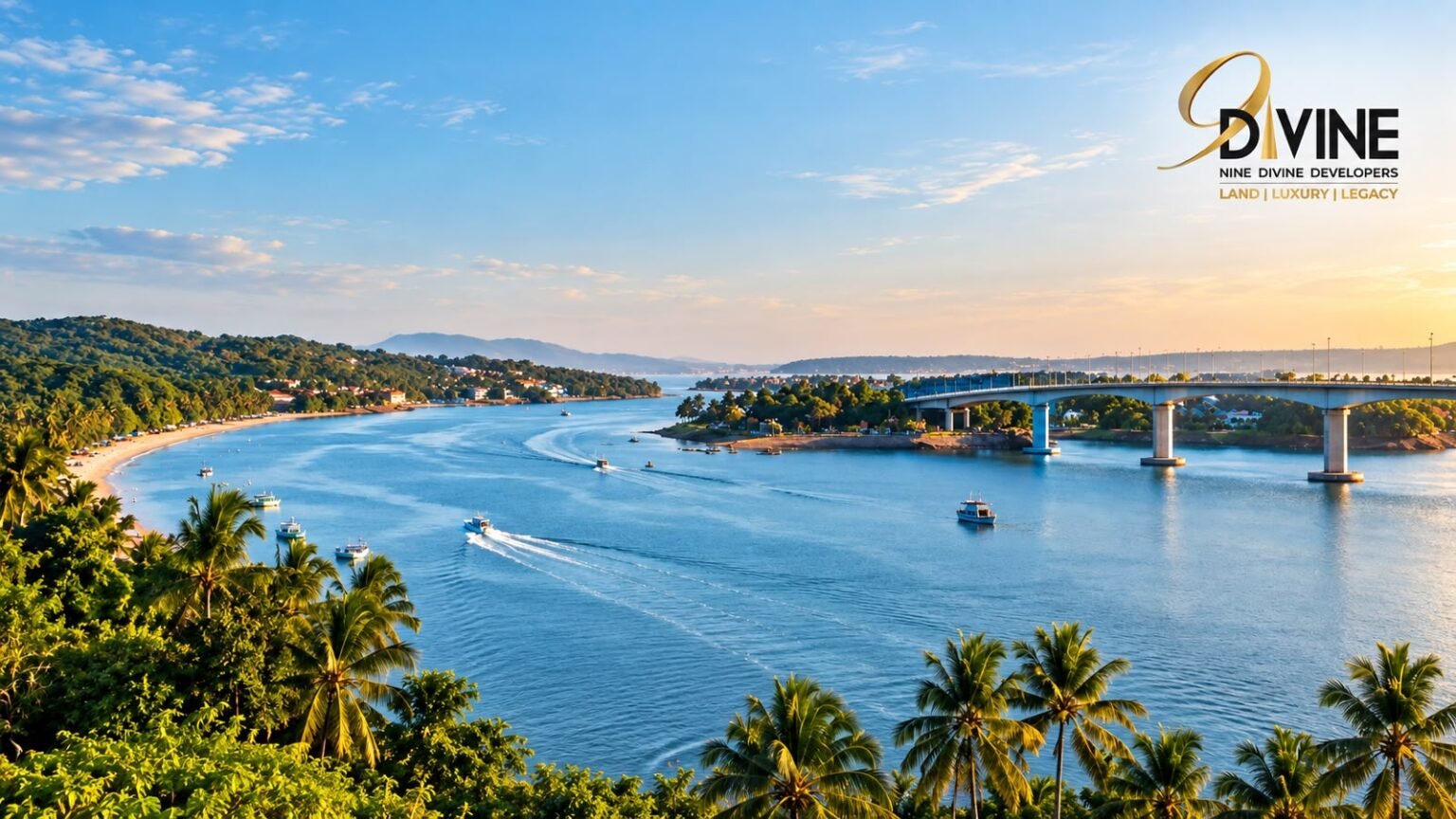 Goa Infrastructure Projects 2026 are reshaping connectivity and supporting the state's next phase of tourism, economic and real estate growth.
Goa Infrastructure Projects 2026: 15 Key Growth Drivers Shaping Real Estate Investment
Goa Is Entering a New Infrastructure-Led Growth Cycle
Goa has long been recognised for its beaches, tourism economy and lifestyle appeal. But in 2026, the state’s growth story is becoming broader.
Table of Contents
- Goa Infrastructure Projects 2026: 15 Key Growth Drivers Shaping Real Estate Investment
- Goa Is Entering a New Infrastructure-Led Growth Cycle
- Goa Water Metro: The Most Closely Watched Connectivity Proposal
- Mopa Airport Is Becoming a Major Growth Engine
- Mopa–Dhargal Six-Lane Access-Controlled Road
- Porvorim Six-Lane Elevated Corridor
- NH-66 Is Becoming More Than a Highway
- Mormugao Port Is Strengthening Goa’s Maritime Economy
- A New Maritime Administration Hub at Panaji
- Mopa Is Also Emerging as an Agri-Logistics Hub
- Goa’s Tourism Base Remains Strong
- Convention and Business Tourism Are Expanding the Market
- Vagator and Baga Show Increasing Private Participation
- Rail Connectivity Is Strengthening Goa’s Coastal Position
- Porvorim Town Square and Urban Infrastructure
- What These Goa Infrastructure Projects 2026 Mean for Real Estate
- Emerging Real Estate Opportunities in a More Connected Goa
- Airport-linked locations
- North Goa connectivity corridors
- Waterfront and river-linked locations
- Hospitality-led locations
- Emerging hinterland locations
- A Smart Investor Framework for Goa Real Estate Investment 2026
- 1. Study connectivity
- 2. Identify infrastructure status
- 3. Study tourism demand
- 4. Understand the local development ecosystem
- 5. Evaluate land-use fundamentals
- 6. Think long term
- Why Location-Led Development Matters
- How Nine Divine Looks at Infrastructure-Led Growth
- The Bigger Picture: Goa Beyond the Beach
- Infrastructure Is Redrawing Goa’s Investment Map
- FAQs
- 1. What are the major Goa infrastructure projects 2026 that investors should monitor?
- 2. What is the Goa infrastructure projects 2026 Water Metro project and how could it affect Goa real estate?
- 3. How is Mopa Airport influencing Goa infrastructure projects 2026?
- 4. What is the Mopa–Dhargal road project and why is it important?
- 5. Why is Porvorim important for Goa infrastructure projects 2026?
- 6. How strong is Goa’s tourism demand in 2026?
- 7. How is Mormugao Port contributing to Goa’s economic growth?
- 8. Is Goa infrastructure projects 2026 development limited to tourism and highways?
- 9. Can infrastructure projects guarantee appreciation in Goa property prices?
- 10. How should investors evaluate Goa infrastructure projects 2026 in an infrastructure-led market?
The next phase is increasingly being shaped by infrastructure, multimodal connectivity, aviation expansion, highways, maritime development, tourism infrastructure and new economic activity.
For investors, this distinction matters.
A destination becomes more investible when accessibility improves, visitor volumes remain strong, economic activity expands and new infrastructure connects previously fragmented locations. This is why tracking Goa infrastructure projects 2026 is important for anyone evaluating the state’s long-term real estate landscape.
The latest developments indicate that Goa is building a more interconnected economic ecosystem.
Manohar International Airport at Mopa is expanding. The proposed Goa Water Metro is moving through its Detailed Project Report stage. The six-lane elevated corridor at Porvorim is progressing. NH-66 is receiving continued infrastructure and environmental attention. Mormugao Port is expanding its maritime capabilities, while tourism infrastructure is broadening beyond conventional beach tourism.
At the same time, Goa recorded 10,802,410 tourist arrivals in 2025, including 10,284,608 domestic and 517,802 foreign visitors, according to the state’s Economic Survey 2025-26.
This combination of infrastructure + connectivity + tourism + economic activity creates an important framework for understanding the potential evolution of Goa’s real estate market.
Goa Water Metro: The Most Closely Watched Connectivity Proposal
Among the Goa infrastructure projects 2026, the proposed Goa Water Metro is arguably one of the most strategically interesting.
The feasibility study has been completed and Kochi Metro Rail Limited is preparing the Detailed Project Report.
The proposed network covers approximately 111 kilometres across nine routes, using Goa’s waterways to create an additional public transport network.
The routes identified during the feasibility stage include:
- Panaji–Narve
- Betim–Old Goa
- Old Goa–Sarmanas
- Vasco–Cortalim
- Cortalim–Durbhat
- Old Goa–Cumbarjua
- Panaji–Dona Paula–Vasco
- Panaji–Chapora
An additional Chapora–Keri–Tiracol sea route has also been considered.
Importantly, the project is not yet under construction. The government has stated that the final cost, funding structure and implementation schedule will be determined after completion of the DPR.
The DPR will examine traffic congestion, vehicle movement, fuel consumption, travel time and carbon emissions, while also considering stakeholder consultations.
For investors, the significance is not simply the proposed terminals or vessels.
The larger significance is network connectivity.
If implemented in phases, water-based public transportation could potentially improve accessibility between residential, commercial, tourism and employment clusters that currently depend heavily on road travel.
That makes the Water Metro an important infrastructure development to monitor—not as a guaranteed real estate catalyst, but as a potential future connectivity layer.
Mopa Airport Is Becoming a Major Growth Engine
Manohar International Airport at Mopa has already moved beyond the early-stage airport narrative.
According to the Goa Economic Survey 2025-26, terminal expansion is underway at an estimated cost of ₹255.69 crore.
The terminal’s built-up area is expected to increase from approximately 65,600 sq m to 83,900 sq m.
From its commencement in January 2023 through January 2026, Mopa handled 14,094,729 domestic and international passengers and facilitated 97,383 aircraft movements.
The airport connected Goa with 20 domestic and 12 international destinations during that period.
The Economic Survey also records that Mopa crossed the 10 million passenger milestone in June 2025.
This matters for real estate because airports do more than move passengers.
They can support:
- hospitality
- business travel
- logistics
- employment
- tourism
- second-home demand
- commercial development
- ancillary services
The emerging Mopa ecosystem is therefore important to monitor when assessing Goa infrastructure projects 2026.
Mopa–Dhargal Six-Lane Access-Controlled Road
Airport connectivity is just as important as airport capacity.
A major supporting infrastructure project is the 7-km six-lane access-controlled road connecting Manohar International Airport with Dhargal on NH-166S.
The project cost approximately ₹1,183 crore and was inaugurated in July 2024.
The significance of this road is its role as an airport-access corridor.
As Mopa grows, improved road connectivity can strengthen accessibility to surrounding locations and reduce friction for travellers, businesses, hospitality operators and residents.
For real estate analysis, the important question is therefore not simply:
“How close is a property to Mopa?”
A more useful question is:
“How efficiently can the property connect to Mopa and the wider road network?”
That distinction can become increasingly important as the airport ecosystem expands.
Porvorim Six-Lane Elevated Corridor
Porvorim is another location where infrastructure is directly responding to growing traffic demand.
The six-lane elevated corridor project covers approximately km 508.000 to km 513.150 of NH-66, including approaches.
Government traffic notifications issued in April and May 2026 confirmed construction-related traffic diversions to facilitate the project’s progress.
This is significant because Porvorim functions as an important gateway between Panaji and North Goa.
Improved movement through this corridor can have wider implications for:
- commuting
- retail
- hospitality
- residential development
- commercial activity
- access to North Goa tourism markets
For investors studying Goa infrastructure projects 2026, Porvorim is therefore worth following closely.
NH-66 Is Becoming More Than a Highway
NH-66 remains one of Goa’s most important road corridors.
In 2026, the state’s Green NH66 Mission was launched to transform approximately 70 kilometres of NH-66 from Patradevi in North Goa to Galgibag in South Goa into a greener corridor through plantation along medians and roadside areas.
The programme is being implemented across 10 identified locations.
The initiative has environmental objectives including carbon sequestration, soil stabilisation and reduction of vehicle headlight glare.
This illustrates another dimension of Goa’s infrastructure story.
Future infrastructure is increasingly being discussed not only in terms of speed and capacity, but also sustainability and destination quality.
That is particularly relevant for a state whose long-term economic value is closely connected with its natural environment.
Mormugao Port Is Strengthening Goa’s Maritime Economy
Goa’s infrastructure story is not limited to tourism and road connectivity.
Mormugao Port is strengthening its position as a major maritime and logistics asset.
During FY 2025-26, Mormugao Port handled 21.01 million metric tonnes of cargo, representing approximately 16% growth over the previous financial year.
The port recorded its highest cargo handling in five years and the highest growth rate among India’s major ports during the year.
The port is also pursuing modernisation and sustainability initiatives.
In June 2026, the Union Ministry of Ports, Shipping and Waterways highlighted more than ₹1,300 crore of infrastructure completed at Mormugao since 2014, with more than ₹2,000 crore under implementation.
A stronger port ecosystem can support logistics, trade, employment and ancillary commercial activity.
That makes maritime infrastructure an important but sometimes overlooked component of Goa’s long-term economic geography.
A New Maritime Administration Hub at Panaji
Another recent development is the new Captain of Ports Terminal Building at Panaji.
The ₹48.87-crore waterfront facility was inaugurated in June 2026.
The G+3 building covers more than 4,405 sq m and includes facilities related to maritime administration, vessel monitoring, navigation control and communication.
On its own, this may not appear to be a major real estate story.
But it forms part of a broader shift toward strengthening Goa’s maritime infrastructure and institutional capacity.
The state has also been discussing a wider maritime ecosystem involving shipbuilding, ship repair, inland waterways and maritime planning.
Mopa Is Also Emerging as an Agri-Logistics Hub
One of the more interesting developments around Mopa is not directly related to tourism.
In March 2026, the Goa Agricultural Produce and Livestock Marketing Board and GMR Airport Limited signed an MoU for developing a Pack House and agri-logistics facility at Mopa Airport.
The facility is intended to support grading, packaging and export of agricultural produce while reducing post-harvest losses.
This is significant because it shows Mopa evolving beyond a passenger airport.
The emergence of aviation-linked logistics can contribute to a more diversified economic ecosystem around the airport.
For real estate investors, economic diversification is important because it potentially broadens demand beyond traditional holiday accommodation.
Goa’s Tourism Base Remains Strong
Infrastructure becomes more meaningful when there is underlying economic demand.
Goa’s tourism numbers continue to demonstrate the strength of its visitor economy.
According to the Economic Survey 2025-26:
2025 total tourist arrivals: 10,802,410
This included:
- 10,284,608 domestic tourists
- 517,802 foreign tourists
Total tourist arrivals increased by 3.78% over 2024.
Goa also recorded 1,784 international flights through Dabolim and Mopa during 2025, carrying 235,798 foreign tourists.
The state had approximately 9,005 hotels, providing 77,253 rooms and 119,719 beds as of March 2025.
The data points to something important for Goa infrastructure projects 2026:
Goa is not dependent on one single tourism segment.
Its visitor economy includes domestic tourism, international tourism, hospitality, leisure, events, cruise tourism, business travel and emerging experiential tourism formats.
Convention and Business Tourism Are Expanding the Market
Goa’s economic opportunity is also expanding beyond leisure tourism.
The Urja Bharat Convention Centre at the ONGC Advanced Training Institute in Canaguinim was inaugurated in July 2026.
The facility has seating capacity for more than 4,000 delegates and is positioned to attract conferences, exhibitions, corporate programmes and government events.
This is another example of infrastructure contributing to tourism diversification.
A stronger MICE ecosystem can potentially increase demand for:
- hotels
- serviced accommodation
- restaurants
- transportation
- event venues
- business services
- premium short-stay properties
The implication is important: the future Goa visitor may increasingly arrive for different reasons and at different times of the year.
Vagator and Baga Show Increasing Private Participation
Tourism infrastructure is also opening opportunities for private-sector participation.
In 2026, the Goa Tourism Development Corporation issued tenders for development, operation and maintenance of GTDC properties at Vagator under a private investment model.
A separate tender at Baga involves operation and maintenance of existing public parking and development, operation and maintenance of ancillary tourism and commercial facilities.
These developments demonstrate an important direction in Goa’s tourism ecosystem:
Public assets + private investment + improved visitor infrastructure.
This can create opportunities for new hospitality, commercial and experiential formats while improving destination infrastructure.
Rail Connectivity Is Strengthening Goa’s Coastal Position
Roads and airports receive most attention, but rail remains a crucial component of Goa’s connectivity.
In June 2026, the Madgaon–Karwar Express was introduced, strengthening rail connectivity between Goa and coastal Karnataka.
The broader Konkan Railway network also continues to receive infrastructure improvements, including additional railway capacity and passenger facilities.
For investors, rail connectivity matters because it expands the accessible catchment around Goa.
A destination does not have to depend entirely on air travel when multiple transport modes are available.
This supports the larger infrastructure principle:
The more connected a destination becomes, the wider its potential economic catchment can become.
Porvorim Town Square and Urban Infrastructure
Infrastructure-led growth is also visible at the urban level.
The Goa Economic Survey 2025-26 records the Porvorim Town Square project as an urban development initiative involving underground parking for approximately 200 vehicles, an amphitheatre, entrance plaza, kiosks/cafeteria, toilet facilities and land development.
The project was initiated in 2024 and was reported at 28% completion in the Economic Survey, with a projected completion timeline of January 2027.
This type of infrastructure can contribute to the evolution of urban public spaces.
For real estate, the broader implication is that destination quality increasingly depends on more than roads and buildings.
Public spaces, mobility, retail, hospitality and community infrastructure also influence how locations develop.
What These Goa Infrastructure Projects 2026 Mean for Real Estate
The biggest mistake an investor can make is to look at each infrastructure project independently.
The more useful approach is to examine the combined network effect.
Consider the chain:
Infrastructure → Connectivity → Accessibility → Tourism & Economic Activity → Real Estate Demand
For example:
Mopa Airport expansion can strengthen aviation connectivity.
The Mopa–Dhargal road improves road access.
The Water Metro could introduce another layer of internal connectivity.
Porvorim’s elevated corridor can improve movement along a major North Goa gateway.
NH-66 upgrades strengthen the north-south spine.
Mormugao Port supports maritime and logistics activity.
Tourism infrastructure expands visitor experiences.
Together, these developments can reshape the geography of economic activity.
This is why Goa infrastructure projects 2026 should not be evaluated only by today’s property prices.
Investors should also study the infrastructure pipeline around a location.
Emerging Real Estate Opportunities in a More Connected Goa
The next generation of opportunities may increasingly emerge around connectivity corridors rather than isolated destinations.
Several broad categories deserve attention.
Airport-linked locations
Areas with efficient access to Mopa can potentially benefit from tourism, hospitality, business travel and logistics expansion.
North Goa connectivity corridors
Locations connected to Panaji, Porvorim, Mapusa, Vagator, Anjuna and the wider North Goa network remain important because of their established tourism and residential ecosystems.
Waterfront and river-linked locations
The proposed Water Metro makes waterfront accessibility an increasingly interesting infrastructure theme.
Hospitality-led locations
Tourism infrastructure, private investment and MICE development can support demand for differentiated accommodation and hospitality formats.
Emerging hinterland locations
As connectivity improves, some locations outside Goa’s traditional tourist core may become more accessible to visitors and residents.
For long-term investors, this can create an opportunity to identify locations before the full impact of infrastructure is reflected in market positioning.
However, infrastructure proximity alone should never be treated as a guarantee of appreciation.
A Smart Investor Framework for Goa Real Estate Investment 2026
Investors evaluating a property should look beyond the headline infrastructure announcement.
A practical framework is:
1. Study connectivity
Check actual road, airport, rail and waterway access.
2. Identify infrastructure status
Differentiate between:
- announced
- planned
- feasibility stage
- DPR stage
- tendered
- under construction
- operational
This is especially important for the proposed Water Metro, which remains in the DPR stage as of 7 September 2026.
3. Study tourism demand
Look at visitor arrivals, hotel supply, international connectivity and emerging tourism segments.
4. Understand the local development ecosystem
Look beyond one project.
Study roads, hospitality, commercial activity, public infrastructure and employment drivers together.
5. Evaluate land-use fundamentals
Infrastructure cannot compensate for unsuitable zoning, weak access, poor planning or unclear development potential.
6. Think long term
Real estate linked to infrastructure transformation should be evaluated with a multi-year perspective rather than short-term speculation.
Why Location-Led Development Matters
The future of Goa’s real estate market may increasingly be defined by location quality rather than simply property type.
A luxury villa, plotted development, second home or hospitality asset becomes more strategically positioned when it sits within a strong ecosystem of:
- transport connectivity
- tourism demand
- social infrastructure
- hospitality
- commercial activity
- natural attractions
- urban amenities
This is where the concept of destination development becomes important.
Instead of asking only:
“What property am I buying?”
Investors should also ask:
“What destination ecosystem is developing around it?”
That question can provide a much stronger framework for evaluating long-term real estate opportunities.
How Nine Divine Looks at Infrastructure-Led Growth
Nine Divine’s broader philosophy is built around a simple principle:
We don’t build projects. We build destinations.
For a destination-focused developer, infrastructure is not merely a collection of government projects and Goa infrastructure projects 2026.
It is part of the ecosystem that determines how people travel, stay, work, invest and experience a location.
The same principle applies when evaluating emerging real estate opportunities in Goa.
The objective is not to chase every infrastructure announcement.
It is to identify locations where connectivity, tourism, lifestyle, economic activity and long-term destination development can converge.
For investors, this creates a more disciplined approach to real estate.
Rather than focusing exclusively on today’s market, the objective becomes understanding where the destination is heading.
The Bigger Picture: Goa Beyond the Beach
Goa’s next chapter is increasingly about diversification.
The state is building stronger aviation capacity, improving highways, developing maritime infrastructure, exploring water-based mobility, strengthening tourism infrastructure and creating new economic linkages.
The proposed Water Metro could eventually add another layer to the state’s transportation network.
Mopa is expanding its passenger infrastructure while also developing an agri-logistics ecosystem.
Mormugao Port is strengthening maritime and cargo capabilities.
North Goa is receiving major road infrastructure.
Tourism remains strong, while convention, business and experiential tourism are broadening the demand base.
For investors, the message is straightforward:
Infrastructure does not automatically create real estate value. But infrastructure can change accessibility, accessibility can influence economic activity, and economic activity can reshape the real estate map.
That is the lens through which Goa infrastructure projects 2026 should be studied.
Infrastructure Is Redrawing Goa’s Investment Map
Goa is moving into a phase where infrastructure, tourism and economic development are increasingly interconnected.
The proposed 111-km Water Metro network, Mopa Airport expansion, Mopa–Dhargal corridor, Porvorim elevated highway, NH-66 improvements, maritime investments and growing tourism infrastructure collectively point toward a more connected state.
For investors considering Goa real estate investment 2026, the opportunity lies in understanding these changes before making a location decision.
The most important question is not simply where Goa is attractive today.
It is:
Which locations are becoming better connected, more accessible and more economically relevant over the next several years?
That is where infrastructure-led real estate analysis becomes valuable.
And for a destination-focused developer like Nine Divine, that long-term perspective remains central to identifying the next generation of high-potential real estate destinations.
Infrastructure creates the framework. Connectivity creates access. Tourism creates demand. Economic activity creates depth. Together, they can shape the next investment corridors of Goa.
FAQs
1. What are the major Goa infrastructure projects 2026 that investors should monitor?
The major Goa infrastructure projects 2026 include the proposed Goa Water Metro, Mopa Airport terminal expansion, the Mopa–Dhargal six-lane access-controlled road, Porvorim’s six-lane elevated corridor, NH-66 improvement initiatives, Mormugao Port modernisation, new maritime infrastructure, tourism projects and improved rail connectivity.
Among these, the proposed Water Metro is particularly significant because its feasibility study has been completed and the Detailed Project Report is being prepared for an approximately 111-km network across nine proposed routes. However, it is important to distinguish between a project being planned and being under construction.
For the latest official information on Goa’s infrastructure and economic development, investors can refer to the Government of Goa Economic Survey 2025-26.
For investors, the importance of these developments lies in their combined effect on accessibility, tourism, employment, logistics and economic activity rather than any single infrastructure project.
2. What is the Goa infrastructure projects 2026 Water Metro project and how could it affect Goa real estate?
The proposed Goa Water Metro is a planned water-based public transportation network covering approximately 111 km across nine routes. The feasibility study has been completed, while the Detailed Project Report is under preparation.
The proposed network includes connections involving Panaji, Betim, Old Goa, Vasco, Cortalim, Durbhat, Cumbarjua, Dona Paula, Chapora and other locations.
The project is not yet operational or under construction. The final project cost, funding arrangement and implementation schedule are expected to be determined after the DPR.
From a real estate perspective, the potential significance of the Water Metro lies in improved connectivity between different parts of Goa. If implemented in phases, water-based public transport could potentially create new accessibility corridors and strengthen connections between tourism, residential, commercial and employment centres.
Investors should therefore treat the Water Metro as a future infrastructure catalyst rather than a guaranteed real estate appreciation driver.
For additional government information on Goa’s maritime and water-transport initiatives, investors can refer to the Press Information Bureau’s Goa maritime infrastructure update.
3. How is Mopa Airport influencing Goa infrastructure projects 2026?
Mopa’s Manohar International Airport is becoming one of the most important infrastructure assets in Goa.
According to the Government of Goa Economic Survey 2025-26, the airport handled more than 14 million domestic and international passengers between January 2023 and January 2026, with 97,383 aircraft movements during that period.
Terminal expansion is also underway, with an estimated investment of ₹255.69 crore, increasing the terminal’s built-up area from approximately 65,600 sq m to 83,900 sq m.
For Goa real estate investment 2026, this matters because airport infrastructure can support tourism, hospitality, business travel, employment, logistics and ancillary commercial activity.
The investment opportunity should therefore be evaluated not simply by distance from the airport, but by the quality of road connectivity, surrounding development, tourism demand and the wider economic ecosystem.
4. What is the Mopa–Dhargal road project and why is it important?
The Mopa–Dhargal road is a 7-km six-lane access-controlled road connecting Manohar International Airport with Dhargal on NH-166S.
The project was developed at a cost of approximately ₹1,183 crore and was inaugurated in July 2024.
The Press Information Bureau’s infrastructure update highlights the road as an important access link to Mopa Airport.
For real estate investors, airport infrastructure becomes considerably more relevant when supported by efficient road connectivity.
The corridor can potentially improve travel efficiency between the airport and the wider road network, strengthening accessibility for tourists, residents, businesses and hospitality operators.
Therefore, when assessing Goa infrastructure projects 2026, investors should consider both airport capacity and the transportation network connecting the airport to surrounding destinations.
5. Why is Porvorim important for Goa infrastructure projects 2026?
Porvorim is strategically positioned along NH-66 and functions as an important gateway between Panaji and North Goa.
The six-lane elevated corridor through Porvorim is being developed to improve traffic movement along this important section of NH-66.
Government traffic notifications during 2026 confirmed construction-related diversions associated with the project. Investors can monitor official project and traffic updates through the Government of Goa Department of Information & Publicity.
The significance for Goa real estate investment 2026 comes from the relationship between connectivity and urban development.
Better movement through a major gateway can potentially support residential, commercial, retail and hospitality activity around connected locations.
However, investors should evaluate individual properties based on access, planning, surrounding development and actual infrastructure status rather than assuming that every property near a highway project will benefit equally.
6. How strong is Goa’s tourism demand in 2026?
Goa continues to have a substantial tourism economy.
According to the Goa Economic Survey 2025-26, the state recorded 10,802,410 tourist arrivals in 2025, including:
- 10,284,608 domestic tourists
- 517,802 foreign tourists
Total arrivals increased by approximately 3.78% over 2024.
Goa also recorded international scheduled flights and charter operations during 2025, supporting the state’s international tourism ecosystem.
For Goa infrastructure projects 2026, these tourism numbers provide important context. Infrastructure development becomes particularly significant when it supports an already-established visitor economy.
For real estate investors, strong tourism demand can support multiple property-related segments, including hospitality, second homes, vacation accommodation, restaurants, retail and experiential tourism.
7. How is Mormugao Port contributing to Goa’s economic growth?
Mormugao Port is an important part of Goa’s maritime and logistics ecosystem.
According to the Press Information Bureau, Mormugao Port handled approximately 21.01 million metric tonnes of cargo during FY 2025-26, representing around 16% growth over the previous financial year.
The port is also undergoing infrastructure development. More than ₹1,300 crore of infrastructure has been completed since 2014, while more than ₹2,000 crore of projects are under implementation, according to a June 2026 government update.
This is relevant to Goa real estate investment 2026 because a stronger maritime economy can support logistics, employment, trade, commercial services and associated business activity.
The wider lesson is that Goa’s future economic growth is not dependent exclusively on leisure tourism. Aviation, maritime activity, logistics, hospitality and business infrastructure are increasingly contributing to the state’s economic ecosystem.
8. Is Goa infrastructure projects 2026 development limited to tourism and highways?
No. One of the most interesting aspects of Goa infrastructure projects 2026 is the diversification of infrastructure investment.
For example, a March 2026 agreement between the Goa Agricultural Produce and Livestock Marketing Board and GMR Airport Limited focuses on developing a Pack House and agri-logistics facility at Mopa Airport.
The facility is intended to support grading, packaging and export of agricultural produce.
The Government of Goa Department of Information & Publicity provides details of the initiative.
This matters because economic diversification can create additional employment and commercial activity around major infrastructure nodes.
For Goa real estate investment 2026, investors should therefore look beyond tourism alone and consider how aviation, logistics, agriculture, maritime activity, business travel and urban development interact.
9. Can infrastructure projects guarantee appreciation in Goa property prices?
No. Infrastructure should be viewed as a potential growth catalyst, not a guarantee of property appreciation.
A major road, airport, railway connection or proposed Water Metro can improve accessibility, but the real estate outcome depends on several additional factors.
These can include:
- location quality
- legal and planning status
- land use
- accessibility
- surrounding development
- tourism demand
- commercial activity
- infrastructure completion
- availability of social amenities
- long-term destination planning
This is particularly important when analysing Goa infrastructure projects 2026, because projects can exist at different stages—from announcement and feasibility to DPR, tendering, construction and operation.
Investors should verify the current status of major infrastructure through official sources such as the Government of Goa and the Press Information Bureau before making investment decisions.
The strongest approach is therefore to use infrastructure as one component of a broader location-analysis framework.
10. How should investors evaluate Goa infrastructure projects 2026 in an infrastructure-led market?
Investors evaluating Goa real estate investment 2026 should adopt a location-first and infrastructure-aware approach.
A useful framework is to study five interconnected factors:
- Connectivity:
Examine road, airport, rail and potential waterway access. - Infrastructure status:
Determine whether a project is announced, planned, under DPR preparation, tendered, under construction or operational. - Tourism and economic demand:
Study tourist arrivals, hospitality infrastructure, aviation connectivity, business activity and employment drivers. - Destination ecosystem:
Look at nearby commercial areas, public infrastructure, hospitality, social amenities and lifestyle attractions. - Long-term development potential:
Evaluate whether the location is positioned within a broader growth corridor rather than relying on a single infrastructure announcement.
The Goa Economic Survey 2025-26 is a useful starting point for understanding the state’s infrastructure, tourism and economic indicators.
Ultimately, the most important question is not simply “Which property is available today?”
It is:
“Which locations are becoming better connected, more accessible and more economically relevant over the next several years?”
That is the core principle behind evaluating Goa infrastructure projects 2026 alongside Goa real estate investment 2026.
Latest Posts
You Might Also Like



Nine Divine Group specializes in sustainable living, eco-friendly development, and heritage property restoration for modern lifestyles.
TOP NEWS




CONTACT INFO
Phone:
+91 72 9100 8100
Email :
info@ninedivinegroup.com
Address :
FF-12A, Sethi mart, near Mahagun Meadows,
Sector 150, Noida, Uttar Pradesh 201304
© 2025 Nine Divine Group. All Right Reserved.
No Comments