




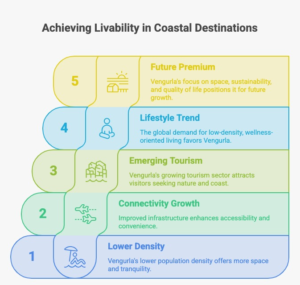
 A visual representation of how low-density coastal living is redefining real estate value through sustainability, open spaces, improved connectivity, and lifestyle-driven investment trends across India's western coastline.
Vengurla vs Goa: Why Low-Density Coastal Living Is Gaining Value for Investors
The Global Shift Toward Space, Sustainability, and Coastal Living
For decades, the world’s most desirable coastal destinations followed a predictable growth pattern. Improved connectivity attracted tourists, tourism drove hospitality investment, infrastructure expanded, and real estate values followed. From Spain’s Costa del Sol and Portugal’s Algarve to Bali and Thailand’s Phuket, popularity often became the primary indicator of a destination’s success.
Table of Contents
- Vengurla vs Goa: Why Low-Density Coastal Living Is Gaining Value for Investors
- The Global Shift Toward Space, Sustainability, and Coastal Living
- The New Economics of Coastal Living
- Why Density Is Becoming a New Luxury Metric
- Vengurla vs Goa: Understanding the Demographic Difference
- Land Availability and the Economics of Scarcity
- Infrastructure: The Foundation of Coastal Growth
- The Impact of Manohar International Airport (Mopa)
- Konkan Railway: The Quiet Infrastructure Success Story
- Why Infrastructure Matters More Than Current Popularity
- Tourism Growth vs Tourism Carrying Capacity: The Next Big Real Estate Indicator
- Goa’s Tourism Success Story
- Why Carrying Capacity Is Becoming an Investment Consideration
- The Appeal of Lower-Volume Coastal Tourism
- Sustainability: From Environmental Concept to Real Estate Driver
- Why Environmental Quality Matters to Buyers
- The Rise of Ecological Capital
- The Rise of India’s Second-Home Economy
- Why Affluent Buyers Are Expanding Their Search Beyond Traditional Markets
- Desire for Privacy
- Wellness-Oriented Living
- Long-Term Lifestyle Planning
- Remote Work Has Changed Coastal Real Estate Forever
- Lifestyle Geography Is Replacing Workplace Geography
- Coastal Living as a Productivity Asset
- Global Lessons from Emerging Coastal Markets
- Portugal’s Secondary Coastal Growth
- Costa Rica’s Sustainable Coastal Model
- Greece and Lifestyle Migration
- What India Can Learn from Global Coastal Markets
- Infrastructure Matters
- Sustainability Matters
- Livability Matters
- Density Matters
- Vengurla vs Goa: Understanding Coastal Real Estate Through an Investor Lens
- Mature Markets vs Emerging Markets: A Strategic Comparison
- Characteristics of Mature Coastal Markets
- Characteristics of Emerging Coastal Markets
- Why Investors Are Paying Attention to Low-Density Coastal Regions
- Infrastructure Remains the Most Important Long-Term Growth Driver
- The Growing Importance of Sustainability in Real Estate Decisions
- Risks Investors Should Consider
- Regulatory Considerations
- Infrastructure Execution Timelines
- Market Liquidity
- Environmental Considerations
- Opportunities Shaping the Future of Coastal Real Estate
- The Expansion of India’s Second-Home Market
- Wellness-Oriented Living
- Domestic Tourism Growth
- The Future Outlook: What Could the Next Decade Look Like?
- FAQs
Today, however, a new trend is emerging.
Around the world, affluent buyers, investors, entrepreneurs, retirees, and remote professionals are increasingly evaluating destinations through a different lens. Instead of asking where the largest crowds are gathering, they are asking where quality of life can be preserved over the long term.
This shift has elevated the importance of concepts such as livability, environmental quality, carrying capacity, sustainability, and population density. As a result, low-density coastal regions are gaining attention as potential long-term lifestyle and investment destinations.
Within India, this trend creates an interesting discussion around Vengurla vs Goa.
While Goa remains India’s most established coastal lifestyle market, Vengurla represents a quieter and less densely developed coastal ecosystem within Maharashtra’s Sindhudurg district. Comparing Vengurla vs Goa is not about identifying a winner. Rather, it provides valuable insight into how coastal destinations evolve and how investor preferences are changing.
The discussion around Vengurla vs Goa is particularly relevant today because infrastructure development, changing work patterns, rising second-home demand, and sustainability concerns are reshaping the future of coastal real estate.
According to the official tourism data released by the Government of Goa, the state crossed more than 1.08 crore tourist arrivals in 2025, reflecting its continued position as one of India’s most sought-after travel destinations. At the same time, emerging coastal regions across the Konkan belt are witnessing growing interest from investors seeking lower-density environments and long-term lifestyle value.
For investors, NRIs, HNIs, and second-home buyers, the real question is not whether one destination is better than another. The more important question is:
Why is low-density coastal living becoming increasingly valuable in the modern economy?
Understanding the answer requires looking beyond beaches and property prices. It requires examining demographics, infrastructure, environmental sustainability, land availability, tourism patterns, and broader global lifestyle trends.
The New Economics of Coastal Living
Historically, coastal property markets were driven primarily by tourism.
The formula was straightforward:
More tourists → More hospitality development → More infrastructure → Higher property demand.
While this model remains relevant, post-pandemic buyer behaviour has introduced additional variables.
Today’s investors increasingly consider:
- Population density
- Environmental quality
- Accessibility
- Wellness opportunities
- Work-life integration
- Long-term livability
- Infrastructure resilience
This change reflects a broader shift in global consumer preferences.
According to the World Travel & Tourism Council, wellness tourism, nature-focused travel, and experience-based living continue to grow faster than many traditional tourism segments.
As a result, destinations offering space, privacy, and ecological quality are becoming increasingly attractive.
The discussion surrounding Vengurla vs Goa fits directly into this global trend.
Why Density Is Becoming a New Luxury Metric
Traditionally, luxury was associated with exclusivity, premium amenities, and prime locations.
Today, another factor is quietly joining that list:
Space.
In many mature real estate markets worldwide, lower population density is increasingly viewed as a premium feature.
Why?
Because density influences:
- Traffic congestion
- Noise levels
- Resource pressure
- Environmental quality
- Public infrastructure load
- Community experience
The value of space became particularly evident after 2020 when many people reassessed their living environments.
Remote work and flexible lifestyles enabled professionals to spend more time outside major metropolitan centres. This increased interest in destinations where natural surroundings and lifestyle quality could coexist with modern connectivity.
This trend has become one of the most significant forces influencing coastal real estate demand globally.
Vengurla vs Goa: Understanding the Demographic Difference
When comparing Vengurla vs Goa, population density provides an important starting point.
According to Census data:
Region | Population | Density |
Goa | Approx. 1.46 Million | 394 persons per sq km |
Vengurla Taluka | Approx. 85,801 | 284 persons per sq km |
Source:
Census of India
The difference may appear modest initially, but its implications become more significant when viewed through the lens of future development.
Lower density often translates into:
- Reduced development pressure
- Lower congestion levels
- Greater land availability
- Enhanced environmental quality
- More opportunities for planned growth
Importantly, density alone does not determine desirability.
Many high-density cities remain highly successful.
However, within coastal lifestyle markets, density increasingly influences the overall experience that residents and visitors associate with a destination.
The conversation around Vengurla vs Goa therefore becomes less about population figures and more about how different stages of development shape future livability.
Land Availability and the Economics of Scarcity
One of the most important yet least discussed aspects of coastal real estate is land supply.
Unlike inland markets, coastal regions face natural limitations because development is constrained by geography, environmental regulations, and coastline availability.
This creates a phenomenon known as scarcity economics.
As destinations mature, available coastal land gradually becomes more limited.
This process has been observed globally in:
- Algarve (Portugal)
- Costa del Sol (Spain)
- Phuket (Thailand)
- Bali (Indonesia)
Goa’s real estate market has evolved significantly over several decades, supported by tourism growth, infrastructure development, and strong domestic and international visibility.
As a mature coastal market, Goa now operates within a framework where prime locations are increasingly scarce.
By contrast, portions of Sindhudurg’s coastline, including Vengurla, remain at an earlier stage of development.
This distinction is particularly important when evaluating Vengurla vs Goa from a long-term investment perspective.
Investors often focus on current pricing.
Experienced investors focus on future supply.
The ability of a region to accommodate future growth while maintaining environmental quality can significantly influence long-term value creation.
Infrastructure: The Foundation of Coastal Growth
No coastal destination achieves long-term growth without infrastructure.
Tourism may create awareness.
Infrastructure creates accessibility.
Accessibility creates investment.
The transformation of India’s western coastline over the past two decades demonstrates this relationship clearly.
Major infrastructure investments have improved connectivity across the Konkan region and strengthened links between Maharashtra, Goa, and key metropolitan centres.
The Impact of Manohar International Airport (Mopa)
One of the most important recent developments influencing the broader coastal ecosystem has been the commissioning of Manohar International Airport.
The airport has expanded connectivity to:
- Mumbai
- Delhi
- Bengaluru
- Hyderabad
- International destinations
Improved air connectivity has several long-term implications:
- Increased tourism arrivals
- Enhanced investor visibility
- Greater accessibility for second-home owners
- Reduced travel friction
According to tourism reports, Goa recorded over one crore tourist arrivals in 2025, reflecting continued growth in domestic travel demand.
As accessibility improves, surrounding coastal regions often benefit indirectly through increased regional awareness and movement.
This is one of the key factors contributing to growing interest in the broader Konkan coastline.
Konkan Railway: The Quiet Infrastructure Success Story
While airports often receive greater attention, rail connectivity has played an equally important role in transforming western India’s coastal corridor.
The Konkan Railway remains one of India’s most significant transportation achievements.
The railway connects:
- Mumbai
- Ratnagiri
- Sindhudurg
- Goa
- Karnataka
Its long-term impact includes:
- Improved mobility
- Tourism growth
- Regional integration
- Economic development
For destinations like Vengurla, accessibility through regional transport networks continues to improve over time, enhancing their visibility among both tourists and investors.
Why Infrastructure Matters More Than Current Popularity
One of the most common mistakes investors make is focusing exclusively on current demand.
Long-term value is often shaped by future accessibility.
Historically, some of the world’s strongest real estate growth stories occurred in locations where infrastructure improvements preceded large-scale demand.
Examples include:
- Portugal’s Algarve
- Dubai Marina
- Bali’s secondary coastal districts
- Southern Thailand’s emerging resort regions
The relevance of Vengurla vs Goa lies partly in this principle.
Goa represents a destination where infrastructure and tourism ecosystems are already well established.
Vengurla represents a destination situated within a region benefiting from ongoing connectivity improvements and broader economic integration.
Neither position is inherently superior.
They simply reflect different stages within the coastal development cycle.
As investors increasingly evaluate destinations through the lenses of sustainability, livability, accessibility, and long-term scarcity, understanding these stages becomes increasingly important.
Tourism Growth vs Tourism Carrying Capacity: The Next Big Real Estate Indicator
For decades, tourism numbers were viewed as one of the strongest indicators of a destination’s success.
More visitors generally meant:
- Stronger local economies
- Higher hospitality revenues
- Better infrastructure
- Increased property demand
- Greater investor confidence
This relationship remains important today.
However, global tourism experts are increasingly emphasizing another metric that often receives less attention:
Carrying Capacity.
Carrying capacity refers to the number of people a destination can comfortably accommodate without creating excessive pressure on infrastructure, natural resources, public services, and environmental systems.
As coastal destinations mature, carrying capacity becomes increasingly relevant to both residents and investors.
This is one of the most important dimensions of the Vengurla vs Goa discussion.
Goa’s Tourism Success Story
Goa remains India’s most recognized coastal tourism destination.
According to official tourism data, Goa recorded over 1.08 crore tourist arrivals in 2025, continuing its strong post-pandemic growth trajectory.
This success has generated significant benefits:
- International brand recognition
- Hospitality expansion
- Employment creation
- Infrastructure development
- Real estate growth
Over several decades, tourism has helped transform Goa into one of India’s most mature lifestyle and second-home markets.
The region’s hospitality ecosystem includes:
- Luxury resorts
- Boutique hotels
- Wellness retreats
- International restaurants
- Premium residential communities
For investors, these factors contribute to a sophisticated and established market environment.
Why Carrying Capacity Is Becoming an Investment Consideration
As destinations grow, investors increasingly evaluate how effectively growth is being managed.
Questions that were once considered environmental concerns are now becoming investment considerations:
- Can water resources support future demand?
- How efficiently is waste managed?
- How much development can the coastline accommodate?
- Can infrastructure keep pace with population growth?
- Will environmental quality remain intact?
Globally, these questions are influencing long-term real estate value.
From the Mediterranean to Southeast Asia, destinations that successfully balance tourism growth with environmental stewardship often maintain stronger long-term desirability.
The emerging conversation around Vengurla vs Goa increasingly reflects this broader global trend.
The Appeal of Lower-Volume Coastal Tourism
One of the most significant shifts in travel behaviour over the past decade has been the rise of experiential tourism.
Travelers are increasingly seeking:
- Authentic local experiences
- Wellness retreats
- Nature-based travel
- Slow tourism
- Cultural immersion
- Longer stays
This trend has encouraged interest in destinations that offer a more relaxed pace of life.
While Goa continues to attract diverse visitor segments and large tourism volumes, regions such as Vengurla appeal to travelers seeking quieter coastal environments.
Importantly, this does not imply one model is superior to another.
Rather, both destinations serve different travel preferences.
For investors evaluating Vengurla vs Goa, understanding these evolving tourism dynamics helps provide context for future demand patterns.
Sustainability: From Environmental Concept to Real Estate Driver
One of the biggest changes in global real estate over the last decade is the growing connection between environmental quality and property value.
Historically, sustainability was often viewed primarily through an environmental lens.
Today, sustainability increasingly influences:
- Investment decisions
- Consumer behaviour
- Tourism preferences
- Corporate relocation strategies
- Residential demand
In many markets, sustainability has evolved into an economic factor.
Why Environmental Quality Matters to Buyers
When people evaluate coastal destinations, they rarely think solely about property.
They think about lifestyle.
This includes:
- Air quality
- Green spaces
- Beach quality
- Biodiversity
- Water quality
- Noise levels
- Access to nature
These factors contribute directly to the experience of living in a destination.
According to the Global Wellness Institute, wellness-oriented lifestyles continue to influence both tourism and residential decision-making worldwide.
As a result, destinations capable of preserving environmental quality often attract increasing attention from affluent buyers.
The Rise of Ecological Capital
A concept gaining traction among urban planners and economists is “ecological capital.”
Ecological capital refers to the natural assets that contribute to long-term human and economic well-being.
Examples include:
- Coastlines
- Forests
- Wetlands
- Biodiversity
- Natural landscapes
Historically, these assets were often viewed separately from economic value.
Today, they are increasingly considered part of a destination’s long-term competitiveness.
When evaluating Vengurla vs Goa, ecological capital becomes an important lens because both destinations possess valuable coastal ecosystems that contribute significantly to their appeal.
Investors are increasingly recognizing that environmental quality is not simply a lifestyle benefit—it can also influence long-term property demand.
The Rise of India’s Second-Home Economy
Perhaps no trend has influenced coastal real estate more significantly in recent years than the growth of second-home ownership.
Before the pandemic, second homes were often viewed as luxury purchases.
Today, they are increasingly viewed as lifestyle assets.
Several factors have contributed to this shift:
- Hybrid work models
- Wealth creation
- Improved infrastructure
- Increased domestic tourism
- Lifestyle diversification
As a result, coastal destinations across India have experienced rising interest from affluent buyers seeking properties that serve both personal and investment purposes.
Why Affluent Buyers Are Expanding Their Search Beyond Traditional Markets
Historically, many second-home buyers focused on established destinations.
However, recent years have witnessed growing interest in emerging locations.
Several reasons explain this trend:
Desire for Privacy
Affluent buyers increasingly value:
- Personal space
- Quiet surroundings
- Reduced congestion
- Community exclusivity
Wellness-Oriented Living
Many buyers are prioritizing:
- Nature access
- Outdoor activities
- Mental well-being
- Work-life balance
Long-Term Lifestyle Planning
Second homes are increasingly viewed as:
- Future retirement residences
- Family retreats
- Hybrid work locations
- Wealth preservation assets
These trends directly influence the ongoing conversation surrounding Vengurla vs Goa.
Remote Work Has Changed Coastal Real Estate Forever
One of the most transformative developments of the modern era has been the widespread adoption of remote and hybrid work.
Before 2020, housing decisions were often tied directly to workplace proximity.
Today, many professionals have greater geographic flexibility.
This has fundamentally changed residential preferences.
Lifestyle Geography Is Replacing Workplace Geography
A growing number of professionals now evaluate destinations based on:
- Quality of life
- Connectivity
- Climate
- Wellness opportunities
- Access to nature
Rather than asking:
“How close is this property to my office?”
Many buyers now ask:
“How does this location support the life I want to live?”
This shift is reshaping coastal real estate markets globally.
The relevance of Vengurla vs Goa becomes clearer when viewed through this lens.
Both destinations offer access to coastal lifestyles, but they represent different points along the spectrum of development intensity and population density.
Coastal Living as a Productivity Asset
An emerging body of research suggests that access to nature can positively influence:
- Mental well-being
- Creativity
- Stress reduction
- Overall life satisfaction
This is one reason why entrepreneurs, business owners, consultants, and remote professionals are increasingly exploring coastal living options.
For many of these individuals, residential decisions are no longer purely financial.
They are lifestyle decisions supported by economic considerations.
Global Lessons from Emerging Coastal Markets
The dynamics observed in Vengurla vs Goa are not unique to India.
Similar patterns have emerged in several global markets.
Portugal’s Secondary Coastal Growth
Portugal’s Algarve remains one of Europe’s most desirable coastal regions.
However, as major destinations matured, demand gradually expanded into smaller coastal towns offering:
- Lower density
- Greater privacy
- Comparable natural beauty
This pattern demonstrates how growth often spreads beyond primary destinations over time.
Costa Rica’s Sustainable Coastal Model
Costa Rica has become an international benchmark for eco-conscious tourism and lifestyle migration.
Many buyers have chosen smaller coastal communities because of:
- Environmental quality
- Sustainability initiatives
- Lower-density development
The country’s experience highlights the growing importance of ecological preservation in real estate demand.
Greece and Lifestyle Migration
Across Greece, lifestyle migration has become increasingly important.
Many buyers are selecting destinations based not solely on tourism popularity but on long-term livability and quality of life.
This reflects a broader global trend that extends well beyond any single country.
What India Can Learn from Global Coastal Markets
Several common lessons emerge from international experience:
Infrastructure Matters
Accessibility remains fundamental to growth.
Sustainability Matters
Environmental quality increasingly influences value.
Livability Matters
Long-term residential appeal is becoming as important as tourism demand.
Density Matters
Space and privacy are increasingly recognized as premium attributes.
These themes help explain why the conversation around Vengurla vs Goa resonates with investors today.
The comparison reflects larger questions about how coastal destinations create value in a changing world.
Vengurla vs Goa: Understanding Coastal Real Estate Through an Investor Lens
Every successful real estate investment begins with understanding market cycles.
Some destinations are in the early stages of growth.
Others have already achieved maturity.
Neither stage is inherently better. Each serves different investment objectives.
This is perhaps the most important lesson from the discussion surrounding Vengurla vs Goa.
Too often, investors attempt to identify a single “best” destination.
In reality, successful investing is often about matching investment goals with the characteristics of a particular market.
For example:
- Mature markets may offer greater stability and established demand.
- Emerging markets may offer greater growth potential but require longer investment horizons.
Understanding where a destination sits within its development cycle helps investors make more informed decisions.
Mature Markets vs Emerging Markets: A Strategic Comparison
When evaluating Vengurla vs Goa, it is useful to think in terms of market maturity.
Characteristics of Mature Coastal Markets
Mature markets typically feature:
- Strong destination recognition
- Established tourism ecosystems
- Developed infrastructure
- Diverse hospitality offerings
- Higher market liquidity
- Greater transaction volumes
Goa represents one of India’s most mature coastal real estate and tourism markets.
Decades of tourism growth have contributed to:
- Global visibility
- Strong hospitality infrastructure
- Diverse residential offerings
- Robust second-home demand
For many investors, maturity provides confidence because market behaviour is often easier to evaluate.
Characteristics of Emerging Coastal Markets
Emerging markets often feature:
- Lower development intensity
- Greater land availability
- Growing infrastructure investment
- Earlier-stage tourism ecosystems
- Longer growth cycles
Many parts of Sindhudurg, including Vengurla, exhibit characteristics commonly associated with emerging coastal markets.
These regions may appeal to investors seeking exposure to long-term growth trends linked to:
- Infrastructure development
- Lifestyle migration
- Tourism expansion
- Second-home demand
Importantly, emerging markets typically require patience.
Value creation often occurs gradually as connectivity, awareness, and economic activity evolve.
Why Investors Are Paying Attention to Low-Density Coastal Regions
Historically, real estate value was strongly linked to urbanization.
Cities attracted jobs.
Jobs attracted people.
People created demand.
Today, a new dynamic is emerging.
Technology and remote work have reduced the need for many professionals to remain physically close to major business districts.
This shift has increased interest in destinations offering:
- Natural surroundings
- Better work-life balance
- Lower congestion
- Wellness-oriented lifestyles
As a result, low-density coastal destinations are becoming increasingly relevant to modern investment conversations.
The growing interest in Vengurla vs Goa reflects this larger transition.
Infrastructure Remains the Most Important Long-Term Growth Driver
While lifestyle trends influence demand, infrastructure remains the foundation of long-term value creation.
History consistently demonstrates that accessibility drives growth.
Examples can be found across:
- Portugal
- Spain
- Thailand
- Indonesia
- United Arab Emirates
In each case, transportation improvements often preceded significant increases in tourism and real estate activity.
Within India’s western coastal corridor, infrastructure developments continue to strengthen regional connectivity.
Key contributors include:
For investors, monitoring infrastructure progress often provides valuable insight into future growth potential.
The Growing Importance of Sustainability in Real Estate Decisions
One of the most important developments shaping future property markets is the increasing connection between sustainability and value.
Historically, environmental quality was viewed primarily as a lifestyle benefit.
Today, it is increasingly recognized as an economic asset.
According to global sustainability research, destinations that effectively preserve environmental quality often maintain stronger long-term desirability.
This trend has significant implications for coastal real estate.
Factors such as:
- Beach quality
- Biodiversity
- Green cover
- Water resources
- Coastal ecosystem health
They are becoming increasingly important to both residents and investors.
The discussion surrounding Vengurla vs Goa highlights how sustainability is becoming part of the broader investment conversation.
Risks Investors Should Consider
Every investment opportunity involves risk.
Understanding potential challenges is just as important as identifying opportunities.
A balanced analysis of Vengurla vs Goa therefore, requires acknowledging the factors investors should evaluate carefully.
Regulatory Considerations
Coastal regions often operate within environmental frameworks designed to protect sensitive ecosystems.
Examples include:
- Coastal Regulation Zone (CRZ) rules
- Environmental clearances
- Development restrictions
Investors should always conduct due diligence regarding applicable regulations before making decisions.
Infrastructure Execution Timelines
Infrastructure projects can significantly influence regional growth.
However, project timelines may vary.
Factors influencing execution include:
- Funding
- Approvals
- Construction schedules
- Policy priorities
Investors should evaluate infrastructure plans realistically rather than assuming immediate outcomes.
Market Liquidity
Mature markets often exhibit:
- Higher transaction volumes
- Greater buyer activity
- More predictable liquidity
Emerging markets may experience:
- Longer holding periods
- Lower transaction frequency
- Extended value realization cycles
Neither characteristic is inherently positive or negative.
They simply reflect different market dynamics.
Environmental Considerations
Coastal regions are among the most environmentally sensitive geographies in the world.
Investors should assess:
- Coastal resilience
- Environmental regulations
- Resource management
- Long-term sustainability initiatives
Responsible development increasingly plays a critical role in preserving destination quality.
Opportunities Shaping the Future of Coastal Real Estate
While risks deserve consideration, several powerful trends continue to support long-term interest in coastal destinations.
The Expansion of India’s Second-Home Market
According to multiple industry reports from Knight Frank, CBRE, JLL, and ANAROCK, demand for lifestyle-oriented residential assets continues to grow.
This trend is being supported by:
- Rising disposable incomes
- Wealth creation
- Flexible work models
- Lifestyle diversification
Wellness-Oriented Living
The Global Wellness Institute continues to identify wellness-focused lifestyles as a major global growth trend.
Demand is increasingly influenced by:
- Nature access
- Outdoor recreation
- Mental well-being
- Sustainable living
Coastal destinations are naturally positioned to benefit from these preferences.
Domestic Tourism Growth
India’s domestic tourism market continues to expand significantly.
Growing domestic mobility supports:
- Hospitality demand
- Infrastructure investment
- Regional economic development
- Lifestyle destination awareness
This trend contributes to the broader relevance of Vengurla vs Goa as investors examine evolving coastal markets.
The Future Outlook: What Could the Next Decade Look Like?
Predicting future market performance with certainty is impossible.
However, several structural trends are likely to influence coastal destinations over the coming decade.
Trend 1: Density Will Become Increasingly Important
As urban populations continue to grow, lower-density environments may become increasingly attractive.
The concept of “space as luxury” is likely to gain further relevance.
Trend 2: Sustainability Will Influence Value Creation
Environmental quality is expected to become an increasingly important component of destination competitiveness.
Destinations that successfully balance growth and preservation may benefit in the long term.
Trend 3: Lifestyle Migration Will Continue
Many professionals now possess greater flexibility regarding where they live and work.
This trend is likely to continue influencing residential preferences.
Trend 4: Infrastructure Will Shape Regional Growth
Improved connectivity will remain one of the strongest drivers of future economic activity.
Investors should continue monitoring transportation and regional development initiatives.
Trend 5: Coastal Real Estate Will Become More Experience-Driven
Future buyers may increasingly evaluate destinations based on:
- Quality of life
- Wellness opportunities
- Community experience
- Environmental quality
rather than purely financial considerations.
FAQs
1. What makes the comparison of Vengurla vs Goa relevant for today’s investors?
The discussion around Vengurla vs Goa reflects a broader shift in real estate preferences. Investors are increasingly evaluating destinations based on factors such as population density, sustainability, infrastructure growth, and long-term livability rather than solely on tourism popularity. While Goa represents a mature coastal market, Vengurla highlights the growing appeal of lower-density coastal regions.
2. Is Vengurla less densely populated than Goa?
Yes. According to Census data, Vengurla Taluka has a lower population density than Goa’s state average. This lower density contributes to factors such as reduced congestion, greater open spaces, and a different lifestyle experience, which are increasingly valued by second-home buyers and lifestyle investors evaluating Vengurla vs Goa.
3. Why is low-density coastal living becoming more valuable?
Globally, buyers are increasingly prioritizing space, privacy, wellness, and environmental quality. The rise of hybrid work models and lifestyle migration has encouraged many investors to explore lower-density coastal destinations. This trend is a key reason why the Vengurla vs Goa conversation is gaining attention among investors and second-home buyers.
4. How does infrastructure influence the Vengurla vs Goa investment outlook?
Infrastructure remains one of the strongest drivers of long-term property value. Airports, highways, and railway networks improve accessibility, attract tourism, and support economic growth. Developments such as Manohar International Airport and the Konkan Railway have strengthened connectivity across the western coastal corridor, influencing both Goa and surrounding Konkan regions.
5. What role does sustainability play in the Vengurla vs Goa discussion?
Sustainability has become an increasingly important factor in real estate value creation. Investors now consider environmental quality, coastal ecosystem health, green cover, and resource management when evaluating destinations. In the context of Vengurla vs Goa, sustainability provides an important framework for understanding long-term livability and resilience.
6. Why are second-home buyers looking beyond traditional coastal markets?
Many second-home buyers are seeking destinations that offer a balance between accessibility, lifestyle quality, and environmental appeal. The growth of remote work, wellness-focused living, and lifestyle investing has encouraged buyers to explore both established and emerging coastal destinations. This trend has made the Vengurla vs Goa comparison particularly relevant.
7. Is Goa still an attractive destination for coastal real estate investment?
Goa remains one of India’s most established coastal markets, supported by strong tourism demand, developed infrastructure, international visibility, and a mature hospitality ecosystem. For investors comparing Vengurla vs Goa, Goa offers insights into how a coastal market evolves over time and sustains long-term demand.
8. What should investors evaluate before purchasing coastal property?
Investors should assess several factors before making a coastal real estate decision, including:
Infrastructure connectivity
Regulatory compliance
Environmental considerations
Market maturity
Tourism trends
Population density
Long-term development potential
The broader Vengurla vs Goa analysis demonstrates why evaluating these fundamentals is essential for informed decision-making.
The story of Vengurla vs Goa is ultimately not about comparing two destinations to determine which is better. Rather, it is about understanding how coastal markets evolve and why buyer preferences are changing across India and around the world.
Over the past decade, factors such as remote work, wellness-focused lifestyles, sustainability awareness, and the growth of the second-home economy have transformed the way investors evaluate coastal destinations. Traditional metrics such as tourism numbers and property prices remain important, but they are increasingly being complemented by considerations such as livability, population density, environmental quality, infrastructure resilience, and long-term lifestyle value.
Goa represents the strength of a mature coastal ecosystem—one that has benefited from decades of tourism growth, infrastructure investment, global recognition, and sustained real estate demand. Its evolution demonstrates how accessibility, hospitality, and economic activity can create a thriving coastal economy.
Vengurla, on the other hand, highlights characteristics that are becoming increasingly relevant in today’s market: lower density, greater open spaces, environmental appeal, and a quieter coastal experience. As infrastructure improvements continue across the Konkan region, destinations like Vengurla are becoming part of a larger conversation about the future of coastal living in India.
The most significant takeaway from the Vengurla vs Goa discussion is that the future of coastal real estate may not be defined solely by popularity. Increasingly, it may be shaped by how effectively destinations balance growth with sustainability, accessibility with exclusivity, and development with environmental preservation.
For investors, NRIs, HNIs, entrepreneurs, and second-home buyers, the key lesson is clear: understanding long-term value creation requires looking beyond short-term trends. The coastal destinations that successfully preserve livability, ecological quality, and infrastructure readiness are likely to remain relevant for decades to come.
As India’s coastal landscape continues to evolve, the question is no longer simply where people want to travel. The more important question is where people will choose to live, work, invest, and build lasting lifestyle value—and that is precisely why the conversation around Vengurla vs Goa matters today.









No Comments