




 With improving connectivity, expanding tourism, and a scenic coastline, Sindhudurg is increasingly attracting attention as an emerging destination for long-term investment and sustainable coastal growth.
Why Sindhudurg Investment Is Moving from a Hidden Coastline to an Investor Watchlist
The Investment Opportunities Most People Notice Too Late
Throughout history, some of the strongest investment destinations have emerged quietly before attracting widespread attention. In real estate and land markets, investors often discover the greatest opportunities not when a location becomes famous, but when the fundamental drivers of growth begin aligning beneath the surface.
Table of Contents
- Why Sindhudurg Investment Is Moving from a Hidden Coastline to an Investor Watchlist
- The Investment Opportunities Most People Notice Too Late
- Understanding Sindhudurg’s Transformation Story
- From Coastal District to Emerging Investment Geography
- Why the Investment Conversation Has Changed
- Infrastructure Is Rewriting the Sindhudurg Investment Narrative
- Chipi Airport and Regional Accessibility
- Why Connectivity Matters
- Mumbai-Goa Highway Expansion
- Enhanced Mobility
- Regional Integration
- Improved Accessibility
- The Konkan Coastal Expressway Vision
- The Nagpur-Goa Economic Corridor
- Tourism Is Evolving Beyond Traditional Coastal Travel
- The Strength of a Diversified Tourism Ecosystem
- Rise of Experiential Tourism
- India’s First Submarine Tourism Initiative
- The Goa Spillover Effect and Regional Growth Dynamics
- Why Adjacent Growth Corridors Matter
- Strategic Geographic Advantage
- Why Coastal Real Estate Is Becoming a National Investment Theme
- Post-Pandemic Lifestyle Migration
- The Rise of Second-Home Ownership
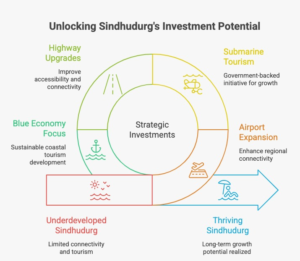
- Land Scarcity: The Often Overlooked Driver of Sindhudurg Investment
- Understanding Developable Land
- Why Scarcity Matters
- How Sophisticated Investors Evaluate Land Markets
- Hospitality Growth Is Still in Its Early Stages
- Emerging Hospitality Trends
- Demand and Supply Dynamics
- Tourism’s Economic Multiplier Effect
- Sindhudurg and India’s Blue Economy Opportunity
- What Is the Blue Economy?
- Why Sindhudurg Is Strategically Positioned
- Long-Term Relevance for Investors
- What Sophisticated Investors Look for Before Entering Emerging Markets
- Infrastructure Signals
- Tourism Signals
- Policy Signals
- Scarcity Signals
- Risks Every Investor Should Evaluate
- Infrastructure Delays
- Regulatory Considerations
- Liquidity Considerations
- Environmental Sustainability
- Sindhudurg Investment Outlook: What the Next Decade Could Look Like
- Infrastructure Maturity
- Tourism Expansion
- Lifestyle Migration
- Blue Economy Growth
- Regional Economic Integration
- FAQs
- Why Sindhudurg Is Appearing on More Investor Watchlists
Over the past two decades, India has witnessed several such transformations. Locations that were once considered peripheral gradually evolved into important economic and investment hubs due to infrastructure upgrades, connectivity improvements, policy support, and changing consumer preferences. These transitions rarely happen overnight. Instead, they unfold through a combination of long-term developments that steadily reshape how people live, travel, work, and invest.
Today, a similar conversation is beginning to emerge around Sindhudurg.
Located along Maharashtra’s Konkan coastline, Sindhudurg has historically been known for its natural beauty, fisheries, agriculture, cultural heritage, and tourism potential. While the district remained relatively less discussed in mainstream investment conversations compared to larger metropolitan regions, recent developments have started attracting the attention of investors, entrepreneurs, second-home buyers, hospitality operators, and long-term wealth planners.
The growing interest in Sindhudurg Investment is not being driven by speculation alone. Rather, it is supported by several measurable factors including infrastructure development, enhanced connectivity, tourism diversification, government initiatives, coastal economic opportunities, and increasing interest in lifestyle-oriented destinations.
One of Sindhudurg’s most distinctive advantages is its approximately 121–122 km coastline, making it one of Maharashtra’s most important coastal districts. According to the Maharashtra Tourism Department, the region offers a unique blend of beaches, forts, marine biodiversity, eco-tourism opportunities, and cultural attractions.
At the same time, projects such as the operational Sindhudurg Airport at Chipi, upgrades to the Mumbai-Goa Highway, coastal tourism initiatives, and broader Konkan infrastructure investments are contributing to a changing economic landscape.
For investors, understanding Sindhudurg Investment requires looking beyond traditional real estate discussions. It involves examining how infrastructure, tourism, environmental assets, and economic development intersect to create long-term opportunities.
This article explores the key drivers shaping Sindhudurg’s emergence as a destination increasingly appearing on India’s investment watchlists and examines why many investors are studying the region as part of a long-term wealth creation strategy.
Understanding Sindhudurg’s Transformation Story
From Coastal District to Emerging Investment Geography
For decades, Sindhudurg’s economy was primarily associated with agriculture, fisheries, horticulture, tourism, and small-scale trade. Mango cultivation, cashew production, fishing activities, and coastal tourism have long formed important pillars of the local economy.
However, many regions around the world undergo significant transformation when infrastructure improves and economic activity expands beyond traditional sectors. Sindhudurg appears to be entering such a phase.
The district occupies a strategically important position within the Konkan region. Its location along the Arabian Sea, combined with proximity to Goa and access to major transportation corridors, provides a unique combination of environmental and economic advantages.
Historically, accessibility remained one of the region’s primary limitations. Long travel times often restricted visitor movement and constrained broader investment activity. As connectivity improves, these barriers are gradually being reduced.
Investors evaluating Sindhudurg Investment increasingly focus on structural indicators rather than short-term market sentiment. These indicators include:
- Transportation infrastructure
- Tourism growth
- Government investment
- Hospitality expansion
- Land availability
- Environmental sustainability
- Coastal economic development
Together, these factors are contributing to a shift in how the district is perceived.
Why the Investment Conversation Has Changed
Several years ago, discussions about Sindhudurg primarily centered around tourism and natural attractions. Today, the conversation is becoming more sophisticated.
Investors are increasingly examining:
- Regional infrastructure plans
- Future connectivity corridors
- Hospitality opportunities
- Coastal development initiatives
- Lifestyle migration trends
- Long-term land scarcity dynamics
This evolution reflects a broader shift occurring across India, where investors are increasingly looking beyond major cities in search of emerging growth corridors.
The rise of remote work, hybrid work models, wellness-focused lifestyles, and second-home ownership has also influenced investment patterns. Many high-net-worth individuals and entrepreneurs are exploring destinations that offer environmental quality alongside improving accessibility.
As a result, Sindhudurg Investment is gradually becoming part of a larger conversation about the future of coastal living, tourism, and regional economic growth.
Infrastructure Is Rewriting the Sindhudurg Investment Narrative
Infrastructure has historically played a decisive role in determining long-term investment outcomes.
Whether examining the growth of Gurgaon, Navi Mumbai, Pune, or emerging industrial corridors, infrastructure often acts as the catalyst that unlocks economic potential.
For investors studying Sindhudurg Investment, infrastructure developments represent one of the most important factors influencing future growth.
Chipi Airport and Regional Accessibility
Among the most significant developments in recent years has been the operationalization of Sindhudurg Airport at Chipi.
The airport has substantially improved accessibility to the district by reducing dependence on lengthy road journeys and creating a direct gateway for tourists, business travelers, and property owners.
Information available through the Airports Authority of India and regional tourism authorities highlights the strategic importance of enhanced air connectivity in supporting regional economic development.
Improved air access can influence multiple sectors simultaneously:
- Tourism
- Hospitality
- Business travel
- Real estate demand
- Entrepreneurial activity
- Service industries
For many investors evaluating Sindhudurg Investment, the airport serves as a critical indicator of long-term connectivity improvements.
Why Connectivity Matters
Investment destinations often experience growth when travel friction decreases.
When accessibility improves:
- Visitor numbers can increase
- Hospitality demand may expand
- Business activity becomes easier
- Tourism becomes more predictable
- Lifestyle migration becomes more feasible
While infrastructure alone does not guarantee investment success, it frequently creates conditions that support broader economic development.
Mumbai-Goa Highway Expansion
Another major development influencing Sindhudurg Investment is the ongoing improvement of the Mumbai-Goa Highway.
The corridor serves as one of the most important transportation routes connecting Mumbai, Goa, and the Konkan region.
Information from the National Highways Authority of India (NHAI) highlights the broader objective of improving transportation efficiency, reducing travel bottlenecks, and supporting regional economic growth.
For investors, highway infrastructure can have several implications:
Enhanced Mobility
Improved road infrastructure supports:
- Tourism movement
- Commercial transportation
- Supply chains
- Hospitality operations
Regional Integration
Highways strengthen economic relationships between districts and major urban centers.
Improved Accessibility
Accessibility remains one of the most closely watched indicators in emerging investment markets.
When travel becomes easier and more predictable, both economic and social activity can accelerate.
The Konkan Coastal Expressway Vision
Beyond existing road improvements, the proposed Konkan Coastal Expressway represents another development attracting investor attention.
Although still part of longer-term infrastructure planning, the project has generated interest because of its potential to improve regional connectivity across Maharashtra’s coastline.
If implemented as envisioned, such connectivity projects could contribute to:
- Faster intercity movement
- Increased tourism circulation
- Enhanced logistics efficiency
- Greater economic integration
Long-term investors often monitor infrastructure proposals years before completion because investment cycles frequently begin before projects become fully operational.
The significance of Sindhudurg Investment therefore extends beyond existing infrastructure and includes future transportation networks that may influence regional growth over the coming decade.
The Nagpur-Goa Economic Corridor
Another strategic initiative being discussed in Maharashtra’s broader infrastructure landscape is enhanced east-west connectivity linking inland economic centers with coastal regions.
Such corridors can contribute to:
- Trade expansion
- Tourism circulation
- Regional development
- Business activity
For investors, transportation corridors often serve as indicators of future economic integration.
The combination of airport connectivity, highway upgrades, and broader infrastructure planning creates a more comprehensive framework for evaluating Sindhudurg Investment from a long-term perspective.
Tourism Is Evolving Beyond Traditional Coastal Travel
Tourism remains one of Sindhudurg’s most visible economic drivers.
However, the district’s tourism story is increasingly evolving beyond conventional beach tourism.
Across the world, tourism trends are shifting toward experiences that emphasize authenticity, sustainability, wellness, adventure, and cultural engagement.
Sindhudurg’s natural assets position it well within several of these emerging tourism categories.
The Strength of a Diversified Tourism Ecosystem
According to information available through the Maharashtra Tourism Department, Sindhudurg offers a combination of:
- Beaches
- Marine ecosystems
- Historical forts
- Backwaters
- Adventure activities
- Cultural heritage
- Eco-tourism opportunities
Diversification is important because it reduces dependence on a single tourism segment.
Destinations that offer multiple experiences often attract:
- Wider visitor demographics
- Longer stays
- Repeat visitation
- More resilient tourism demand
These characteristics can create stronger long-term economic foundations.
Rise of Experiential Tourism
Experiential tourism has emerged as one of the fastest-growing segments globally.
Today’s travelers increasingly seek:
- Unique experiences
- Nature-based activities
- Cultural immersion
- Wellness retreats
- Sustainable travel opportunities
Sindhudurg’s coastal ecosystems, historic sites, marine resources, and natural landscapes align closely with these evolving preferences.
As tourism becomes more experience-driven, investors are paying closer attention to destinations capable of supporting diversified visitor demand.
This trend adds another dimension to the broader Sindhudurg Investment narrative.
India’s First Submarine Tourism Initiative
One of the most widely discussed tourism developments in the district is the submarine tourism initiative near Nivati Rock.
The project has received support from state and central authorities and aims to create unique underwater tourism experiences through:
- Marine heritage attractions
- Artificial reef development
- Underwater tourism infrastructure
- Educational marine experiences
Information regarding the project has been highlighted by multiple national media outlets and tourism authorities.
What makes this initiative significant is not merely its novelty.
Rather, it reflects a broader effort to position Sindhudurg as a destination capable of offering differentiated tourism experiences that extend beyond traditional coastal recreation.
For investors evaluating Sindhudurg Investment, tourism diversification often serves as an indicator of broader economic evolution.
When destinations attract multiple visitor segments, they can support hospitality growth, local entrepreneurship, employment generation, and long-term economic activity.
The continued expansion of experiential tourism therefore remains an important factor in understanding why Sindhudurg is increasingly appearing on investor watchlists.
The Goa Spillover Effect and Regional Growth Dynamics
One of the most widely observed phenomena in regional economic development is the spillover effect. As established destinations mature, surrounding regions often begin attracting attention from investors, businesses, tourists, and infrastructure planners.
This pattern has been observed across India.
Delhi’s growth encouraged expansion into Gurgaon and Noida. Mumbai’s economic influence supported the emergence of Navi Mumbai and surrounding corridors. Similar dynamics have occurred around Bengaluru, Hyderabad, Pune, and Chennai.
The concept is relatively simple. As economic activity increases within a region, demand for land, tourism, hospitality, and lifestyle assets often expands beyond the primary market into adjacent geographies.
For those studying Sindhudurg Investment, understanding this broader regional context is important.
Why Adjacent Growth Corridors Matter
Investors often track neighboring regions because infrastructure, tourism, and economic activity rarely stop at administrative boundaries.
Instead, growth frequently spreads through:
- Transportation networks
- Tourism circuits
- Hospitality ecosystems
- Business linkages
- Lifestyle migration patterns
Sindhudurg’s location within the Konkan belt places it within a larger coastal ecosystem that continues to attract increasing attention from domestic and international travelers.
The district’s strategic position allows it to benefit from broader regional tourism and economic activity while maintaining its own distinct identity.
Strategic Geographic Advantage
Geography remains one of the few investment factors that cannot be replicated.
Sindhudurg possesses several geographic strengths:
- Extensive coastline
- Access to the Arabian Sea
- Marine biodiversity
- Connectivity to major tourism circuits
- Proximity to western India’s major economic centers
For long-term investors, geography often serves as the foundation upon which infrastructure and economic activity are built.
This is one reason why Sindhudurg Investment is increasingly being evaluated through a long-term strategic lens rather than solely through short-term market trends.
Why Coastal Real Estate Is Becoming a National Investment Theme
The growing interest in Sindhudurg Investment is also linked to a broader shift occurring across India’s real estate landscape.
Over the past decade, coastal destinations have gained attention not only as tourism hubs but also as lifestyle and investment destinations.
Several factors are driving this trend.
Post-Pandemic Lifestyle Migration
The pandemic accelerated changes in how people think about work, housing, and quality of life.
Many professionals, entrepreneurs, and business owners began prioritizing:
- Open spaces
- Environmental quality
- Wellness-oriented living
- Flexible work environments
- Nature-connected lifestyles
Research reports from Knight Frank India Research and JLL India Research have highlighted growing interest in second homes and lifestyle-oriented residential markets.
While metropolitan centers remain critical economic engines, many investors are increasingly diversifying their real estate portfolios by exploring destinations that offer a balance between accessibility and quality of life.
The Rise of Second-Home Ownership
Second homes have evolved beyond vacation properties.
For many investors, they now represent:
- Lifestyle assets
- Long-term holdings
- Wealth preservation tools
- Family legacy assets
As transportation infrastructure improves, destinations previously considered remote become increasingly viable for periodic occupancy and long-term ownership.
This trend contributes to the growing relevance of Sindhudurg Investment within broader discussions about lifestyle-oriented real estate.
Land Scarcity: The Often Overlooked Driver of Sindhudurg Investment
When evaluating emerging investment destinations, investors often focus on demand.
However, supply dynamics can be equally important.
In coastal regions, land availability is influenced by several factors that can limit future development.
Understanding Developable Land
Not all land within a district can be developed.
Several constraints influence development potential:
- Coastal Regulation Zone (CRZ) norms
- Environmental protection requirements
- Forest areas
- Agricultural classifications
- Topographical limitations
Information available through various government planning frameworks highlights the importance of balancing development with environmental preservation.
As a result, the amount of developable land may be significantly smaller than the district’s total geographical area.
Why Scarcity Matters
From an investment perspective, scarcity often influences long-term value.
When infrastructure improves and demand increases, limited supply can become an important factor shaping market dynamics.
This does not automatically guarantee appreciation, but it does create conditions that investors monitor closely.
For those evaluating Sindhudurg Investment, understanding land availability requires a nuanced approach that considers regulatory, environmental, and geographical realities.
How Sophisticated Investors Evaluate Land Markets
Experienced investors typically assess several variables:
- Connectivity
- Infrastructure proximity
- Tourism activity
- Environmental regulations
- Long-term development potential
Rather than focusing solely on current market conditions, many investors examine how these factors may evolve over a period of years or decades.
Hospitality Growth Is Still in Its Early Stages
Tourism and hospitality often evolve together.
As visitor numbers increase and tourism offerings diversify, demand for accommodation, services, and visitor experiences can expand.
This creates opportunities for hospitality development.
Emerging Hospitality Trends
Several hospitality categories are gaining attention globally:
- Boutique resorts
- Wellness retreats
- Eco-tourism accommodations
- Nature-focused stays
- Experiential hospitality concepts
These formats often align well with destinations that emphasize environmental quality and unique local experiences.
Demand and Supply Dynamics
One factor investors frequently analyze is the relationship between visitor growth and accommodation capacity.
As destinations evolve, demand for quality hospitality infrastructure may increase alongside tourism activity.
For investors studying Sindhudurg Investment, hospitality serves as an important indicator because it reflects broader economic engagement with the region.
Tourism’s Economic Multiplier Effect
Tourism can support a wide range of local industries including:
- Transportation
- Restaurants
- Retail
- Recreation
- Services
- Small businesses
These multiplier effects contribute to regional economic development and help diversify local economies.
Sindhudurg and India’s Blue Economy Opportunity
One of the least discussed but potentially most significant themes influencing Sindhudurg Investment is India’s growing focus on the Blue Economy.
What Is the Blue Economy?
The Blue Economy refers to sustainable economic activities connected to oceans, coasts, and marine resources.
According to policy discussions from NITI Aayog and the Sagarmala Programme, key areas include:
- Coastal tourism
- Fisheries
- Maritime infrastructure
- Marine conservation
- Sustainable coastal development
Why Sindhudurg Is Strategically Positioned
Sindhudurg’s extensive coastline and marine assets position it within this larger national conversation.
The district’s strengths include:
- Marine biodiversity
- Coastal ecosystems
- Fisheries resources
- Tourism assets
- Maritime heritage
As India continues investing in coastal development, regions with strong marine and tourism assets may benefit from broader policy support and economic activity.
Long-Term Relevance for Investors
The significance of the Blue Economy lies in its long-term nature.
Unlike short-term market cycles, coastal economic development often unfolds over decades.
For long-term investors, understanding these structural trends can provide valuable context when evaluating emerging destinations.
What Sophisticated Investors Look for Before Entering Emerging Markets
Investment decisions are rarely based on a single factor.
Experienced investors typically assess multiple indicators before committing capital.
Infrastructure Signals
Key questions include:
- Is connectivity improving?
- Are transportation networks expanding?
- Are government investments visible?
Tourism Signals
Investors often evaluate:
- Visitor growth
- Tourism diversification
- Hospitality expansion
Policy Signals
Policy support can influence:
- Infrastructure development
- Tourism promotion
- Economic activity
Scarcity Signals
Supply constraints often affect long-term market dynamics.
Investors therefore examine:
- Land availability
- Environmental regulations
- Development limitations
When viewed collectively, these indicators help investors build a more comprehensive understanding of Sindhudurg Investment.
Risks Every Investor Should Evaluate
A balanced investment analysis must consider both opportunities and risks.
Infrastructure Delays
Large infrastructure projects can experience delays due to:
- Regulatory approvals
- Funding requirements
- Construction challenges
Investors should therefore evaluate timelines carefully.
Regulatory Considerations
Coastal regions often operate within complex regulatory frameworks.
These may include:
- Environmental approvals
- CRZ regulations
- Land-use classifications
Due diligence remains essential.
Liquidity Considerations
Emerging markets may exhibit lower liquidity compared to mature urban markets.
Investors should align investment horizons with their liquidity requirements.
Environmental Sustainability
Long-term growth depends upon maintaining environmental balance.
Sustainable development practices play an important role in preserving the natural assets that contribute to Sindhudurg’s attractiveness.
Sindhudurg Investment Outlook: What the Next Decade Could Look Like
Predicting future outcomes with certainty is impossible.
However, investors can evaluate trends and structural drivers.
Several themes are likely to influence the future of Sindhudurg Investment.
Infrastructure Maturity
As transportation projects advance, connectivity may continue improving across the region.
Tourism Expansion
Tourism diversification could support broader economic activity and hospitality development.
Lifestyle Migration
Growing interest in coastal living, wellness-focused lifestyles, and second homes may continue influencing demand patterns.
Blue Economy Growth
National initiatives related to coastal development and marine resources could create additional opportunities over time.
Regional Economic Integration
Improved connectivity may strengthen relationships between Sindhudurg and larger economic centers across western India.
Together, these trends contribute to the increasing attention the district is receiving from long-term investors.
FAQs
1- Is Sindhudurg Investment suitable for long-term investors?
Many investors evaluate Sindhudurg Investment from a long-term perspective due to ongoing infrastructure development, tourism growth, and coastal economic opportunities.
2- What infrastructure projects are influencing Sindhudurg Investment?
Key developments include Sindhudurg Airport at Chipi, Mumbai-Goa Highway improvements, proposed coastal connectivity projects, and broader regional infrastructure initiatives.
3- Why is connectivity important for Sindhudurg Investment?
Improved connectivity can influence tourism, hospitality, business activity, and overall economic development.
4- How does tourism affect Sindhudurg Investment?
Tourism supports local economic activity and can create demand across hospitality, transportation, retail, and service sectors.
5- What role does the Blue Economy play?
The Blue Economy focuses on sustainable coastal and marine development, creating long-term opportunities related to tourism, fisheries, and coastal infrastructure.
6- What risks should investors consider?
Infrastructure delays, regulatory requirements, liquidity considerations, and environmental compliance are among the factors investors should evaluate carefully.
Why Sindhudurg Is Appearing on More Investor Watchlists
Investment destinations rarely emerge because of a single catalyst.
More often, they evolve through the gradual convergence of multiple growth drivers.
Sindhudurg’s growing visibility among investors reflects such a process.
Improving connectivity through airport and highway infrastructure, expanding tourism opportunities, coastal development initiatives, hospitality growth, and broader economic trends are collectively contributing to a changing regional landscape.
At the same time, factors such as land scarcity, environmental significance, and Blue Economy initiatives add additional layers to the investment conversation.
For long-term investors, the importance of Sindhudurg Investment lies not simply in present conditions but in understanding how infrastructure, tourism, policy, and economic development may interact over the coming decade.
As India’s coastal regions continue evolving, Sindhudurg is increasingly being studied as a destination where multiple structural trends are beginning to converge. Whether viewed through the lens of tourism, infrastructure, land markets, or coastal economics, the district is gradually moving from a hidden coastline to a place that is earning a position on the investment watchlists of informed and patient investors.







No Comments