



 The Maha-Goa growth corridor is evolving through stronger connectivity, tourism expansion and infrastructure development, creating new opportunities for long-term real estate investment.
Table of Contents
- Maha-Goa Growth Corridor 2026: Why More Investors Are Exploring Sindhudurg for Long-Term Real Estate Growth
- What Is Driving the Maha-Goa Growth Corridor?
- 1. Improving Road Connectivity
- 2. Expanding Aviation Connectivity
- 3. Tourism Diversification
- 4. Hospitality Expansion
- 5. Second-Home Demand
- Sindhudurg Infrastructure Growth: Why Connectivity Matters to Investors
- NH-66: The Coastal Road Spine
- Maharashtra Shaktipeeth Expressway
- Konkan Greenfield Expressway
- Chipi Airport: Strengthening Sindhudurg’s Accessibility
- MOPA Airport: A Major Aviation Catalyst for North Goa
- How MOPA Can Influence the Wider Investment Ecosystem
- Tourism Growth: The Demand Engine Behind Coastal Real Estate
- Sindhudurg’s Emerging Tourism Economy
- Hospitality Expansion Can Strengthen the Destination Economy
- North Goa’s Luxury Real Estate Ecosystem Is Attracting Institutional Capital
- Why Second-Home Demand Is Becoming Important
- What Could Support Long-Term Property Appreciation in Sindhudurg?
- Connectivity
- Accessibility
- Tourism
- Hospitality
- Local Services
- Residential Demand
- Potential Property Appreciation
- Six Long-Term Value Drivers to Monitor
- 1. Connectivity
- 2. Tourism
- 3. Hospitality
- 4. Land Characteristics
- 5. Micro-Location
- 6. Holding Period
- Government Initiatives Are Building the Tourism Ecosystem
- Sindhudurg and North Goa: Two Complementary Investment Profiles
- What Investors Should Check Before Investing in Sindhudurg
- Land and Title
- Land Use and Permissions
- Infrastructure
- Financial Evaluation
- 2026–2030: What Should Investors Monitor?
- 2026: Foundation Phase
- 2027–2028: Development Phase
- 2029–2030 and Beyond: Maturity Phase
- 7 Key Takeaways for Long-Term Investors
- 1. Sindhudurg’s connectivity story is strengthening
- 2. MOPA is already operating at meaningful scale
- 3. Goa continues to generate substantial tourism demand
- 4. Tourism is becoming more diversified
- 5. Sindhudurg’s tourism infrastructure pipeline is expanding
- 6. Luxury real estate continues to attract capital in North Goa
- 7. Appreciation should be evaluated, not assumed
- FAQs
- The Long-Term Case for the Maha-Goa Growth Corridor
Maha-Goa Growth Corridor 2026: Why More Investors Are Exploring Sindhudurg for Long-Term Real Estate Growth
The western coast of India is entering a new phase of infrastructure-led development. Across the broader Sindhudurg–North Goa corridor, roads, airports, tourism infrastructure, hospitality investments and changing lifestyle preferences are gradually creating a more connected coastal economic ecosystem.
For investors considering whether to invest in Sindhudurg, the important question is not whether a particular property will deliver a predetermined return. Instead, it is whether the region is developing the fundamental conditions that can support sustainable long-term demand.
That distinction matters.
Infrastructure does not automatically translate into property appreciation. However, when improved connectivity is combined with rising tourism, hospitality development, employment, lifestyle demand and limited high-quality land, the underlying investment environment can become more attractive.
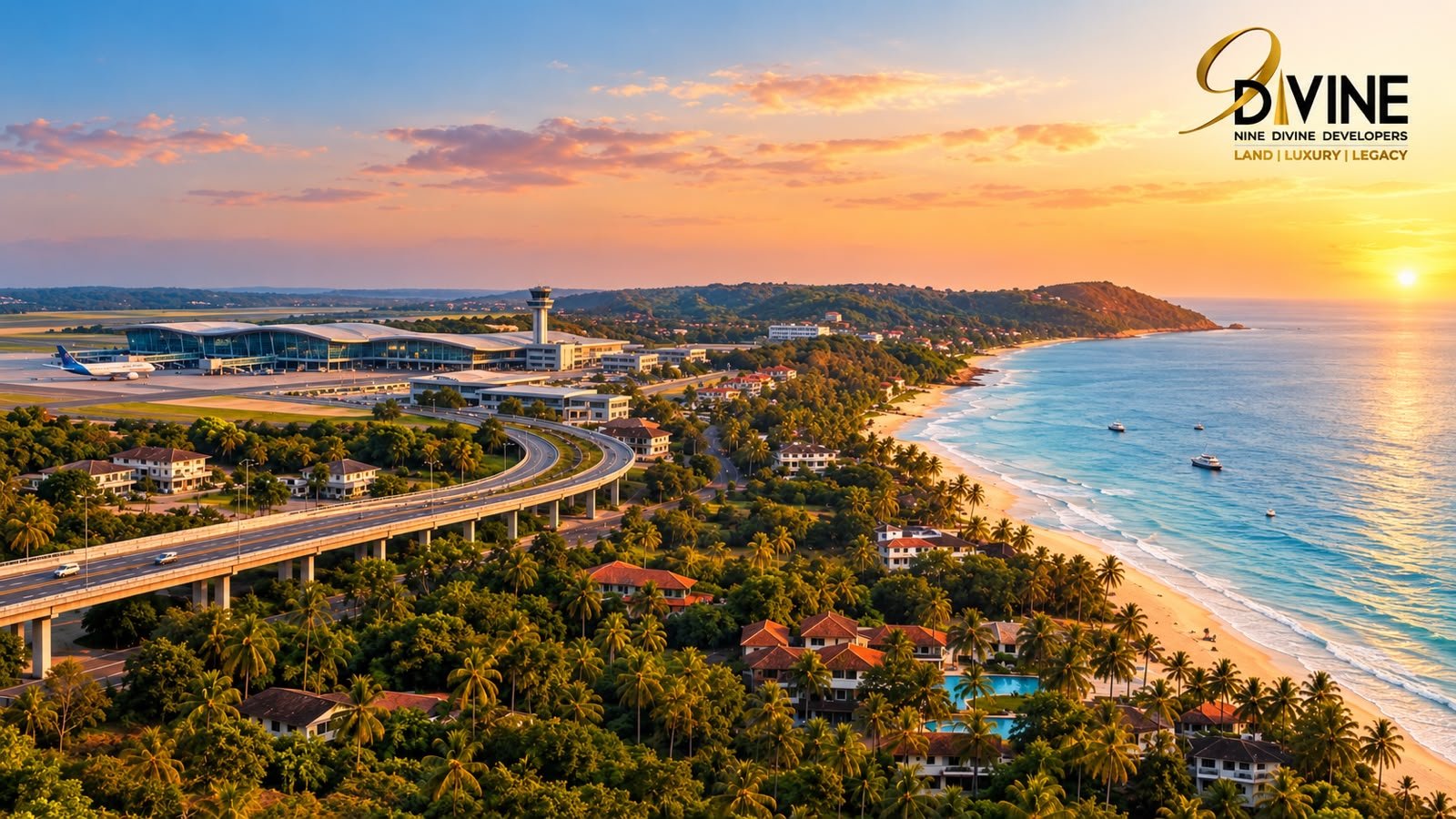
The wider region already benefits from Goa’s established tourism economy, while Sindhudurg is building its own destination identity around beaches, forts, marine experiences, nature and cultural tourism. At the same time, airports at Mopa and Chipi are adding aviation connectivity to the region.
Recent data illustrates the scale of this tourism ecosystem. Goa recorded approximately 61.4 lakh tourist arrivals between January and July 2026, including about 59 lakh domestic and 2.4 lakh international visitors. July alone recorded around 6.9 lakh arrivals, approximately 2.3% higher than July 2025.
For long-term investors, therefore, the Maha-Goa story is increasingly about connectivity, destination growth and demand creation rather than short-term speculation.
What Is Driving the Maha-Goa Growth Corridor?
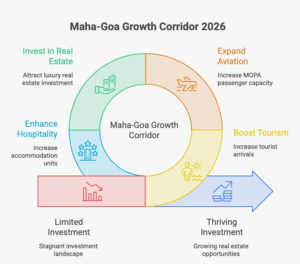
The emerging Maha-Goa investment corridor is being shaped by several interconnected forces.
1. Improving Road Connectivity
NH-66 continues to serve as the principal north-south road spine along the Konkan coast, connecting Maharashtra with Goa and Karnataka.
Further infrastructure proposals and developments, including the Shaktipeeth Expressway and Konkan Greenfield Expressway, could strengthen connectivity between the interior and coastal parts of Maharashtra over the longer term.
2. Expanding Aviation Connectivity
Two airports are particularly important to the regional investment narrative:
- Manohar International Airport (MOPA) in North Goa
- Sindhudurg Airport at Chipi
Their importance extends beyond passenger travel. Airports reduce geographical friction for tourists, second-home buyers, hospitality operators and businesses.
3. Tourism Diversification
The region is moving beyond a traditional beach-tourism model.
Goa is increasingly promoting:
- wellness tourism;
- heritage tourism;
- MICE;
- adventure tourism;
- nautical tourism;
- spiritual tourism;
- gastronomy;
- workation and experience-led travel.
4. Hospitality Expansion
The expansion of hotels, resorts, villas and destination-oriented hospitality creates additional economic activity around tourism destinations.
5. Second-Home Demand
Luxury buyers increasingly view coastal property through a combination of lifestyle, wealth diversification and potential long-term value creation.
Together, these factors provide the foundation for a broader Maha-Goa growth corridor.
Sindhudurg Infrastructure Growth: Why Connectivity Matters to Investors
Infrastructure is one of the most important variables when evaluating Sindhudurg real estate investment.
A destination can possess beaches, forests, heritage attractions and natural beauty, but accessibility determines how easily tourists, residents, investors and businesses can reach it.
NH-66: The Coastal Road Spine
NH-66 remains central to the Konkan’s connectivity architecture.
For Sindhudurg, road connectivity has implications across several sectors:
- tourism;
- hospitality;
- local commerce;
- logistics;
- second homes;
- residential development;
- land demand.
As sections of the Mumbai-Goa highway network improve, travel reliability and regional accessibility can gradually become stronger factors in destination selection.
For investors, however, infrastructure should be evaluated carefully. A project being announced does not mean that its full economic impact has already arrived.
The appropriate framework is:
Announcement → Construction → Completion → Actual Usage → Economic Impact
That distinction is especially important when evaluating land or property on the basis of future infrastructure.
Maharashtra Shaktipeeth Expressway
The proposed Shaktipeeth Expressway is another infrastructure project relevant to Sindhudurg’s longer-term connectivity story.
A Maharashtra Government document describes the project as a 760-km, six-lane, access-controlled expressway connecting 12 districts, including Sindhudurg. The same document states that the project is intended to improve connectivity and reduce travel time across the connected districts.
For investors, its significance is broader than simply reducing travel time.
Better connectivity can potentially:
- widen tourism catchment areas;
- improve access to emerging destinations;
- facilitate movement of goods and services;
- strengthen economic links between inland and coastal districts;
- improve the attractiveness of strategically located land.
However, investors should always verify the latest official project status, alignment, acquisition position and implementation timeline before making an investment decision.
Konkan Greenfield Expressway
The proposed Konkan Greenfield Expressway represents another potential long-term connectivity catalyst.
A Maharashtra Government industry document describes the proposed corridor as part of a broader strategy to improve road, rail and coastal connectivity along the Konkan, with Ratnagiri and Sindhudurg expected to benefit from enhanced connectivity.
The key investment lesson is straightforward:
Future infrastructure can influence future demand, but only completed and functioning infrastructure should be treated as an established market fact.
That is why long-term investors should track project milestones rather than relying solely on announcements.
Chipi Airport: Strengthening Sindhudurg’s Accessibility
Sindhudurg Airport at Chipi provides an additional aviation connection for the district.
The importance of airport connectivity becomes clearer when viewed alongside Sindhudurg’s tourism ambitions.
The Ministry of Tourism’s Swadesh Darshan 2.0 documentation for Maharashtra identifies Sindhudurg as a destination with substantial tourism infrastructure potential and describes multiple proposed and ongoing tourism projects across the district. It also identifies Parule Chipi Airport as an important part of the district’s connectivity ecosystem.
For real estate, aviation connectivity can support a broader chain:
Airport accessibility → Tourist movement → Hospitality demand → Local economic activity → Lifestyle demand → Property interest
This is not a guarantee of appreciation. Instead, it is one of the structural factors investors can monitor.
MOPA Airport: A Major Aviation Catalyst for North Goa
If Chipi is important for Sindhudurg, Manohar International Airport (MOPA) has become a major aviation catalyst for North Goa.
The Goa Economic Survey 2025–26 provides particularly significant data.
From its commencement on 5 January 2023 through January 2026, MOPA handled 14,094,729 domestic and international passengers and 97,383 aircraft movements, connecting 20 domestic and 12 international destinations.
The airport is also undergoing terminal expansion.
According to the same official Goa Economic Survey, the terminal expansion is being undertaken at a cost of approximately ₹255.69 crore, increasing the built-up area from 65,600 sq m to 83,900 sq m. The airport has entered Phase III and has an ultimate planned capacity of 35 million passengers annually.
These figures matter because airport infrastructure can influence the geography of tourism and investment.
How MOPA Can Influence the Wider Investment Ecosystem
The relationship can be understood through five stages:
Greater aviation connectivity
↓
Larger tourism catchment
↓
Higher hospitality and service demand
↓
Greater destination visibility
↓
Potentially stronger real-estate interest
North Goa already has a mature tourism ecosystem. As connectivity expands, the broader region can become more accessible to visitors seeking coastal experiences beyond the most established tourism centres.
The Government of Goa itself has highlighted the economic multiplier potential of MOPA and its capacity to support employment and wider economic activity.
For anyone evaluating whether to invest in Sindhudurg, MOPA is therefore relevant not because every Sindhudurg property automatically benefits from the airport, but because it strengthens the wider regional tourism and connectivity ecosystem.
Tourism Growth: The Demand Engine Behind Coastal Real Estate
Tourism is one of the strongest economic drivers connecting North Goa and Sindhudurg.
According to the latest reported Goa Tourism Department figures, the state welcomed approximately 61.4 lakh tourists between January and July 2026. Domestic visitors accounted for roughly 59 lakh, while international arrivals were approximately 2.4 lakh. July alone recorded approximately 6.9 lakh visitors, representing around 2.3% growth over July 2025.
The significance of these numbers goes beyond visitor volume.
Goa’s tourism strategy is increasingly focused on diversification.
The state has been promoting:
- wellness;
- heritage;
- MICE;
- adventure;
- nautical tourism;
- spiritual tourism;
- gastronomy;
- workation;
- hinterland experiences.
This creates the possibility of a more distributed tourism economy rather than one dependent solely on traditional beach holidays.
Sindhudurg’s Emerging Tourism Economy
Sindhudurg offers a different but complementary tourism proposition.
Its attractions include:
- Tarkarli;
- Malvan;
- Vijaydurg;
- Devgad;
- Vengurla;
- Shiroda;
- beaches;
- forts;
- marine experiences;
- scuba diving;
- nature;
- local cuisine;
- cultural experiences.
The Ministry of Tourism’s Maharashtra tourism planning documents identify multiple tourism-development opportunities across Sindhudurg, including the development of tourism sub-circuits around Vijaydurg, Devgad, Tarkarli and Shiroda-Sawantwadi.
The same government document references proposed experiences including:
- houseboats;
- floating cottages;
- glass-bottom boats;
- heritage accommodation;
- tourism facilities around forts and palaces.
This diversification can be important for long-term Sindhudurg real estate investment because tourism demand can create supporting demand for accommodation, hospitality, restaurants, local services and lifestyle properties.
Hospitality Expansion Can Strengthen the Destination Economy
Hospitality is another important indicator to watch.
Goa’s official Goa Economy in Figures 2026 records 9,573 hotels/lodging houses and 122,490 beds in 2025–26, compared with 9,005 hotels/lodging houses and 119,719 beds in 2024–25.
This provides evidence of the depth of Goa’s accommodation ecosystem.
Sindhudurg, meanwhile, is seeing increasing attention toward tourism infrastructure.
The Ministry of Tourism’s planning document highlights proposed and ongoing developments including tourism facilities at Nivati Fort, Sawantwadi Palace, Tarkarli and other coastal destinations. It also records plans involving a five-star tourism centre at Shiroda-Velagarunder in Vengurla taluka.
The investment significance can be viewed through the hospitality multiplier:
Hotel/Resort Investment
→ Employment
→ Local Services
→ Tourism Spending
→ Destination Visibility
→ Visitor Demand
→ Potential Real Estate Demand
Again, this should be viewed as an economic mechanism rather than a guaranteed property-return formula.
North Goa’s Luxury Real Estate Ecosystem Is Attracting Institutional Capital
North Goa already has a developed premium property ecosystem, with markets such as:
- Assagao;
- Anjuna;
- Vagator;
- Candolim;
- Siolim;
- Reis Magos;
- Porvorim;
- Arpora.
The region has also attracted institutional participation in luxury residential development.
In 2026, ASK Curated Luxury Asset Fund I invested ₹63 crore in Ananda Nilaya, an ultra-luxury villa development in Arpora, North Goa, according to The Economic Times.
The importance of such transactions is not that institutional capital guarantees future price appreciation.
Instead, it demonstrates that professional investors are evaluating Goa’s premium residential market through factors such as:
- asset quality;
- location;
- affluent buyer demand;
- hospitality and lifestyle appeal;
- long-term market positioning.
This provides useful context for investors studying the evolution of the broader Maha-Goa corridor.
Why Second-Home Demand Is Becoming Important
The second-home market is increasingly connected with India’s luxury real-estate story.
Recent reporting based on India Sotheby’s International Realty research indicates that 35% of affluent respondents expressed interest in vacation homes in Goa, while the broader luxury housing segment continues to attract high-net-worth buyers.
The motivations behind a second home are also changing.
A buyer may consider:
- personal lifestyle;
- family use;
- wealth diversification;
- long-term ownership;
- rental potential;
- retirement planning;
- legacy value.
For HNIs and NRIs, a coastal second home can therefore represent a combination of lifestyle and asset ownership rather than a purely speculative purchase.
This is particularly relevant to Sindhudurg because the district offers a different proposition built around lower-density coastal environments, nature, heritage and emerging tourism infrastructure.
The key question for investors is not simply:
“How much can the property appreciate?”
It should also be:
“What long-term demand could make this location more valuable and useful?”
That is a much stronger framework for evaluating real estate.
What Could Support Long-Term Property Appreciation in Sindhudurg?
The central thesis behind Sindhudurg real estate investment is infrastructure-led demand creation.
A useful framework is:
Connectivity
Better roads and airports can improve accessibility.
↓
Accessibility
Easier access can expand the potential visitor and buyer catchment.
↓
Tourism
More diverse tourism can create recurring visitor demand.
↓
Hospitality
Hotels, resorts and tourism businesses increase economic activity.
↓
Local Services
Restaurants, transport, retail and leisure services develop around demand.
↓
Residential Demand
Second-home buyers, entrepreneurs and lifestyle investors may increasingly explore the market.
↓
Potential Property Appreciation
The final step is potential, not certainty.
Property values depend on multiple variables, including:
- acquisition price;
- micro-location;
- land title;
- development permissions;
- surrounding infrastructure;
- market cycles;
- liquidity;
- demand;
- quality of the asset.
Six Long-Term Value Drivers to Monitor
1. Connectivity
Properties located within practical reach of major roads and airports can have an accessibility advantage.
2. Tourism
Growing visitor numbers can create demand for accommodation and supporting services.
3. Hospitality
New hospitality capacity can strengthen destination credibility.
4. Land Characteristics
High-quality, legally clear and appropriately zoned land is fundamentally different from land that cannot be developed.
5. Micro-Location
A broad district-level growth story does not mean every village or parcel will perform equally.
6. Holding Period
Infrastructure-led real estate stories generally require patience because economic benefits can take years to translate into property-market behaviour.
Government Initiatives Are Building the Tourism Ecosystem
Government participation is visible at both state and national levels.
The Ministry of Tourism has sanctioned multiple tourism-development projects in Goa and Maharashtra under programmes including Swadesh Darshan, Swadesh Darshan 2.0, PRASHAD, CBDD and SASCI.
For Sindhudurg, the Ministry’s documentation includes the Sindhudurg Coastal Circuit, covering destinations such as Sagareshwar, Tarkarli, Vijaydurg and Mitbhav, with a sanctioned amount of ₹45.47 crore under the earlier Swadesh Darshan programme.
Goa has also received central support for tourism experiences including:
- Porvorim Creek Experience;
- Colva Beach Experience;
- Harvalem Waterfall;
- cruise infrastructure;
- heritage and destination-development projects.
These initiatives matter because tourism infrastructure is part of the foundation destinations need to attract visitors consistently and retain higher-value tourism activity.
Sindhudurg and North Goa: Two Complementary Investment Profiles
The emerging Maha-Goa corridor should not be viewed as a competition between two destinations.
Instead, the two markets have complementary characteristics.
Factor | North Goa | Sindhudurg |
Market maturity | Established | Emerging |
Tourism ecosystem | Mature | Expanding |
Luxury hospitality | Strong | Growing |
Aviation connectivity | MOPA | Chipi + wider regional access |
Second-home ecosystem | Established | Developing |
Tourism diversification | Strong | Expanding |
Infrastructure runway | Continuing | Significant |
Investment orientation | Premium/lifestyle | Long-term growth-oriented |
For an HNI, North Goa may represent an established luxury ecosystem.
For another investor, Sindhudurg may offer interest in an emerging destination where infrastructure and tourism development are still evolving.
The appropriate investment decision therefore depends on the investor’s:
- budget;
- risk tolerance;
- holding period;
- intended use;
- liquidity requirements;
- preferred asset type.
What Investors Should Check Before Investing in Sindhudurg
A compelling regional story does not replace property-level due diligence.
Anyone considering investing in Sindhudurg should independently verify the asset.
Land and Title
Check:
- ownership history;
- title chain;
- encumbrances;
- mutation records;
- survey boundaries;
- access rights;
- pending litigation.
Land Use and Permissions
Verify:
- agricultural/non-agricultural status;
- zoning;
- development permissions;
- CRZ applicability;
- environmental restrictions;
- forest-related restrictions;
- local planning regulations.
Infrastructure
Never rely solely on marketing claims about future infrastructure.
Check whether the project is:
Operational
Under Construction
Approved
Proposed
Under Planning
These categories have very different investment implications.
Financial Evaluation
Investors should also consider:
- acquisition cost;
- transaction costs;
- holding period;
- maintenance;
- taxation;
- liquidity;
- potential rental economics;
- exit strategy.
The strongest investment decision is generally the one based on verified facts rather than projected headlines.
2026–2030: What Should Investors Monitor?
The next phase of the Maha-Goa corridor should be evaluated through measurable milestones.
2026: Foundation Phase
Monitor:
- MOPA passenger growth;
- MOPA terminal expansion;
- Goa tourism arrivals;
- Chipi connectivity;
- NH-66 progress;
- hospitality announcements;
- tourism infrastructure.
2027–2028: Development Phase
Track:
- infrastructure completion;
- actual travel-time improvements;
- hotel and resort capacity;
- tourism diversification;
- airport connectivity;
- property transaction activity.
2029–2030 and Beyond: Maturity Phase
The key questions will become:
- Has infrastructure actually improved accessibility?
- Has tourism expanded sustainably?
- Has hospitality capacity increased?
- Has local economic activity strengthened?
- Has real-estate demand broadened?
- Which micro-markets have demonstrated genuine end-user demand?
This is a more reliable way of assessing long-term potential than assigning a predetermined appreciation percentage to the entire region.
7 Key Takeaways for Long-Term Investors
1. Sindhudurg’s connectivity story is strengthening
NH-66, Chipi Airport and proposed future infrastructure can improve regional accessibility.
2. MOPA is already operating at meaningful scale
The airport handled more than 14 million passengers cumulatively through January 2026.
3. Goa continues to generate substantial tourism demand
Approximately 61.4 lakh tourists visited Goa during January–July 2026.
4. Tourism is becoming more diversified
Wellness, heritage, MICE, adventure, nautical tourism and workation are broadening the destination proposition.
5. Sindhudurg’s tourism infrastructure pipeline is expanding
Government planning documents identify multiple tourism circuits and proposed destination-development projects.
6. Luxury real estate continues to attract capital in North Goa
The ₹63 crore ASK transaction demonstrates institutional interest in the premium segment.
7. Appreciation should be evaluated, not assumed
Infrastructure, tourism and demand can support long-term value creation, but actual performance depends on asset quality, location, acquisition price, legal status and market conditions.
FAQs
1. Is Sindhudurg a good place to invest in 2026?
Yes, Sindhudurg can be considered an emerging location for long-term real estate investment in 2026, particularly for investors interested in coastal property, second homes and infrastructure-led growth. The investment case is supported by improving connectivity, tourism development, aviation access and expanding destination infrastructure. The Ministry of Tourism’s Sindhudurg master planning documents identify significant tourism potential across beaches, heritage destinations and nature-based attractions.
However, investors should not assume that infrastructure automatically guarantees property appreciation. Those planning to invest in Sindhudurg should evaluate the property’s exact location, title, zoning, accessibility, development permissions, surrounding infrastructure and long-term demand before purchasing.
2. Why are investors exploring Sindhudurg real estate investment?
Sindhudurg real estate investment is attracting attention because several long-term growth factors are developing simultaneously. These include road connectivity, airport accessibility, tourism infrastructure, coastal tourism, hospitality development and growing interest in second-home destinations.
The Ministry of Tourism’s Sindhudurg destination master plan highlights the district’s potential for theme-based tourism and identifies beaches, nature destinations and other attractions as important components of its tourism strategy.
For investors considering whether to invest in Sindhudurg, this creates an investment thesis based on destination development rather than short-term speculation. The most important consideration remains whether a specific property is positioned to benefit from these broader trends.
3. How could MOPA Airport influence Sindhudurg real estate investment?
Manohar International Airport (MOPA) strengthens the wider North Goa aviation ecosystem and is relevant when assessing the broader Maha-Goa corridor. According to the Goa Economic Survey 2025–26, MOPA handled 14,094,729 domestic and international passengers between its commencement on January 5, 2023 and January 2026, along with 97,383 aircraft movements. It connected 20 domestic and 12 international destinations during that period.
The airport is also undergoing a ₹255.69 crore terminal expansion, while its ultimate planned capacity is stated at 35 million passengers annually.
MOPA does not automatically determine property values in Sindhudurg. Its relevance is through the wider tourism and connectivity ecosystem, particularly where road connectivity makes destinations practically accessible.
4. What impact can NH-66 have on the potential to invest in Sindhudurg?
NH-66 is an important connectivity corridor along India’s western coast and plays a significant role in connecting Maharashtra’s Konkan region with Goa and Karnataka. Improved highway connectivity can reduce travel friction and support tourism, hospitality, commerce and residential accessibility.
For someone looking to invest in Sindhudurg, proximity to established roads can therefore be an important factor when evaluating individual properties.
However, investors should distinguish between existing road infrastructure and proposed future projects. The Government of Maharashtra’s infrastructure documentation also identifies the proposed Konkan Greenfield Expressway and Shaktipeeth Expressway as major connectivity initiatives involving Sindhudurg.
Infrastructure should consequently be evaluated according to its actual implementation status rather than simply its announcement.
5. How can tourism growth influence Sindhudurg real estate investment?
Tourism can influence real estate through a broader economic multiplier. As visitor numbers increase, demand can expand for hotels, resorts, restaurants, transportation, recreation, local services and second homes.
Sindhudurg’s official tourism planning framework identifies destinations including Tarkarli, Vijaydurg, Devgad, Shiroda, Nivati Fort and other coastal and heritage locations as part of its tourism-development ecosystem.
The district’s tourism master planning also highlights its beaches and natural attractions and explores opportunities for more diversified tourism experiences.
For those considering Sindhudurg real estate investment, tourism growth is therefore an important demand indicator. However, tourism growth alone should never be treated as proof of a specific property’s future appreciation.
6. Is Sindhudurg suitable for second-home investment?
Sindhudurg can be relevant for buyers looking for a coastal second home combining lifestyle use with a long-term property-holding strategy. The district offers beaches, marine experiences, heritage attractions, and nature-based tourism, while infrastructure development is gradually improving accessibility.
The Ministry of Tourism’s official tourism planning documents identify several Sindhudurg destinations for tourism development and infrastructure enhancement.
For buyers planning to invest in Sindhudurg as a second-home destination, however, practical factors are particularly important. These include road access, electricity and water availability, maintenance, local services, legal status, development permissions and proximity to tourism and commercial centres.
A second home should therefore be evaluated as both a lifestyle asset and a real estate asset, rather than solely on expected appreciation.
7. What factors could influence Sindhudurg property appreciation over the long term?
Several factors can influence long-term property values in an emerging destination such as Sindhudurg:
infrastructure and road connectivity;
airport accessibility;
tourism growth;
hospitality development;
quality of surrounding infrastructure;
land-use regulations;
micro-location;
availability of legally clear land;
buyer demand;
local economic activity.
The Government of Maharashtra’s infrastructure material identifies connectivity projects involving Sindhudurg, including the proposed Konkan Greenfield Expressway and Shaktipeeth Expressway. Meanwhile, the Ministry of Tourism’s master plan identifies substantial tourism-development opportunities within Sindhudurg.
Therefore, investors considering Sindhudurg real estate investment should view appreciation as a potential outcome of multiple economic factors, not as a guaranteed return.
8. What government initiatives are supporting tourism growth in Sindhudurg?
Government-backed tourism programmes are an important part of Sindhudurg’s long-term development story. The Ministry of Tourism has previously supported the Sindhudurg Coastal Circuit, covering destinations such as Shiroda Beach, Sagareshwar, Tarkarli, Vijaydurg, Devgad, Mitbhav, Tondavali, Mocehmad and Nivati Fort.
More recent Swadesh Darshan 2.0 planning for Sindhudurg takes a broader destination-development approach, with attention to tourism zones, nature-based attractions, beaches, heritage and visitor experiences.
For investors seeking to invest in Sindhudurg, such initiatives are relevant because public tourism infrastructure can contribute to destination visibility, visitor accessibility and the development of supporting economic activity.
Nevertheless, individual property decisions should always be based on current, verified local information.
9. Is Sindhudurg suitable for HNIs, NRIs and long-term wealth creators?
Sindhudurg can be relevant to HNIs, NRIs and long-term investors seeking exposure to an emerging coastal destination, particularly where the investment objective includes lifestyle ownership, land holding, second-home use or long-term diversification.
The region’s appeal is supported by its tourism assets and improving connectivity, while the wider Maha-Goa corridor benefits from North Goa’s established tourism ecosystem and MOPA’s growing aviation network. MOPA had already handled more than 14 million passengers cumulatively through January 2026, according to the Goa Economic Survey.
Those looking to invest in Sindhudurg should nevertheless adopt a location-specific strategy. HNIs and NRIs should assess title quality, accessibility, land-use regulations, infrastructure, taxation, ownership requirements and exit liquidity before committing capital.
The objective should be long-term wealth preservation and potential value creation, rather than chasing speculative short-term returns.
10. What should buyers check before investing in Sindhudurg land or property?
Before deciding to invest in Sindhudurg, buyers should conduct comprehensive property-level due diligence rather than relying only on the broader regional growth narrative.
Important checks include:
Title and ownership: Verify the complete ownership chain, encumbrances, mutation records and survey details.
Land use: Confirm zoning, agricultural/non-agricultural status and applicable development permissions.
Environmental restrictions: Depending on the location, buyers should investigate CRZ, forest, environmental and other applicable regulations.
Connectivity: Verify actual road access and current infrastructure status.
Future projects: Confirm whether an infrastructure project is operational, under construction, approved or merely proposed.
Development feasibility: Understand what can legally be constructed on the property.
The Ministry of Tourism’s Sindhudurg planning documents demonstrate that tourism development is being approached at a destination level, but that does not replace property-specific legal and technical due diligence.
For serious Sindhudurg real estate investment, the strongest approach is therefore:
Verify the title → Verify the land → Verify the location → Verify infrastructure → Verify development potential → Then evaluate the price.
The Long-Term Case for the Maha-Goa Growth Corridor
The investment narrative around Sindhudurg and North Goa is increasingly being shaped by a convergence of measurable economic forces.
MOPA is expanding aviation capacity.
Chipi provides an aviation connection for Sindhudurg.
NH-66 is strengthening the coastal road network.
Future infrastructure projects could improve regional accessibility further.
Goa continues to attract millions of tourists.
Sindhudurg is developing a broader tourism proposition.
Hospitality infrastructure is expanding.
And luxury buyers continue to show interest in coastal second-home markets.
For those evaluating whether to invest in Sindhudurg, the strongest approach is therefore not to focus on speculative return projections. Instead, investors should study the fundamentals:
Connectivity → Tourism → Hospitality → Economic Activity → Demand → Asset Quality → Long-Term Value
That framework allows HNIs, NRIs, entrepreneurs and long-term investors to assess the region with greater clarity.
The Maha-Goa corridor is still evolving. That is precisely why the next few years will be important to watch—not for guaranteed returns, but for evidence of how infrastructure, tourism and real estate increasingly interact to shape the region’s long-term economic landscape.






[…] The proposed Water Metro could eventually add another layer to the state’s transportation network. […]