



 Sindhudurg real estate is entering a powerful new phase—where infrastructure, tourism, hospitality and coastal lifestyle converge to shape an emerging premium destination.
Taj Shiroda–Velaghar: How Sindhudurg’s Infrastructure & Tourism Growth Could Shape Its Real Estate Future
Sindhudurg is entering an important phase in its evolution from a largely leisure-oriented coastal destination into a more connected tourism and lifestyle ecosystem. The latest development to bring this transition into sharper focus is the tripartite agreement for a proposed Taj hotel at Shiroda–Velaghar, signed between Indian Hotels Company Limited (IHCL), Maharashtra Tourism Development Corporation (MTDC) and a representative body of local landholders on 18 August 2026.
Table of Contents
- Taj Shiroda–Velaghar: How Sindhudurg’s Infrastructure & Tourism Growth Could Shape Its Real Estate Future
- The Taj Shiroda–Velaghar Development: Why the Latest Announcement Matters
- What Is Confirmed?
- What Was Originally Announced?
- What Has Not Yet Been Confirmed?
- Why Premium Hospitality Could Strengthen Sindhudurg Tourism
- From Coastal Tourism to Experiential Tourism
- The Potential Hospitality Multiplier
- Sindhudurg’s Infrastructure Development Is Changing Accessibility
- NH-66: The Road Connectivity Backbone
- Konkan Railway: An Established Regional Advantage
- Sindhudurg Airport Adds a Local Aviation Layer
- Mopa Airport Gives Sindhudurg Access to a Wider Regional Gateway
- Tourism Infrastructure Is Expanding Beyond Conventional Beach Tourism
- The Destination-Development Cycle: Why Infrastructure Matters to Real Estate
- Infrastructure
- Accessibility
- Tourism
- Hospitality
- Economic Activity
- Lifestyle Demand
- Real Estate Ecosystem
- Sindhudurg’s Emerging Second-Home and Lifestyle Ecosystem
- What Makes a Lifestyle Destination More Sustainable?
- What HNIs, NRIs and Second-Home Buyers Should Evaluate
- Location and Connectivity
- Title and Documentation
- Land Use and Permissions
- Infrastructure Availability
- Developer Track Record
- Long-Term Usability
- How Could the Taj Project Influence Sindhudurg’s Lifestyle Ecosystem?
- The Nine Divine Perspective: Building Around the Destination
- Five Developments to Watch in Sindhudurg
- 1. Taj Shiroda–Velaghar
- 2. Sindhudurg Airport
- 3. Mopa Airport
- 4. Tourism Infrastructure
- 5. Road and Rail Connectivity
- FAQs
- Sindhudurg’s Story Is Becoming Bigger Than a Single Hotel
For anyone tracking Sindhudurg real estate, this development is significant not because a hotel alone determines property-market performance, but because it adds another important component to a larger destination-development story.
Road connectivity, rail access, airport infrastructure, tourism projects, premium hospitality and changing lifestyle preferences are increasingly intersecting across the Konkan region. Sindhudurg already benefits from the Konkan Railway network, NH-66 connectivity and its own airport, while nearby Mopa International Airport provides another important regional aviation gateway. Maharashtra Tourism also identifies air, rail and road access as established ways to reach the district.
The result is an emerging ecosystem where Sindhudurg real estate can increasingly be viewed through the broader lens of tourism, accessibility, lifestyle and destination development.
The key question, therefore, is not simply whether one hotel will change the property market. It is how multiple developments working together could influence the region’s long-term economic and lifestyle landscape.
The Taj Shiroda–Velaghar Development: Why the Latest Announcement Matters
The strongest current news hook for Sindhudurg real estate is the renewed progress of the proposed Taj hospitality project at Shiroda–Velaghar.
According to the latest report by The Times of India, IHCL, MTDC and the local landholders’ representative body signed a tripartite agreement on 18 August 2026. The agreement is intended to facilitate the long-awaited luxury hospitality development.
What Is Confirmed?
The latest confirmed development is the tripartite agreement involving:
- Indian Hotels Company Limited (IHCL), operator of the Taj brand
- Maharashtra Tourism Development Corporation
- A representative body of local landholders
The agreement was signed in the presence of senior Maharashtra government leaders. The state government has described the project as an important potential addition to Sindhudurg’s tourism landscape, with possible benefits for employment, local entrepreneurship and tourism-related businesses.
This is important for Sindhudurg real estate because premium hospitality can become one component of a broader destination ecosystem.
What Was Originally Announced?
IHCL had previously announced a luxury hotel project in Shiroda on land leased from the Government of Maharashtra. Its original announcement described a resort spread across approximately 138 acres, with 150 rooms, including 46 villas, alongside restaurants, a bar and conference facilities.
These specifications should be understood as previously announced project parameters, rather than automatically assuming they represent the final configuration today.
What Has Not Yet Been Confirmed?
The latest agreement should not be interpreted as confirmation of an operational hotel or a specific opening date.
At present, the responsible way to describe the project is:
Confirmed: Tripartite agreement signed in August 2026.
Previously announced: Luxury resort concept and original scale announced by IHCL.
Future: Construction, final configuration, opening timeline and operational commencement remain subject to subsequent project development and official updates.
This distinction is particularly important when discussing Sindhudurg real estate, because infrastructure and hospitality announcements should be evaluated according to their actual stage of implementation.
Why Premium Hospitality Could Strengthen Sindhudurg Tourism
The potential significance of the Taj project extends beyond accommodation.
Sindhudurg already has a diverse tourism proposition built around beaches, forts, waterways, forests, marine experiences and local culture. Maharashtra Tourism describes the district as accessible by air, rail and road, with Konkan Railway stations including Kankavli, Sindhudurg, Kudal and Sawantwadi.
A premium hospitality development could potentially complement these existing attractions by adding greater accommodation depth for travellers seeking higher-end experiences.
From Coastal Tourism to Experiential Tourism
The next phase of tourism in Sindhudurg does not necessarily need to depend on beaches alone.
The destination can potentially combine:
- Coastal leisure
- Scuba diving and marine experiences
- Heritage tourism
- Sindhudurg Fort
- Eco-tourism
- Local cuisine and culture
- Wellness and nature-based travel
- Luxury hospitality
- Experiential holidays
This diversification matters for Sindhudurg real estate because a destination with multiple reasons to visit can potentially support a wider range of tourism-linked economic activity.
The Potential Hospitality Multiplier
A luxury hotel does not operate in isolation.
Its broader ecosystem can involve:
Hotel → Transport → Restaurants → Local Suppliers → Guides → Activity Providers → Artisans → Farmers → Employment
The latest state comments on the Shiroda–Velaghar project specifically point towards opportunities for farmers, artisans, transport operators, guides, activity providers and other tourism-related businesses.
For Sindhudurg real estate, this is relevant because destination maturity is influenced not only by hotel rooms, but also by the businesses and services that develop around tourism.
Sindhudurg’s Infrastructure Development Is Changing Accessibility
One of the most important foundations of Sindhudurg real estate is accessibility.
A beautiful destination can attract visitors, but reliable connectivity makes repeat visits, second-home ownership, hospitality investment and business activity more practical.
Sindhudurg’s connectivity story is built around several complementary infrastructure systems.
NH-66: The Road Connectivity Backbone
NH-66 remains one of the most important road corridors for the Konkan region.
For Sindhudurg, the highway connects important centres including Kankavli, Kudal and Sawantwadi and provides road access for travellers moving along the Mumbai–Goa corridor. Maharashtra Tourism identifies NH-17, the earlier designation of the corridor, as an important road route through the district.
For Sindhudurg real estate, road connectivity has practical importance because it affects how easily owners, tourists, service providers and businesses can access individual destinations.
It also expands the effective catchment of weekend and short-duration travel.
Konkan Railway: An Established Regional Advantage
Rail connectivity is another structural strength.
The Konkan Railway network already serves stations across Sindhudurg, while 2026 has brought additional passenger connectivity developments.
In June 2026, Konkan Railway announced a commercial stoppage at Sindhudurg station for the Surat–Mangaluru Junction bi-weekly express, beginning from 24–25 June depending on direction.
Special trains operating during the 2026 summer season also included Sindhudurg among their scheduled halts, illustrating the role of the station within the wider Konkan network.
For Sindhudurg real estate, rail connectivity adds another layer of accessibility beyond road travel.
Sindhudurg Airport Adds a Local Aviation Layer
The district’s own airport is another important part of the connectivity story.
The Airports Authority of India’s 2026 aeronautical information confirms that Sindhudurg Airport has been upgraded for IFR, or Instrument Flight Rules, supporting all-weather operations.
The airport is located near Chipi-Parule in Vengurla taluka, approximately 17 kilometres west of Kudal, according to the AAI’s aeronautical information.
This distinction is important.
The value of aviation connectivity is not simply about the number of flights. Reliability, operating capability, airline networks and onward surface connectivity all matter.
For Sindhudurg real estate, a more dependable local airport can strengthen the practical case for people who want to combine coastal living with access to larger urban centres.
Mopa Airport Gives Sindhudurg Access to a Wider Regional Gateway
Mopa International Airport in North Goa has another role in the regional connectivity equation.
It should not be described as a Sindhudurg airport. Instead, it is better understood as a regional aviation gateway that can serve the wider Konkan–Goa tourism ecosystem.
The latest GMR Airports Q3 FY26 disclosure reported that Mopa handled 1.46 million passengers in Q3 FY26, its highest quarterly traffic at that point, representing 22% year-on-year growth. For the first nine months of FY26, the airport handled 3.82 million passengers, up 13% year-on-year.
For Sindhudurg real estate, the relevance of Mopa lies in regional accessibility.
A traveller can evaluate the wider destination based on a combination of:
International airport → road transfer → coastal destination → hospitality/lifestyle experience
This expands the potential geographic catchment beyond the district’s immediate transport infrastructure.
Tourism Infrastructure Is Expanding Beyond Conventional Beach Tourism
The tourism ecosystem is also becoming more diversified.
Government-backed projects demonstrate that Sindhudurg’s tourism potential is being viewed through coastal, marine and experiential tourism.
The Ministry of Tourism has reported the completion of the Sindhudurg Coastal Circuit, covering Sagareshwar, Tarkarli, Vijaydurg and Mitbhav, with a sanctioned amount of ₹19.06 crore under Swadesh Darshan.
Another particularly notable project is the Ex-INS Guldar Underwater Museum, Artificial Reef and Submarine Tourism project.
The Ministry of Tourism sanctioned the project at a total outlay of ₹46.91 crore. According to a July 2026 PIB update, the Maharashtra government expects the project to be completed by 31 March 2028, while the DPR projects around 800 direct jobs within 10 years of completion.
Importantly, this is a project under development, not an operational attraction today.
For Sindhudurg real estate, the significance lies in the possibility of a broader tourism portfolio developing around the district rather than dependence on one attraction.
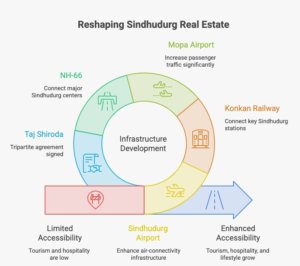
The Destination-Development Cycle: Why Infrastructure Matters to Real Estate
The relationship between infrastructure and Sindhudurg real estate should be understood as a sequence rather than a guaranteed one-to-one relationship.
Infrastructure
Better roads, railways and airports improve accessibility.
↓
Accessibility
More convenient access can make a destination easier to visit.
↓
Tourism
Higher accessibility can support tourism when combined with compelling attractions and experiences.
↓
Hospitality
Growing tourism demand can create opportunities for hotels, resorts, restaurants and other visitor services.
↓
Economic Activity
Hospitality creates demand for transport, food, entertainment, guides, retail and local services.
↓
Lifestyle Demand
As destinations mature, some visitors may also begin considering longer stays or second-home ownership.
↓
Real Estate Ecosystem
This can create a broader market for carefully planned residential, plotted and lifestyle developments.
This framework does not mean that every infrastructure project automatically increases property values.
Instead, it explains why infrastructure is one of several factors worth studying when evaluating Sindhudurg real estate.
Sindhudurg’s Emerging Second-Home and Lifestyle Ecosystem
The changing nature of travel in India is also relevant to Sindhudurg real estate.
Second-home buyers increasingly evaluate properties not only as financial assets but also as lifestyle assets.
For a coastal destination, the proposition can combine:
- Personal leisure use
- Weekend living
- Extended holidays
- Nature-oriented living
- Family retreats
- Potential hospitality or rental use where legally permissible
- Long-term ownership
Sindhudurg’s combination of coastline, greenery, heritage, marine experiences and improving accessibility gives the destination a distinct lifestyle proposition.
What Makes a Lifestyle Destination More Sustainable?
A strong lifestyle destination generally needs more than attractive landscapes.
Buyers and visitors increasingly look at:
- Connectivity
- Infrastructure
- Utilities
- Healthcare and essential services
- Hospitality quality
- Local tourism experiences
- Social infrastructure
- Developer credibility
- Legal clarity
- Land-use permissions
- Long-term destination planning
These fundamentals are important when assessing Sindhudurg real estate because they separate a short-term location trend from a destination with a potentially more durable ecosystem.
What HNIs, NRIs and Second-Home Buyers Should Evaluate
The growth story should not be interpreted as a reason to overlook due diligence.
Anyone evaluating Sindhudurg real estate should examine the individual property and its legal and physical characteristics carefully.
Key considerations include:
Location and Connectivity
How far is the property from major roads, railway stations, airports, beaches and tourism hubs?
Title and Documentation
Are ownership records, title documents and relevant approvals clear?
Land Use and Permissions
Is the intended use legally permissible under applicable planning and development regulations?
Infrastructure Availability
Are electricity, water, access roads, drainage and other services available or planned?
Developer Track Record
What is the developer’s experience in land development, planning, execution and customer delivery?
Long-Term Usability
Can the property serve its intended lifestyle purpose over the long term?
These considerations are more useful than relying on blanket claims about future returns.
How Could the Taj Project Influence Sindhudurg’s Lifestyle Ecosystem?
The proposed Taj development creates another layer in the region’s evolving hospitality landscape.
If implemented as planned, a globally recognised hospitality brand could potentially contribute to:
- Greater destination visibility
- Premium accommodation supply
- Higher-end leisure tourism
- Employment opportunities
- Local business participation
- Hospitality skills development
- Demand for transport and experiences
- Greater integration with nearby tourism attractions
The latest government and media commentary specifically highlights employment, local entrepreneurship and demand for products and services from farmers, artisans, transport operators, guides and activity providers.
For Sindhudurg real estate, this matters because a mature destination is typically supported by an ecosystem rather than by isolated developments.
A hotel can be an anchor.
Infrastructure can improve access.
Tourism attractions can generate reasons to visit.
Local businesses can improve the visitor experience.
And lifestyle-oriented developments can provide another layer of long-term destination participation.
The Nine Divine Perspective: Building Around the Destination
For Nine Divine, the evolving story of Sindhudurg real estate is best understood through the broader concept of destination-led development.
The objective is not simply to create another property in a coastal location.
It is to understand how infrastructure, tourism, lifestyle preferences and destination economics interact over time.
Thoughtfully planned communities can potentially complement an emerging destination by providing residents with:
- Lifestyle-oriented spaces
- Nature-led surroundings
- Planned infrastructure
- Second-home opportunities
- Community environments
- Long-term ownership potential
Nine Divine’s approach can therefore be positioned within the larger transformation taking place across Sindhudurg: from a destination known primarily for its natural and cultural attractions towards a more connected lifestyle ecosystem.
This is particularly relevant for buyers researching Sindhudurg real estate who are interested in more than a conventional residential purchase.
The opportunity is to participate in a destination while maintaining the importance of location, planning, documentation and long-term usability.
Five Developments to Watch in Sindhudurg
The next phase of Sindhudurg real estate will depend on how several developments progress together.
1. Taj Shiroda–Velaghar
The August 2026 tripartite agreement represents the latest confirmed milestone. The next important indicators will be subsequent project-development announcements and execution progress.
2. Sindhudurg Airport
The transition to IFR/all-weather operating capability is an important aviation milestone.
3. Mopa Airport
Continued passenger growth and expansion of domestic and international connectivity can influence the wider regional tourism catchment.
4. Tourism Infrastructure
The Coastal Circuit and the Ex-INS Guldar project demonstrate continued investment in the destination’s tourism proposition.
5. Road and Rail Connectivity
NH-66 and Konkan Railway remain essential components of the district’s accessibility network, with incremental rail connectivity improvements continuing in 2026.
FAQs
1. What are the latest infrastructure developments shaping Sindhudurg real estate?
The Sindhudurg real estate market is increasingly influenced by improvements across road, rail and air connectivity. Key infrastructure includes NH-66, the Konkan Railway network, Sindhudurg Airport and the wider regional connectivity provided by Mopa International Airport.
Sindhudurg Airport has also received an important operational upgrade, with Airports Authority of India information reflecting IFR/all-weather operating capability. Meanwhile, Konkan Railway continues to provide rail connectivity through stations such as Kankavli, Sindhudurg, Kudal and Sawantwadi.
These developments can make the district more accessible to tourists, second-home owners and businesses. However, infrastructure should be viewed as one factor within a broader destination-development ecosystem rather than as a guarantee of property appreciation.
2. What is the latest update on the Taj project in Sindhudurg?
The latest significant development concerning the proposed Taj Shiroda–Velaghar project is the tripartite agreement signed on 18 August 2026 involving Indian Hotels Company Limited (IHCL), Maharashtra Tourism Development Corporation (MTDC) and a representative body of local landholders.
The agreement represents a significant advancement for the proposed hospitality development. It is important, however, to distinguish between an agreement/project milestone and an operational hotel. The latest announcement does not mean that the Taj property is already operational or that a final opening date has been confirmed.
For Sindhudurg real estate, the development is relevant because a premium hospitality project can potentially strengthen destination visibility, tourism infrastructure, and the wider ecosystem of businesses supporting visitors.
3. What is Taj Shiroda–Velaghar and why is it important for Sindhudurg?
Taj Shiroda–Velaghar refers to the proposed luxury hospitality development associated with IHCL’s Taj brand at Shiroda in Sindhudurg.
IHCL’s earlier announcement described a resort planned across approximately 138 acres, with 150 rooms, including 46 villas, along with restaurants, a bar and conference facilities. These figures relate to the previously announced project concept and should not automatically be treated as the final configuration of the development.
Its significance for Sindhudurg real estate comes from the potential role of premium hospitality in destination development. A luxury hotel can potentially attract higher-value leisure travellers, strengthen accommodation capacity and create additional demand for transport, experiences, food, local products and tourism services.
The wider impact will ultimately depend on project execution, tourism demand and the development of supporting infrastructure.
4. How is Mopa Airport connected to Sindhudurg real estate and tourism?
Mopa International Airport is located in North Goa, so it should not be described as Sindhudurg’s own airport. Its relevance lies in its role as a regional aviation gateway for the broader Goa–Konkan tourism ecosystem.
Growing passenger traffic at Mopa can potentially expand the catchment of travellers who can access destinations in and around Sindhudurg by road. This is particularly relevant for premium tourism, international visitors and second-home owners who value convenient air connectivity.
For Sindhudurg real estate, Mopa therefore represents an additional regional connectivity layer alongside Sindhudurg Airport.
According to GMR Airports’ Q3 FY26 update, Mopa handled approximately 1.46 million passengers during Q3 FY26, with passenger traffic growing year-on-year.
5. What is driving tourism growth in Sindhudurg?
The tourism proposition of Sindhudurg is becoming increasingly diverse. Its attractions include beaches, forts, marine tourism, scuba diving, heritage, local culture, nature and experiential travel.
Government-backed tourism infrastructure is also contributing to this diversification. The Ministry of Tourism has highlighted the Sindhudurg Coastal Circuit, covering destinations including Sagareshwar, Tarkarli, Vijaydurg and Mitbhav.
Another major project is the proposed Ex-INS Guldar Underwater Museum, Artificial Reef and Submarine Tourism project, which has received central tourism funding and is currently under development.
This expanding tourism mix is relevant to Sindhudurg real estate because destinations with multiple tourism experiences can potentially support broader hospitality, commercial and lifestyle ecosystems.
6. Is Sindhudurg emerging as a second-home destination?
Sindhudurg has several characteristics that make it relevant to the emerging second-home and lifestyle real estate segment: a long coastline, natural surroundings, heritage attractions, tourism infrastructure and improving accessibility.
For Sindhudurg real estate, the second-home proposition can extend beyond conventional investment thinking. Buyers may consider properties for weekend use, family retreats, extended stays or lifestyle-oriented ownership.
However, the emergence of a destination does not mean every property will perform equally. Buyers should assess the specific location, accessibility, title, land-use permissions, infrastructure, developer track record and intended use.
The strongest approach is therefore to evaluate Sindhudurg real estate at both levels: the broader destination ecosystem and the individual property’s fundamentals.
7. How can infrastructure development influence Sindhudurg real estate demand?
Infrastructure can influence Sindhudurg real estate through a broader chain of economic activity:
Better Connectivity → Easier Access → Tourism → Hospitality → Local Businesses → Employment → Lifestyle Demand → Real Estate Ecosystem
Improved roads can reduce travel friction. Rail connectivity can expand the visitor catchment. Airports can improve access for longer-distance travellers. Hospitality projects can increase accommodation capacity and destination visibility.
However, infrastructure does not automatically guarantee property appreciation. Its influence depends on factors such as actual utilisation, surrounding development, tourism demand, local infrastructure, planning regulations and the quality of individual projects.
For investors, the more useful question is therefore not simply “Is infrastructure coming?” but “How is infrastructure interacting with tourism, employment, hospitality and lifestyle demand in this specific micro-market?”
External sources: MoRTH | Konkan Railway | Airports Authority of India
8. What types of Sindhudurg real estate are gaining relevance as tourism develops?
The evolving destination ecosystem can create interest across several categories of Sindhudurg real estate, including:
Premium plotted communities
Second-home properties
Vacation homes
Lifestyle communities
Nature-oriented developments
Tourism-linked residential opportunities
Premium villas
Investment-oriented land, subject to applicable regulations
Each category serves a different buyer profile.
For example, an HNI or NRI may prioritise a professionally planned second home, while another buyer may prefer a plotted development that provides flexibility for future construction. Lifestyle buyers may place greater emphasis on surroundings, community planning and proximity to tourism attractions.
The important point is that tourism growth does not automatically make every property a suitable investment. Buyers should consider legal documentation, zoning, approvals, access, utilities, development quality and long-term usability before making a decision.
9. What factors should investors consider before investing in Sindhudurg real estate?
Anyone evaluating Sindhudurg real estate should undertake project-level due diligence rather than relying solely on the region’s growth story.
Important factors include:
Location: Examine proximity to highways, airports, railway stations, beaches, tourism hubs and essential services.
Title and documentation: Verify ownership records, title history and relevant legal documentation.
Land use: Confirm that the proposed use complies with applicable planning and development regulations.
Infrastructure: Evaluate existing access roads, electricity, water, drainage and other essential services.
Developer credibility: Consider the developer’s experience, execution capability and delivery record.
Purpose of ownership: Decide whether the property is intended primarily for personal use, a second home, long-term ownership or another legally permissible purpose.
Future development: Consider confirmed infrastructure and tourism projects while treating proposed developments as future possibilities rather than completed facts.
This approach allows buyers to evaluate Sindhudurg real estate using evidence and fundamentals rather than relying on guaranteed-return narratives.
10. What could shape the future of Sindhudurg real estate over the next few years?
The future of Sindhudurg real estate is likely to be influenced by several interconnected developments rather than one individual project.
Five areas deserve particular attention:
Taj Shiroda–Velaghar: The latest tripartite agreement represents an important project milestone.
Sindhudurg Airport: Improved operating capability strengthens the district’s aviation infrastructure.
Mopa Airport: Continued passenger growth can support the wider regional tourism catchment.
NH-66 and Konkan Railway: Continued road and rail connectivity remains fundamental to accessibility.
Tourism diversification: Coastal, marine, heritage, eco-tourism and experiential projects can broaden the destination’s visitor proposition.
Together, these factors could contribute to the evolution of Sindhudurg into a more connected premium lifestyle and tourism destination.
However, future real estate performance will depend on actual execution, demand, local market conditions and individual project fundamentals. For long-term buyers, the most useful strategy is to monitor confirmed developments, infrastructure utilisation and destination maturity rather than relying on speculative projections.
Sindhudurg’s Story Is Becoming Bigger Than a Single Hotel
The latest Taj Shiroda–Velaghar agreement is an important milestone, but its broader significance lies in what it represents.
Sindhudurg is gradually developing a more interconnected ecosystem where infrastructure, tourism, aviation, hospitality and lifestyle demand increasingly intersect.
The district already has an established tourism identity, Konkan Railway connectivity, NH-66 access and its own airport. Mopa adds a wider regional aviation gateway, while tourism initiatives such as the Coastal Circuit and Ex-INS Guldar project can potentially diversify visitor experiences. (Maharashtra Tourism)
Within this environment, Sindhudurg real estate deserves to be studied as part of a broader destination-development story rather than in isolation.
For investors, HNIs, NRIs and second-home buyers, the key is to distinguish confirmed developments from proposed projects, understand the infrastructure timeline and evaluate individual properties on their own fundamentals.
For Nine Divine, this evolving landscape reinforces the value of thoughtfully planned, lifestyle-oriented development that responds to the long-term evolution of the destination.
The future of Sindhudurg real estate will ultimately be shaped not by one announcement, but by how connectivity, tourism, hospitality, local enterprise and quality development come together to create a more mature premium lifestyle destination.






[…] future of Goa’s real estate market may increasingly be defined by location quality rather than simply property […]