




 North Goa real estate is evolving with tourism growth, improved connectivity, international travel access and rising demand for lifestyle-led properties.
North Goa Real Estate in 2026: How Tourism, Connectivity and Global Travel Access Are Shaping Investment Potential
Goa’s property market is entering a more mature phase. The conversation is no longer limited to beach tourism, holiday villas or seasonal demand. Increasing international connectivity, the expansion of Manohar International Airport, evolving traveller preferences and India’s wider push toward easier international travel are reshaping the destination economy.
Table of Contents
- North Goa Real Estate in 2026: How Tourism, Connectivity and Global Travel Access Are Shaping Investment Potential
- Goa Tourism Is Becoming a Stronger Foundation for Property Demand
- International Travel Accessibility Is Becoming an Important Macro Factor
- Is FTI-TTP currently operational at Goa airports?
- Mopa Airport Is the More Direct Connectivity Story for North Goa
- What Does This Mean for Investors?
- Changing Traveller Behaviour Is Expanding the Second-Home Opportunity
- From Holiday Home to Lifestyle Asset
- Why North Goa Is Developing Into a Multi-Micro-Market Property Region
- Assagao, Anjuna and Vagator
- Morjim, Ashwem and Mandrem
- Siolim and the Chapora Corridor
- Arpora and Nagoa
- Candolim and Calangute
- The Short-Term Rental Market: Opportunity With Competition
- Is Airbnb Legal in Goa?
- What About NRIs and OCI Buyers?
- The Emerging Investment Logic
- Is 2026 a Good Time to Invest in North Goa Real Estate?
- 1. Tourism Has Reached Significant Scale
- 2. International Connectivity Is Strengthening
- 3. India’s Travel Infrastructure Is Becoming More Digital
- 4. Traveller Behaviour Is Diversifying
- 5. Second Homes Offer Dual Utility
- What Investors Should Evaluate Before Buying
- Location and Connectivity
- Legal and Land-Use Clarity
- Property Quality
- Risks Investors Should Not Ignore
- Supply Growth
- Rental Pricing Pressure
- Seasonality
- Regulatory Compliance
- Property-Specific Performance
- The Long-Term Outlook for North Goa Real Estate
- What This Means for Nine Divine Group
- FAQs 1. Is North Goa real estate a good investment in 2026?
- 2. Which are the best areas for North Goa real estate investment?
- 3. How is Mopa Airport influencing North Goa real estate?
- 4. Can tourism growth increase demand for North Goa real estate?
- 5. Is Goa becoming a year-round tourism destination, and what does that mean for North Goa real estate?
- 6. Is Airbnb legal in Goa for North Goa real estate owners?
- 7. Can North Goa real estate generate rental income through holiday rentals?
- 8. Can NRIs and OCIs invest in North Goa real estate?
- Why North Goa Real Estate Deserves a Long-Term Lens
For investors evaluating North Goa real estate, the important question is not simply whether tourist arrivals are rising. It is whether Goa is developing the characteristics of a destination where people increasingly want to visit, stay longer, return frequently and eventually own a second home.
The latest numbers provide a strong foundation for that discussion. Goa recorded 10,802,410 tourist arrivals in 2025, comprising 10,284,608 domestic visitors and 517,802 foreign tourists. The state also recorded 1,784 international scheduled flights, with 1,141 operating through Manohar International Airport and 643 through Dabolim.
This matters for North Goa real estate because property demand is increasingly connected to the wider tourism and lifestyle ecosystem rather than to tourism alone.
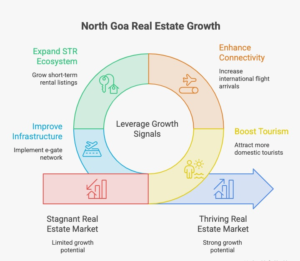
Goa Tourism Is Becoming a Stronger Foundation for Property Demand
Goa’s tourism recovery has developed into a broader structural trend. According to the Goa Economic Survey 2025–26, the state is experiencing a decisive shift toward year-round, experience-led tourism, moving beyond the traditional “sun, sand and sea” model.
The government is promoting wellness circuits, spiritual trails, hinterland experiences, cultural events and regenerative tourism. Domestic arrivals exceeded 10.2 million in 2025, while foreign arrivals reached 517,802. Total tourist arrivals rose from 3.33 million in 2021 to more than 10.8 million in 2025.
This diversification is particularly relevant to North Goa real estate.
A destination dependent almost entirely on a short holiday season creates a different property market from a destination that increasingly attracts:
- leisure travellers
- families
- international visitors
- wellness travellers
- remote professionals
- entrepreneurs
- long-stay visitors
- repeat travellers
- second-home owners
Goa’s official tourism strategy increasingly reflects this broader ecosystem.
The state’s tourism department has also highlighted quality tourism, destination diversification and regenerative tourism as priorities, suggesting that the future growth strategy is increasingly about value, experiences and destination quality, rather than visitor numbers alone.
For North Goa real estate, this creates an important distinction: the strongest long-term opportunity may not necessarily be in properties that depend exclusively on peak-season tourism. Properties offering year-round lifestyle utility could have a broader demand base.
International Travel Accessibility Is Becoming an Important Macro Factor
One of the most visible developments in India’s travel infrastructure is the Fast Track Immigration – Trusted Traveller Programme (FTI-TTP).
The programme was created by the Ministry of Home Affairs to accelerate immigration clearance through biometric authentication and e-gates. The official programme currently states that FTI-TTP is available to Indian nationals and foreign nationals holding OCI cards. Applicants provide biometric information, including fingerprints and a facial image, after the necessary verification process. The programme is offered without an enrolment fee.
This distinction is important when discussing North Goa real estate.
FTI-TTP should not be described as a programme currently available to every foreign tourist visiting India. Ordinary foreign nationals without OCI status are not included in the programme’s current eligibility categories.
Instead, FTI-TTP represents a broader trend: India is investing in faster, technology-enabled international passenger processing.
The government expanded the programme to five additional airports in September 2025, taking the operational network to 13 airports. The Ministry of Home Affairs has also stated that the programme is intended to reduce queues, manual checking and processing delays, while future integration with additional airports is planned.
Is FTI-TTP currently operational at Goa airports?
This requires careful interpretation.
The official FTI-TTP portal currently lists 13 airports with operational e-gates: Delhi, Mumbai, Ahmedabad, Kolkata, Chennai, Bengaluru, Hyderabad, Cochin, Lucknow, Amritsar, Calicut, Trivandrum and Trichy. Goa is not included in that current operational list.
Therefore, the strongest investment interpretation is not that FTI-TTP has already transformed Goa’s immigration experience.
Rather, it is that India’s international travel infrastructure is becoming progressively more digital, faster and more passenger-centric.
For North Goa real estate, that is a relevant macro signal, but it should be considered alongside airport connectivity, tourism demand, road infrastructure and destination development.
Mopa Airport Is the More Direct Connectivity Story for North Goa
While FTI-TTP is a national travel-modernisation initiative, Manohar International Airport at Mopa is a much more direct factor in the North Goa property narrative.
The Government of Goa describes Mopa as a modern airport designed for both domestic and international flights and identifies its role in strengthening Goa’s connectivity and economic growth.
The tourism data is particularly significant. In 2025, Goa recorded 1,784 international scheduled flights carrying 235,798 foreign tourists, with 1,141 flights operating through Mopa and 643 through Dabolim.
This means Mopa is becoming an increasingly important part of Goa’s international access network.
For North Goa real estate, airport accessibility can influence several dimensions of buyer behaviour:
- ease of reaching a second home
- convenience for international visitors
- attractiveness of holiday properties
- potential demand for short stays
- accessibility for NRIs and OCI buyers
- long-term appeal of northern tourism corridors
The relationship is not automatic. A property does not become more valuable merely because it is closer to an airport. But accessibility can become a meaningful component of the location equation when combined with beaches, hospitality, restaurants, lifestyle infrastructure and established tourism demand.
What Does This Mean for Investors?
The emerging picture is therefore broader than one infrastructure project.
International travel modernisation + airport connectivity + tourism diversification + changing traveller behaviour are collectively strengthening Goa’s destination economy.
For investors studying North Goa real estate, the next question is whether these tourism trends are translating into a deeper second-home and lifestyle market.
That is where the market becomes particularly interesting.
Changing Traveller Behaviour Is Expanding the Second-Home Opportunity
The relationship between tourism and North Goa real estate is changing because travellers themselves are changing.
A conventional holiday might involve a three- or four-night hotel stay. A modern leisure trip can increasingly involve a longer stay, remote work, wellness experiences, family travel or a combination of business and leisure.
Goa has strong characteristics for this evolving travel pattern:
- international and domestic air connectivity
- established hospitality infrastructure
- beaches and nature
- restaurants and cafés
- wellness experiences
- cultural attractions
- relatively strong lifestyle recognition
- growing airport access
The result is an expanding market for properties that are more flexible than traditional hotel rooms.
From Holiday Home to Lifestyle Asset
A second home can serve several purposes simultaneously.
It can become:
- a family holiday residence
- a weekend retreat
- a workation base
- a long-stay residence
- a retirement-oriented lifestyle property
- a potential holiday rental, where legally permitted
This dual utility is one reason North Goa real estate continues to attract attention from HNIs, entrepreneurs, NRIs, OCIs and professionals looking beyond conventional residential markets.
However, investors should distinguish lifestyle value from financial return.
A property can be highly valuable to its owner because of location, privacy, design and personal utility even when its rental income is moderate. Conversely, a property with strong tourism demand may still produce weaker investment economics if acquisition costs, operating expenses or competition are high.
That makes location and asset quality increasingly important.
Why North Goa Is Developing Into a Multi-Micro-Market Property Region
North Goa should not be treated as one homogeneous real estate market.
Different areas offer different combinations of tourism, lifestyle, connectivity and residential demand.
Assagao, Anjuna and Vagator
These areas represent one of the strongest lifestyle-oriented clusters in North Goa.
Their appeal is connected to:
- established tourism recognition
- premium hospitality
- restaurants and cafés
- beach access
- nightlife and entertainment
- luxury villas
- international visitor familiarity
Short-term rental data also demonstrates meaningful activity in these markets. AirDNA reported 899 active short-term rental listings in Assagao, with 45% average occupancy and a $181 average daily rate as of June 2026. However, annual revenue per listing was down year-on-year, illustrating why rental potential should never be treated as guaranteed.
Morjim, Ashwem and Mandrem
This northern belt has developed a different identity around beaches, wellness, quieter stays and experiential tourism.
Mandrem had 1,042 active short-term rental listings in AirDNA’s June 2026 dataset, with 39% average occupancy and a $52 average daily rate. Revenue was up year-on-year, although ADR and RevPAR declined, again demonstrating that occupancy and pricing do not always move in the same direction.
Siolim and the Chapora Corridor
Siolim is increasingly relevant to North Goa real estate because it sits within a lifestyle corridor connecting established tourism areas with the northern part of Goa.
AirDNA’s June 2026 data recorded 1,521 active listings in Siolim, with 50% average occupancy and a $95 ADR. Active listings were also up 30.9% year-on-year.
The figures indicate demand, but they also demonstrate rising competition.
Arpora and Nagoa
Arpora provides a useful example of a mature tourism-linked property ecosystem.
AirDNA recorded 1,072 active listings, 46% average occupancy and a $76 ADR in June 2026.
Its location provides access to established tourism, hospitality, restaurants and entertainment.
Candolim and Calangute
These remain established tourism markets with strong visitor familiarity and extensive hospitality infrastructure.
For investors, however, mature markets should be assessed through individual property fundamentals rather than assuming that established tourism automatically means superior investment performance.
The Short-Term Rental Market: Opportunity With Competition
The holiday-rental ecosystem is an important part of the North Goa real estate story.
AirDNA’s latest Goa-wide data, updated in July 2026 using June market data, shows:
Indicator | Goa STR Market |
Active listings | 6,849 |
Average occupancy | 42% |
Average ADR | $75 |
RevPAR | $28 |
YoY listing growth | +26.1% |
YoY occupancy growth | +18.1% |
YoY ADR change | −18.9% |
YoY revenue change | −13.8% |
The figures tell an important story.
Demand is active, but supply is growing quickly.
Occupancy has improved, while average daily rates and revenue per listing have declined. This suggests that competition and pricing pressure are important factors for owners and operators.
For North Goa real estate, the lesson is straightforward:
Tourism growth does not automatically equal rental-return growth.
A successful holiday property may require:
- strong location
- differentiated design
- attractive amenities
- professional management
- competitive pricing
- high-quality photography
- strong reviews
- efficient guest operations
- regulatory compliance
Is Airbnb Legal in Goa?
This is an essential consideration for anyone assessing North Goa real estate for holiday-rental purposes.
The Goa Department of Tourism issued a formal notice in April 2026 stating that individuals operating accommodation through Airbnb or similar short-term rental platforms are required to obtain registration with the Department of Tourism. The department also stated that inspections would be undertaken to verify registration and compliance.
Accommodation operators also have obligations regarding tourist information submission through the TIME system. Establishments hosting foreign tourists have additional reporting requirements, including C-Form filing.
Therefore:
Owning a property does not automatically mean unrestricted short-term rental rights.
Investors should verify:
- land use
- building permissions
- tourism registration
- applicable local requirements
- environmental or coastal restrictions
- operational compliance
- reporting obligations
before assuming a property can operate as a holiday rental.
What About NRIs and OCI Buyers?
Goa’s international appeal naturally raises the question of whether overseas Indians can participate in the property market.
The Reserve Bank of India states that NRIs and OCIs can generally acquire immovable property in India other than agricultural land, farmhouses and plantation property, subject to the applicable FEMA framework.
This distinction is particularly important for Goa because land classification matters.
A buyer should not assume that every parcel marketed as a lifestyle or holiday opportunity is automatically suitable for every category of purchaser or intended use.
For NRIs and OCIs considering North Goa real estate, legal and financial due diligence should therefore form part of the investment process from the beginning.
The Emerging Investment Logic
The strongest case for North Goa real estate is therefore not based on one promised rental return or one airport announcement.
It comes from the convergence of several factors:
Tourism growth
↓
International connectivity
↓
Mopa’s expanding role
↓
Year-round tourism strategy
↓
Changing traveller preferences
↓
Second-home demand
↓
Hospitality and holiday-rental ecosystem
The next question is whether these structural factors make 2026 an appropriate phase for investors to enter the market.
Is 2026 a Good Time to Invest in North Goa Real Estate?
There is a credible case for viewing 2026 as a selective opportunity phase for North Goa real estate, but not as a market where every property should be expected to perform equally.
The positive case rests on several structural developments.
1. Tourism Has Reached Significant Scale
Goa recorded more than 10.8 million tourist arrivals in 2025, including over half a million foreign tourists. The state’s Economic Survey identifies a shift toward year-round, experience-led tourism.
2. International Connectivity Is Strengthening
Mopa handled 1,141 international scheduled flights in 2025, compared with 643 through Dabolim.
3. India’s Travel Infrastructure Is Becoming More Digital
FTI-TTP illustrates the government’s broader push toward faster, biometric-enabled immigration processing, even though the programme currently applies only to Indian nationals and OCI cardholders.
4. Traveller Behaviour Is Diversifying
Wellness, experiential travel, workations, extended stays and lifestyle-led holidays can create demand for accommodation formats beyond conventional hotels.
5. Second Homes Offer Dual Utility
A well-selected property can provide personal lifestyle value while potentially participating in the holiday-rental ecosystem where legally permitted.
These factors make North Goa real estate an interesting long-term market. But the investment case still depends on property fundamentals.
What Investors Should Evaluate Before Buying
Location and Connectivity
For North Goa real estate, location should be evaluated through several layers rather than one headline metric.
Consider:
- distance and travel time from Mopa
- access to beaches
- road quality
- proximity to restaurants
- hospitality ecosystem
- healthcare
- retail
- entertainment
- neighbourhood development
- accessibility during peak periods
Airport proximity can add convenience, but it should never replace broader location analysis.
Legal and Land-Use Clarity
Due diligence should verify:
- title
- ownership history
- encumbrances
- zoning
- permitted land use
- development permissions
- applicable environmental regulations
- CRZ considerations where relevant
- construction approvals
- tourism permissions where applicable
This is particularly important in Goa because development restrictions and land-use rules can vary significantly between parcels.
Recent government action concerning parcels notified as non-developable reinforces the importance of verifying the legal and planning status of individual properties rather than relying solely on marketing descriptions.
Property Quality
For North Goa real estate, quality can become a meaningful differentiator in both lifestyle and rental markets.
Investors should assess:
- architecture
- construction quality
- maintenance
- privacy
- landscaping
- amenities
- parking
- water supply
- electricity
- internet connectivity
- monsoon resilience
- property management
The best-performing property is not necessarily the most expensive one. It is the one whose price and characteristics are appropriately matched to the demand of its target market.
Risks Investors Should Not Ignore
A balanced view of North Goa real estate must include the market’s limitations.
Supply Growth
AirDNA recorded 6,849 active short-term rental listings across Goa in June 2026, with listings growing 26.1% year-on-year.
That indicates a sizeable and growing accommodation ecosystem, but it also means investors face increasing competition.
Rental Pricing Pressure
Goa’s average ADR declined 18.9% year-on-year in the same AirDNA dataset, while average revenue declined 13.8%.
This is why projected rental returns should always be treated as estimates rather than guarantees.
Seasonality
Goa is becoming more year-round, but seasonality has not disappeared.
Demand can vary according to:
- monsoon
- school holidays
- festivals
- international travel cycles
- domestic travel patterns
- major events
Regulatory Compliance
Short-term rental operators need to comply with Goa’s tourism registration and reporting framework.
Property-Specific Performance
Two properties in the same micro-market can perform very differently.
Factors such as design, access, management, pricing, amenities and competition can significantly influence outcomes.
Therefore, North Goa real estate should be evaluated at the property and micro-market level, not simply at the destination level.
The Long-Term Outlook for North Goa Real Estate
The strongest long-term thesis is the emergence of Goa as a broader lifestyle and experience economy.
The state is actively pursuing tourism that extends beyond traditional beach travel. The Economic Survey describes a move toward wellness circuits, spiritual trails, hinterland experiences, sustainability and year-round tourism.
At the same time, international accessibility is improving through:
- expanding air connectivity
- Mopa’s growing role
- digital travel systems
- modern immigration infrastructure
- broader tourism infrastructure
This creates a more interconnected destination economy.
For North Goa real estate, that could support demand from several different groups:
Tourists seeking high-quality stays
Second-home buyers seeking lifestyle utility
NRIs and OCIs seeking India-based residences
Entrepreneurs seeking flexible work-and-leisure locations
HNIs seeking differentiated lifestyle assets
Hospitality operators seeking well-positioned accommodation opportunities
The key word is could.
Infrastructure and tourism trends create market potential, but they do not guarantee property appreciation or rental income.
What This Means for Nine Divine Group
For a developer such as Nine Divine Group, these trends highlight a broader opportunity around the next generation of second-home living.
The market is gradually moving beyond the idea that a second home is simply a property used for a few holidays each year.
Increasingly, buyers may want a residence that can function as:
- a private family retreat
- a workation base
- a wellness-oriented home
- an extended-stay residence
- a lifestyle asset
- a potential holiday accommodation asset where legally appropriate
This creates an opportunity for developers to think about location, design, connectivity, nature, usability and long-term lifestyle value as one integrated proposition.
Nine Divine Group’s positioning around second-home living and lifestyle-led real estate can naturally connect with this broader market evolution without relying on short-term market claims.
The strategic opportunity is therefore less about predicting a specific property return and more about understanding where India’s tourism, mobility and lifestyle preferences are heading.
FAQs 1. Is North Goa real estate a good investment in 2026?
North Goa real estate can be an attractive long-term investment opportunity because of Goa’s strong tourism base, improving international connectivity, growing second-home demand and expanding lifestyle ecosystem. Goa recorded more than 10.8 million tourist arrivals in 2025, including over 517,000 foreign tourists. However, investment potential varies considerably by location, property quality, legal status, pricing, rental feasibility and holding period.
Investors should evaluate the specific property’s title, land use, development permissions, infrastructure, connectivity and demand rather than relying only on broader tourism growth.
2. Which are the best areas for North Goa real estate investment?
The best location depends on the investor’s objective. Assagao, Anjuna, Vagator, Morjim, Ashwem, Mandrem, Siolim, Arpora and other established North Goa corridors offer different combinations of tourism, lifestyle infrastructure, beaches, hospitality and connectivity.
For North Goa real estate, investors should compare micro-markets based on airport accessibility, beach proximity, road connectivity, hospitality ecosystem, development activity, property supply and intended use. A second-home buyer may prioritise privacy and lifestyle, while a holiday-rental investor may prioritise tourist demand and accessibility.
3. How is Mopa Airport influencing North Goa real estate?
Mopa is an important connectivity factor for North Goa real estate because of its location in the northern part of the state and its expanding international and domestic connectivity. Goa recorded 1,141 international scheduled flights through Mopa in 2025, compared with 643 through Dabolim.
Improved airport access can enhance the convenience of reaching North Goa for tourists, second-home owners, NRIs and international visitors. However, airport proximity should be considered alongside road access, beaches, hospitality, infrastructure and neighbourhood quality rather than being treated as an independent guarantee of appreciation.
4. Can tourism growth increase demand for North Goa real estate?
Tourism growth can potentially support North Goa real estate through several interconnected channels. More visitors can increase demand for hotels, villas, holiday homes, serviced accommodation, restaurants, retail and lifestyle infrastructure. Over time, this broader ecosystem can make selected locations more attractive for second-home ownership and hospitality-oriented property.
However, tourism growth does not automatically translate into higher property prices or rental income. Supply, competition, property quality, pricing, regulations and location-specific demand remain important variables.
5. Is Goa becoming a year-round tourism destination, and what does that mean for North Goa real estate?
Goa is actively working to diversify tourism beyond its traditional peak season. The Goa Economic Survey 2025–26 highlights the development of year-round, experience-led tourism, including wellness, spiritual, cultural, hinterland and regenerative tourism.
For North Goa real estate, a broader tourism calendar could potentially support more consistent demand for accommodation and second homes. It may also increase the appeal of properties designed for longer stays, wellness-oriented living, workations and family holidays.
Seasonality, however, remains an important consideration, particularly for properties dependent on short-term rentals.
6. Is Airbnb legal in Goa for North Goa real estate owners?
Owners considering North Goa real estate for short-term rental use should understand that operating accommodation through Airbnb or similar platforms is subject to Goa’s tourism regulations.
The Goa Department of Tourism issued an advisory in April 2026 stating that individuals operating accommodation through Airbnb and similar platforms are required to obtain registration with the Department of Tourism. The department also highlighted inspections and compliance requirements.
Therefore, property ownership should not be interpreted as automatic permission to operate a short-term rental. Investors should verify applicable tourism registration, land-use, building and local regulatory requirements before planning rental operations.
7. Can North Goa real estate generate rental income through holiday rentals?
Selected North Goa real estate can potentially participate in the holiday-rental market, but rental performance varies significantly by location, property type, season, pricing, management and competition.
Current short-term rental data shows an active Goa market, but also increasing supply. AirDNA’s 2026 Goa data indicates thousands of active listings, with occupancy and pricing varying across individual micro-markets.
Investors should therefore model rental income conservatively using realistic occupancy, ADR, operating expenses, maintenance, management fees, taxes and periods of vacancy. Rental income and ROI should always be treated as estimates rather than guaranteed outcomes.
8. Can NRIs and OCIs invest in North Goa real estate?
NRIs and OCIs can generally acquire permitted immovable property in India under the applicable FEMA framework, although there are important restrictions. The Reserve Bank of India states that NRIs and OCIs can generally acquire immovable property other than agricultural land, farmhouse and plantation property, subject to applicable regulations.
For North Goa real estate, this distinction is particularly important because land classification and permitted use need to be verified before purchase.
NRIs and OCIs should obtain professional legal and financial advice for the specific property, ownership structure and transaction before committing capital.
Why North Goa Real Estate Deserves a Long-Term Lens
The future of North Goa real estate is increasingly connected to a much larger story.
Goa is attracting millions of visitors, international connectivity is strengthening, Mopa is playing a growing role in international aviation, and the state’s tourism strategy is moving toward year-round, experience-led and regenerative tourism. At the national level, initiatives such as FTI-TTP demonstrate India’s broader effort to make international travel more technology-enabled and efficient.
For investors, the opportunity lies in understanding how these trends interact with the fundamentals of individual properties.
The strongest investment decisions will continue to depend on location, connectivity, legal clarity, land use, property quality, rental feasibility, supply, regulatory compliance and investment horizon.
Tourism can create demand. Infrastructure can improve accessibility. Lifestyle preferences can expand the second-home market.
But sustainable value creation ultimately depends on the fundamentals of the asset itself.
For that reason, North Goa real estate should be viewed not simply as a tourism investment, but as part of an evolving destination economy where travel, lifestyle, hospitality and residential ownership increasingly intersect.
For investors with a long-term perspective, that intersection is where the most important opportunities—and the most important due diligence—will increasingly lie.










No Comments