




 The proposed Shaktipeeth Highway Sindhudurg, together with major infrastructure projects, is enhancing connectivity, supporting tourism, and shaping the district's long-term economic and investment future.
Shaktipeeth Highway Sindhudurg: How Maharashtra’s Mega Infrastructure Corridor Could Shape the Future of Tourism, Connectivity & Long-Term Land Investment
India is witnessing one of the largest infrastructure transformation phases in its history. From expressways and airports to high-speed rail corridors and logistics networks, infrastructure has become a powerful catalyst for regional economic development. These investments are not only improving connectivity but are also creating new opportunities for tourism, commerce, hospitality, and long-term real estate growth across emerging destinations.
Table of Contents
- Shaktipeeth Highway Sindhudurg: How Maharashtra’s Mega Infrastructure Corridor Could Shape the Future of Tourism, Connectivity & Long-Term Land Investment
- Why Infrastructure Development Matters for Long-Term Real Estate Growth
- Sindhudurg: An Emerging Infrastructure and Tourism Destination
- Understanding the Shaktipeeth Highway Sindhudurg Project
- Key Infrastructure Projects Driving Sindhudurg’s Growth
- NH-66 Mumbai–Goa Highway: Strengthening India’s Western Coastal Corridor
- MOPA International Airport: Expanding Global Accessibility
- Konkan Railway: A Lifeline for Tourism and Regional Development
- Coastal Tourism Infrastructure Continues to Evolve
- How Better Connectivity Could Transform Sindhudurg
- Enhanced Tourism Accessibility
- Supporting Hospitality Growth
- Strengthening Local Businesses and MSMEs
- Improving Freight and Logistics
- Tourism: One of Sindhudurg’s Strongest Growth Drivers
- Coastal Tourism
- Eco-Tourism
- Heritage and Cultural Tourism
- Wellness Tourism
- Destination Weddings and Experiential Hospitality
- Economic Benefits Beyond Tourism
- Lessons from India’s Major Infrastructure Corridors
- Mumbai–Pune Expressway
- Yamuna Expressway
- Samruddhi Mahamarg
- Bengaluru Airport Corridor
- Hyderabad Outer Ring Road
- Key Takeaways for Sindhudurg
- Could Sindhudurg Experience Multi-Fold Land Appreciation?
- Understanding Infrastructure-Led Appreciation
- Improved Accessibility
- Economic Expansion
- Rising Demand
- Limited Supply
- A Scenario-Based Perspective
- Conservative Scenario
- Base Scenario
- Optimistic Long-Term Scenario
- Why Many Investors Monitor the Pre-Infrastructure Phase
- Important Considerations Before Investing in Land
- The Future Outlook for Sindhudurg
- FAQs
One such region attracting increasing attention is Sindhudurg, a coastal district in southern Maharashtra known for its pristine beaches, biodiversity, heritage attractions, and proximity to Goa. While Sindhudurg has long been recognised as a tourism destination, recent and upcoming infrastructure developments are expanding its potential beyond leisure travel. Projects such as the Shaktipeeth Highway Sindhudurg corridor, the upgraded NH-66 Mumbai–Goa Highway, the operational Manohar International Airport (MOPA), and continuous improvements to the Konkan Railway are collectively strengthening the district’s long-term growth outlook.
For investors, High-Net-Worth Individuals (HNIs), Non-Resident Indians (NRIs), wealth advisors, and policymakers, infrastructure-led development is often an important factor when evaluating long-term investment opportunities. Improved accessibility can encourage tourism, attract businesses, support hospitality development, and gradually influence demand for residential, commercial, and land assets. While no infrastructure project guarantees investment returns, history has shown that well-planned connectivity projects have often contributed to sustainable regional development over time.
This article explores how the Shaktipeeth Highway Sindhudurg project, together with other strategic infrastructure initiatives, may influence the district’s future. Drawing on government announcements, infrastructure trends, and lessons from comparable projects across India, the blog presents an educational, balanced, and data-driven perspective to help readers better understand the long-term investment landscape.
Why Infrastructure Development Matters for Long-Term Real Estate Growth
Infrastructure has always played a central role in shaping regional economies. Roads, airports, railways, ports, and urban utilities improve accessibility, reduce travel time, enhance business efficiency, and make destinations more attractive for tourism and investment. As connectivity improves, economic activity often expands, creating opportunities across multiple sectors including hospitality, logistics, retail, manufacturing, and real estate.
Across India, several regions have experienced significant transformation following major infrastructure investments. The development of the Mumbai–Pune Expressway, the Yamuna Expressway, Hyderabad’s Outer Ring Road, and the Samruddhi Mahamarg has demonstrated how improved connectivity can influence urban expansion, industrial growth, and increased investor interest over the long term. While every region has its own unique growth trajectory, these examples highlight the broader relationship between infrastructure development and economic progress.
For land and real estate investors, infrastructure is often considered one of the key indicators of future demand. Better connectivity increases accessibility, which can support tourism, attract new businesses, improve employment opportunities, and encourage residential and commercial development. These factors may gradually contribute to appreciation in land values, although the pace and extent of growth depend on market conditions, policy implementation, and sustained economic activity.
The Shaktipeeth Highway Sindhudurg project represents one such infrastructure initiative that has the potential to improve regional connectivity across Maharashtra while strengthening access to the Konkan coast. When considered alongside other ongoing infrastructure developments, it provides an important context for understanding Sindhudurg’s evolving investment landscape.
Sindhudurg: An Emerging Infrastructure and Tourism Destination
Located along Maharashtra’s scenic Konkan coastline, Sindhudurg is recognised for its natural beauty, rich cultural heritage, marine biodiversity, and growing tourism sector. The district is home to well-known destinations such as Tarkarli, Malvan, Devbag, Vengurla, Amboli, and the historic Sindhudurg Fort, attracting domestic as well as international visitors seeking coastal, adventure, and eco-tourism experiences.
Beyond tourism, Sindhudurg occupies a strategically important location near the Goa border, providing access to one of India’s most vibrant travel and hospitality markets. This geographical advantage has contributed to increasing interest in the district from investors looking for long-term opportunities supported by improving infrastructure and sustainable tourism.
Unlike many mature coastal destinations where land values have already experienced substantial appreciation, Sindhudurg is still undergoing significant infrastructure development. This places the district in what many market observers describe as a “growth transition phase,” where connectivity improvements are gradually strengthening the region’s economic potential.
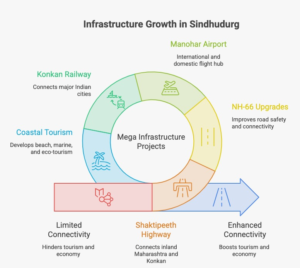
Several important infrastructure assets already support the district’s development, including:
- NH-66 Mumbai–Goa Highway, which is undergoing significant upgrades to improve road connectivity.
- Konkan Railway, connecting the western coastline with major cities across India.
- Manohar International Airport (MOPA) in North Goa, providing improved domestic and international air connectivity within driving distance of Sindhudurg.
- Coastal tourism infrastructure, fishing harbours, and maritime initiatives that continue to support the local economy.
- Government initiatives promoting eco-tourism, heritage conservation, and sustainable tourism across the Konkan region.
Together, these projects are creating an integrated connectivity ecosystem that supports tourism, hospitality, local businesses, and long-term regional development.
Understanding the Shaktipeeth Highway Sindhudurg Project
Among Maharashtra’s proposed infrastructure initiatives, the Shaktipeeth Highway Sindhudurg project has attracted considerable attention due to its scale and long-term regional significance.
The proposed expressway aims to strengthen east-west connectivity by linking several districts across Maharashtra before reaching the Konkan region near the Goa border. According to government announcements, the project is intended to improve access between religious destinations, industrial regions, agricultural markets, and coastal tourism hubs, while reducing travel time and improving freight movement.
The proposed corridor is expected to pass through multiple districts including Wardha, Yavatmal, Hingoli, Nanded, Latur, Dharashiv, Solapur, Sangli, Kolhapur, Satara, and eventually connect towards Sindhudurg and the Goa border. By improving accessibility across these regions, the highway could strengthen both passenger and commercial transportation networks over the coming years.
The Maharashtra Government has estimated the project cost at more than ₹86,000 crore, making it one of the state’s major long-term infrastructure initiatives. The project continues to progress through planning, land acquisition, and environmental approval processes before full-scale implementation.
For Sindhudurg, the importance of the Shaktipeeth Highway Sindhudurg project lies not only in faster travel but also in its ability to complement existing infrastructure such as NH-66, Konkan Railway, and nearby airport connectivity. Rather than functioning as a standalone project, the highway is expected to become part of a broader transportation network supporting tourism, logistics, agriculture, hospitality, and regional economic integration.
Infrastructure experts often note that destinations benefiting from multiple complementary infrastructure projects generally experience more sustainable long-term development than those relying on a single growth driver. In Sindhudurg’s case, the convergence of highways, airports, rail connectivity, and tourism-focused initiatives provides a broader foundation for future growth.
While the final economic impact will depend on successful project execution, complementary investments, and evolving market conditions, the Shaktipeeth Highway Sindhudurg project represents an important component of Maharashtra’s long-term infrastructure vision. For investors adopting a patient, long-term perspective, monitoring such developments can provide valuable insights into how connectivity may influence future demand for tourism, hospitality, and land-based investments.
Key Infrastructure Projects Driving Sindhudurg’s Growth
While the Shaktipeeth Highway Sindhudurg project is expected to become an important long-term connectivity corridor, its true significance becomes even greater when viewed alongside several other infrastructure initiatives transforming the region. Rather than relying on a single catalyst, Sindhudurg is witnessing the convergence of highways, airports, rail connectivity, tourism infrastructure, and government-led development programs. Together, these projects are strengthening the district’s accessibility, economic resilience, and investment potential.
NH-66 Mumbai–Goa Highway: Strengthening India’s Western Coastal Corridor
The upgraded NH-66 Mumbai–Goa Highway remains one of the most significant transportation projects influencing Sindhudurg’s future. Stretching along India’s western coastline, this national highway connects Mumbai with Goa while passing through major districts of Maharashtra, including Sindhudurg.
The ongoing widening and modernization of NH-66 are expected to improve road safety, reduce travel times, and enhance freight movement between major urban centers and the Konkan region. Improved highway connectivity benefits not only tourists but also logistics operators, local businesses, farmers, and hospitality enterprises that rely on efficient transportation.
For investors evaluating long-term opportunities, enhanced road infrastructure generally contributes to greater accessibility, improved market reach, and broader economic activity. As connectivity strengthens, destinations often become more attractive for second homes, hospitality developments, wellness retreats, and tourism-oriented businesses.
The combined impact of the Shaktipeeth Highway Sindhudurg project and the upgraded NH-66 could significantly enhance east-west as well as north-south connectivity, creating a more integrated transportation network across Maharashtra.
MOPA International Airport: Expanding Global Accessibility
The operational Manohar International Airport (MOPA) in North Goa represents another important infrastructure milestone for the broader Konkan region. Located within convenient driving distance of Sindhudurg, the airport has expanded domestic and international connectivity, making coastal Maharashtra increasingly accessible to travellers from across India and overseas.
Air connectivity plays a crucial role in supporting premium tourism destinations. Improved flight availability often encourages higher visitor volumes, shorter travel times, and increased interest from hospitality operators seeking emerging leisure markets.
For Sindhudurg, MOPA Airport complements existing road and railway connectivity by improving access for:
- Domestic holiday travellers
- International tourists
- NRIs visiting western India
- Business travellers
- Hospitality investors
- Luxury wellness tourism
- Destination wedding planners
Rather than replacing existing transportation networks, the airport strengthens the region’s overall accessibility by integrating air travel with highways and rail corridors.
Konkan Railway: A Lifeline for Tourism and Regional Development
The Konkan Railway has long served as one of India’s most remarkable railway engineering achievements, connecting Maharashtra, Goa, Karnataka, and Kerala along the western coast.
For Sindhudurg, the railway continues to play a significant role in supporting tourism, passenger mobility, and regional commerce. The railway provides convenient access for visitors travelling from Mumbai, Pune, Bengaluru, Delhi, Ahmedabad, and several other cities.
As tourism demand grows, rail connectivity remains an important transportation option, particularly for leisure travellers seeking affordable and comfortable access to the Konkan coastline.
When integrated with improved highways and nearby airport connectivity, the railway contributes to a multimodal transportation ecosystem capable of supporting sustained tourism growth over the coming decades.
Coastal Tourism Infrastructure Continues to Evolve
Sindhudurg’s coastline remains one of its strongest economic assets. Government initiatives promoting sustainable tourism, marine activities, eco-tourism, and coastal conservation continue to strengthen the district’s long-term appeal.
Popular destinations such as Tarkarli, Malvan, Devbag, Vengurla, and Amboli already attract visitors interested in scuba diving, water sports, wildlife, beaches, forts, mangroves, and nature-based experiences.
Improved infrastructure can support these attractions by making travel more convenient while encouraging responsible tourism development.
Better accessibility may also encourage investment in:
- Boutique resorts
- Eco-lodges
- Wellness retreats
- Homestays
- Heritage hospitality
- Sustainable tourism projects
- Adventure tourism facilities
- Marine recreation services
Importantly, sustainable development remains essential to preserving Sindhudurg’s ecological and cultural heritage while accommodating future growth.
How Better Connectivity Could Transform Sindhudurg
Infrastructure projects influence regional development through multiple channels. Improved connectivity reduces travel friction, expands market access, and enables greater economic interaction between regions.
For Sindhudurg, the combined influence of the Shaktipeeth Highway Sindhudurg, NH-66, MOPA Airport, and Konkan Railway could create several long-term advantages.
Enhanced Tourism Accessibility
One of the most immediate benefits of improved infrastructure is easier access for travellers.
Shorter travel times and improved transportation networks may encourage:
- Weekend tourism
- Family vacations
- Road trips
- Religious tourism
- Coastal tourism
- Nature tourism
- Wellness travel
As visitor accessibility improves, tourism-related businesses often experience broader opportunities to expand their offerings.
Supporting Hospitality Growth
Hospitality is closely linked with infrastructure quality.
As destinations become easier to reach, developers and operators may evaluate opportunities across:
- Premium resorts
- Boutique hotels
- Nature retreats
- Luxury villas
- Wellness centres
- Convention venues
- Destination wedding venues
Growing hospitality demand also supports employment generation, local entrepreneurship, and service-sector expansion.
Strengthening Local Businesses and MSMEs
Infrastructure development extends benefits beyond tourism.
Improved transportation networks may support:
- Agricultural supply chains
- Fisheries
- Food processing
- Retail businesses
- Local artisans
- Transport services
- Warehousing
- Logistics companies
Small and medium-sized enterprises often benefit from easier market access and reduced transportation costs, contributing to broader regional economic development.
Improving Freight and Logistics
Efficient logistics are fundamental to modern economic growth.
Better highways can facilitate:
- Faster freight movement
- Reduced transit times
- Lower transportation costs
- Improved agricultural distribution
- Better connectivity with industrial regions
Such improvements strengthen the competitiveness of regional businesses while supporting future investment across multiple sectors.
Tourism: One of Sindhudurg’s Strongest Growth Drivers
Tourism remains one of the most important contributors to Sindhudurg’s long-term economic outlook.
The district offers a diverse tourism ecosystem combining natural beauty, cultural heritage, coastal experiences, biodiversity, and historical significance.
Unlike destinations dependent on a single attraction, Sindhudurg benefits from multiple tourism segments.
Coastal Tourism
The district’s pristine beaches continue to attract domestic and international visitors seeking less crowded coastal experiences.
Popular destinations include:
- Tarkarli
- Devbag
- Malvan
- Vengurla
These locations support beach tourism, water sports, scuba diving, and recreational activities.
Eco-Tourism
Sindhudurg’s forests, wildlife, mangroves, and biodiversity provide opportunities for responsible eco-tourism.
Growing environmental awareness has increased traveller interest in destinations offering sustainable experiences, nature conservation, and low-impact tourism.
Heritage and Cultural Tourism
The district’s forts, temples, traditional architecture, local festivals, and maritime history add another dimension to its tourism appeal.
Heritage tourism often attracts visitors seeking authentic cultural experiences beyond conventional leisure travel.
Wellness Tourism
Global interest in wellness travel continues to grow.
Sindhudurg’s natural environment, coastal climate, and relatively low-density landscape may support future opportunities in wellness retreats, yoga centres, holistic healthcare, and nature-based hospitality.
Destination Weddings and Experiential Hospitality
Improved connectivity has expanded destination wedding markets across India.
Scenic coastal settings, boutique hospitality, and improved accessibility may gradually increase opportunities for experiential hospitality businesses in the region.
While future growth will depend on market demand and infrastructure execution, improved transportation networks generally strengthen the viability of such tourism segments.
Economic Benefits Beyond Tourism
Infrastructure investment generates multiplier effects extending well beyond visitor arrivals.
As connectivity improves, regional economies often experience positive developments across several sectors, including:
- Employment generation
- Hospitality services
- Construction activity
- Retail trade
- Agriculture
- Fisheries
- Local manufacturing
- Professional services
- Entrepreneurship
- Government revenue
These sectors collectively contribute to a more diversified regional economy capable of supporting sustainable long-term growth.
For investors, understanding these broader economic linkages provides valuable context when evaluating infrastructure-led investment opportunities. Rather than focusing solely on land appreciation, it is equally important to consider how transportation networks can strengthen the underlying economic fundamentals that support long-term demand.
Lessons from India’s Major Infrastructure Corridors
India’s infrastructure journey over the past two decades provides valuable insights into how strategic transportation projects can influence regional development. While every destination has unique economic, geographic, and policy characteristics, several infrastructure corridors demonstrate a common trend—improved connectivity often creates an enabling environment for tourism, industry, logistics, and real estate growth over the long term.
The Shaktipeeth Highway Sindhudurg project should therefore be viewed within this broader national context rather than as an isolated development.
Mumbai–Pune Expressway
India’s first access-controlled expressway transformed connectivity between Mumbai and Pune while significantly improving access to destinations such as Lonavala, Talegaon, and surrounding regions.
Over time, enhanced accessibility encouraged:
- Residential expansion
- Second-home developments
- Hospitality projects
- Commercial investments
- Logistics and warehousing
- Weekend tourism
The corridor illustrates how transportation infrastructure can influence both lifestyle and economic activity over an extended period.
Yamuna Expressway
The Yamuna Expressway created a faster connection between Delhi and Agra while unlocking new development opportunities along the corridor.
As infrastructure matured, the region experienced growth in:
- Integrated townships
- Educational institutions
- Industrial development
- Warehousing
- Commercial projects
- Airport-led development following Jewar International Airport
The corridor demonstrates that infrastructure often acts as a long-term growth enabler rather than an immediate catalyst.
Samruddhi Mahamarg
The Hindu Hriday Samrat Balasaheb Thackeray Maharashtra Samruddhi Mahamarg is one of Maharashtra’s most significant infrastructure initiatives.
The expressway has strengthened connectivity between Nagpur and Mumbai while supporting:
- Industrial corridors
- Agro-logistics
- Warehousing
- Tourism
- Regional investment
- MSME growth
Its development highlights how integrated transportation networks can contribute to broader regional economic transformation.
Bengaluru Airport Corridor
The development of Kempegowda International Airport and its surrounding infrastructure encouraged commercial expansion, hospitality growth, business parks, and residential development across North Bengaluru.
Rather than airport infrastructure alone, it was the combination of roads, metro connectivity, commercial investment, and employment generation that shaped long-term growth.
Hyderabad Outer Ring Road
Hyderabad’s Outer Ring Road improved urban mobility while facilitating the expansion of technology parks, commercial districts, logistics hubs, and residential communities.
The corridor demonstrates how transportation infrastructure can support planned urban expansion while improving investment confidence.
Key Takeaways for Sindhudurg
- Connectivity improves accessibility.
- Better accessibility encourages tourism.
- Tourism supports hospitality growth.
- Hospitality creates employment.
- Employment strengthens local economies.
- Stronger economies increase long-term investment confidence.
- Infrastructure encourages broader private sector participation.
The Shaktipeeth Highway Sindhudurg project has the potential to contribute to a similar ecosystem by complementing existing infrastructure such as NH-66, MOPA Airport, and the Konkan Railway.
Could Sindhudurg Experience Multi-Fold Land Appreciation?
One of the most frequently discussed topics among long-term investors is whether emerging infrastructure destinations can experience significant appreciation in land values over time.
The answer depends on multiple factors rather than a single infrastructure project.
However, appreciation is never guaranteed and varies considerably depending on:
- Infrastructure execution
- Government policies
- Market demand
- Economic conditions
- Tourism performance
- Availability of developable land
- Investment timelines
Understanding Infrastructure-Led Appreciation
Infrastructure influences land values primarily through four mechanisms:
Improved Accessibility
Better roads reduce travel time and make destinations more attractive for residents, tourists, and businesses.
Economic Expansion
Improved connectivity encourages commercial activity, logistics, hospitality, and entrepreneurship.
Rising Demand
As destinations become easier to access, interest from investors, developers, and end users may gradually increase.
Limited Supply
Coastal districts such as Sindhudurg have finite land availability in many strategic locations. As demand grows, supply constraints may influence pricing over extended periods.
A Scenario-Based Perspective
Rather than predicting returns, it is more responsible to evaluate different long-term possibilities.
Conservative Scenario
- Infrastructure progresses gradually.
- Tourism continues steady growth.
- Hospitality expands at a measured pace.
- Land appreciation remains moderate over time.
Base Scenario
- Major infrastructure projects are completed broadly as planned.
- Tourism experiences sustained growth.
- Hospitality investments increase.
- Business activity expands.
- Demand for second homes and leisure-oriented developments gradually strengthens.
Optimistic Long-Term Scenario
If multiple growth drivers converge successfully—including the Shaktipeeth Highway Sindhudurg, NH-66 upgrades, airport connectivity, tourism expansion, and supportive government policies—Sindhudurg could experience substantially stronger long-term demand.
Under such favourable conditions, some infrastructure-led markets in India have historically recorded multiple-fold appreciation over extended holding periods. Consequently, the possibility of up to 10X appreciation over the long term is best viewed as a market scenario informed by historical infrastructure trends rather than a guaranteed investment outcome. Actual performance will depend on numerous economic, regulatory, and market factors.
Why Many Investors Monitor the Pre-Infrastructure Phase
Infrastructure projects often follow long development cycles that include planning, approvals, land acquisition, construction, and eventual operation.
Many long-term investors monitor regions during the early phases because market pricing may not yet fully reflect future connectivity improvements.
Potential advantages of the pre-infrastructure phase may include:
- Early market participation
- Longer investment horizons
- Opportunity to benefit from gradual regional development
- Greater flexibility in asset selection
However, patient investment horizons and thorough due diligence remain essential.
Important Considerations Before Investing in Land
Every investment decision should be based on careful evaluation rather than speculation.
Before purchasing land, investors should consider:
- Legal title verification
- Land-use regulations
- Development permissions
- Environmental compliance
- Connectivity
- Future infrastructure plans
- Market liquidity
- Financial objectives
- Risk tolerance
- Professional legal and financial advice
Responsible investing focuses on long-term fundamentals rather than short-term market expectations.
The Future Outlook for Sindhudurg
Sindhudurg stands at an interesting stage in its development journey.
The district already possesses several structural advantages, including:
- A strategically located coastline
- Rich tourism assets
- Strong ecological diversity
- Cultural heritage
- Growing hospitality ecosystem
- Proximity to Goa
- Existing transportation infrastructure
As additional projects such as the Shaktipeeth Highway Sindhudurg, NH-66 upgrades, airport connectivity, and tourism initiatives continue to evolve, the district may become increasingly attractive for tourism, entrepreneurship, hospitality, and long-term investment.
Rather than relying on one transformative project, Sindhudurg’s future appears to be supported by multiple complementary infrastructure initiatives working together to improve accessibility and strengthen regional economic resilience.
For investors adopting a long-term perspective, monitoring these developments through credible government updates and market research can help support more informed decision-making.
FAQs
1. What is the Shaktipeeth Highway Sindhudurg project?
The Shaktipeeth Highway Sindhudurg is a proposed access-controlled expressway planned by the Government of Maharashtra to improve east-west connectivity across the state. The corridor is expected to connect several districts before reaching the Konkan region near the Goa border, making travel faster and more efficient for passengers, businesses, and freight movement. Besides improving transportation, the project aims to strengthen tourism, regional trade, and economic development by connecting important pilgrimage destinations and emerging investment regions.
2. Why is the Shaktipeeth Highway Sindhudurg considered important for long-term regional development?
The Shaktipeeth Highway Sindhudurg is significant because infrastructure projects often improve accessibility, reduce travel time, encourage tourism, and strengthen regional economies. Better connectivity can support hospitality, logistics, agriculture, local businesses, and employment generation while making destinations more accessible to visitors and investors. Although the long-term impact will depend on successful execution and market conditions, improved transportation networks generally contribute to sustainable economic growth over time.
3. How could the Shaktipeeth Highway Sindhudurg improve connectivity within Maharashtra?
Once completed, the Shaktipeeth Highway Sindhudurg is expected to provide improved connectivity between central Maharashtra, western Maharashtra, and the Konkan region. This may reduce travel times, improve freight movement, strengthen tourism circuits, and enhance accessibility for businesses, tourists, and local communities. Improved road infrastructure also complements existing transportation networks such as NH-66, Konkan Railway, and nearby airport connectivity.
4. Besides the Shaktipeeth Highway Sindhudurg, what other infrastructure projects are shaping Sindhudurg’s future?
Several major infrastructure projects are supporting Sindhudurg’s long-term growth alongside the Shaktipeeth Highway Sindhudurg. These include the ongoing widening of the NH-66 Mumbai–Goa Highway, the operational Manohar International Airport (MOPA), the Konkan Railway, coastal tourism initiatives, and improvements in regional transportation infrastructure. Together, these projects create a stronger connectivity ecosystem that supports tourism, hospitality, business expansion, and long-term economic development.
5. How does infrastructure influence long-term land appreciation?
Infrastructure is one of several factors that can influence long-term land appreciation. Projects such as the Shaktipeeth Highway Sindhudurg may improve accessibility, encourage tourism, support economic activity, and attract businesses over time. Historically, infrastructure-led regions have often experienced increased investment interest; however, appreciation depends on many variables including demand, government policies, local development, market cycles, and economic conditions. Therefore, infrastructure should be viewed as an important growth indicator rather than a guarantee of returns.
6. Can the Shaktipeeth Highway Sindhudurg lead to 10X land appreciation?
The possibility of 10X appreciation should always be viewed as a long-term market scenario rather than a guaranteed outcome. Some infrastructure-led regions in India have experienced multiple-fold appreciation over extended investment horizons due to improved connectivity, tourism growth, and increasing economic activity. However, the future performance of the Shaktipeeth Highway Sindhudurg corridor will depend on project execution, policy implementation, market demand, infrastructure integration, and overall economic conditions.
7. Why do many investors monitor infrastructure projects before they are completed?
Many long-term investors monitor projects such as the Shaktipeeth Highway Sindhudurg during the planning and construction phases because infrastructure often influences future accessibility and regional development. Historically, early-stage infrastructure development has attracted investor attention in several emerging markets. However, every investment should be evaluated carefully through legal verification, market research, and financial due diligence rather than relying solely on future infrastructure expectations.
8. How could improved connectivity support tourism in Sindhudurg?
The Shaktipeeth Highway in Sindhudurg could make travel more convenient for domestic and interstate visitors by improving road connectivity. Easier access often supports coastal tourism, eco-tourism, wellness tourism, heritage tourism, and destination weddings. Combined with attractions such as Tarkarli, Malvan, Devbag, Vengurla, Sindhudurg Fort, and nearby Goa, improved transportation may strengthen the district’s tourism ecosystem over the long term.
9. How does MOPA International Airport complement the Shaktipeeth Highway Sindhudurg?
The operational Manohar International Airport (MOPA) complements the Shaktipeeth Highway Sindhudurg by strengthening regional connectivity through air travel while highways improve road transportation. Together with NH-66 and the Konkan Railway, airport connectivity supports tourism, business travel, hospitality, and easier access for domestic as well as international visitors. Multiple transportation modes often contribute to stronger regional development than relying on a single infrastructure project.
10. What should investors evaluate before considering land investment in infrastructure-led regions?
Before making any investment decision, investors should carefully assess land title, zoning regulations, development permissions, environmental compliance, infrastructure proximity, liquidity, market demand, and long-term financial goals. While the Shaktipeeth Highway Sindhudurg may strengthen the region’s future growth potential, responsible investment decisions should always be supported by professional legal, financial, and technical due diligence.
Infrastructure has consistently played a transformative role in regional development across India. Roads, airports, railways, and tourism initiatives not only improve accessibility but also create opportunities for businesses, employment, hospitality, and long-term economic growth.
The proposed Shaktipeeth Highway Sindhudurg project represents one important component of Maharashtra’s broader infrastructure vision. Together with NH-66, the Konkan Railway, MOPA International Airport, and continued tourism development, it contributes to a stronger foundation for the district’s future.
While infrastructure alone cannot guarantee investment success, it often provides the conditions necessary for sustainable regional growth. As history has shown in several infrastructure-led markets across India, destinations supported by long-term connectivity improvements frequently attract greater economic activity over time.
For investors, HNIs, NRIs, policymakers, and wealth advisors, the key takeaway is not to focus on short-term speculation but to understand the broader structural trends shaping the region. By following verified government updates, evaluating market fundamentals, and adopting a disciplined long-term approach, stakeholders can make more informed decisions as Sindhudurg continues its development journey.
Ultimately, the story of Shaktipeeth Highway Sindhudurg is not simply about a new road—it is about how strategic infrastructure, responsible planning, sustainable tourism, and regional connectivity can collectively shape the future of one of Maharashtra’s most promising coastal districts.










No Comments